
Dishwashers are not eligible for the federal Energy Efficient Home Improvement credit (Section 25C). That’s the short answer, and it’s worth knowing before you spend an hour hunting IRS forms. The real money is local: utility rebates, state programs, and occasional retailer point-of-sale discounts. Here’s what to do right now:
- Run your ZIP code through the ENERGY STAR Rebate Finder and filter results by “Dishwashers” to see every active offer in your area.
- Check your electric and water utility websites directly — some programs don’t appear in national databases.
- Keep your receipt, model number, and EnergyGuide label from the moment of purchase; most rebate programs require all three.
- Skip IRS Form 5695 for dishwashers — the Energy Efficient Home Improvement credit covers heat pumps, water heaters, and insulation, not standard kitchen appliances.
If a rebate is available in your area, the steps below will get you through the claim process without losing money on a technicality.
Key Takeaways
ENERGY STAR dishwashers qualify for local utility rebates in many areas, but they are not eligible for federal energy tax credits under current IRS rules.
| Point | Details |
|---|---|
| No federal tax credit | Dishwashers are excluded from the Section 25C Energy Efficient Home Improvement credit. |
| Start with Rebate Finder | Enter your ZIP at energystar.gov/rebate-finder and filter by “Dishwashers” to find active local offers. |
| Rebates range $25–$150+ | Typical utility rebates run $25–$150; income-qualified programs can go higher depending on the state. |
| Documentation is required | Keep your receipt, model number, and EnergyGuide label from the moment of purchase. |
| Kitchendevotion curates eligible picks | The Kitchendevotion dishwasher hub lists ENERGY STAR models with efficiency data to speed up rebate verification. |
This article is general information, not a substitute for advice from a qualified financial advisor. Consult a qualified financial professional about your own circumstances before acting on anything here.
Table of Contents
- Where can you find a dishwasher ENERGY STAR rebate near you?
- Do federal energy tax credits apply to dishwashers?
- What do local rebates for ENERGY STAR dishwashers actually look like?
- How to claim a utility rebate for your ENERGY STAR dishwasher
- Buying checklist: what to verify before you commit to a model
- Official tools and pages worth bookmarking
- Why utilities pay you to buy an efficient dishwasher
- The rebate playbook most homeowners get backwards
- Kitchendevotion’s curated ENERGY STAR dishwasher picks
- Sources
- FAQ
Where can you find a dishwasher ENERGY STAR rebate near you?
The fastest starting point is the ENERGY STAR Rebate Finder. Type in your ZIP code, select “Dishwashers” from the product category dropdown, and you’ll see every offer currently sponsored by ENERGY STAR partners in your region. The results show the rebate amount, the sponsoring utility or program, and a direct link to apply.
After that, go one level deeper:
- Your electric utility’s website. Search for “rebates” or “energy efficiency programs” in the site’s navigation. Many utilities run their own appliance programs that don’t always sync with the national ENERGY STAR database in real time.
- Your water utility. Dishwashers are water-saving appliances, and water utilities in drought-prone states (California, Arizona, Texas) often offer separate rebates tied to gallons-per-cycle performance.
- Your state energy office. The DOE Home Upgrades page links to state-level programs and can point you toward your state’s own incentive database.
- DSIRE (Database of State Incentives for Renewables & Efficiency). This federally funded database at dsire.org catalogs state and utility programs by ZIP code and appliance type.
- Retailer point-of-sale programs. Some large appliance retailers run their own instant-discount programs tied to ENERGY STAR certification, separate from utility rebates.
Confirming your model qualifies is a step most people skip and then regret. Before you buy, look up the exact model number on the ENERGY STAR certified dishwasher list to verify it’s on the current certified list. Some rebate programs also require the “Most Efficient” designation, which is a higher tier within ENERGY STAR. Check the rebate’s fine print for that requirement.
Rebate funds are often capped. A quick phone call to your utility’s rebates office before you buy can confirm whether funds are still available and whether you need pre-authorization.
Do federal energy tax credits apply to dishwashers?
No. Dishwashers are not listed as qualifying property under the Energy Efficient Home Improvement credit (Section 25C of the tax code). The IRS guidance on this credit is specific: qualifying items include heat pumps, central air conditioning, water heaters, insulation, windows, doors, and certain electrical panel upgrades. Standard kitchen appliances don’t make that list.
The policy logic is deliberate. Federal credits target upgrades that fundamentally change a home’s energy profile — sealing the building envelope, switching from fossil-fuel heating to electric heat pumps, upgrading inefficient water heaters. A dishwasher, even a highly efficient one, doesn’t move the needle on a home’s overall energy consumption the way those systems do.
The DOE product-lookup and CEE tier tools illustrate this clearly. Equipment like heat pump water heaters must meet specific Consortium for Energy Efficiency (CEE) tier thresholds to qualify for federal credits. Dishwashers have no equivalent federal-eligibility pathway.
One interaction worth knowing: if you do claim a federal credit on a different qualifying upgrade in the same tax year, and you also received a utility rebate on that upgrade, the IRS may require you to subtract that rebate from your qualified expense before calculating the credit. The IRS has clarified that certain subsidies and purchase-price adjustments reduce the cost basis for credit calculations. This doesn’t affect dishwasher purchases directly, but it matters if you’re bundling a dishwasher purchase with, say, a heat pump water heater in the same renovation.
- Dishwashers: no federal tax credit available
- Heat pumps, water heaters, insulation, windows: eligible under Section 25C
- ENERGY STAR certification alone does not create federal credit eligibility
- Rebates received on credit-eligible items may reduce your qualified expense per IRS rules
The ENERGY STAR federal tax credits summary page lists every currently eligible product category — dishwashers are absent from it.
What do local rebates for ENERGY STAR dishwashers actually look like?
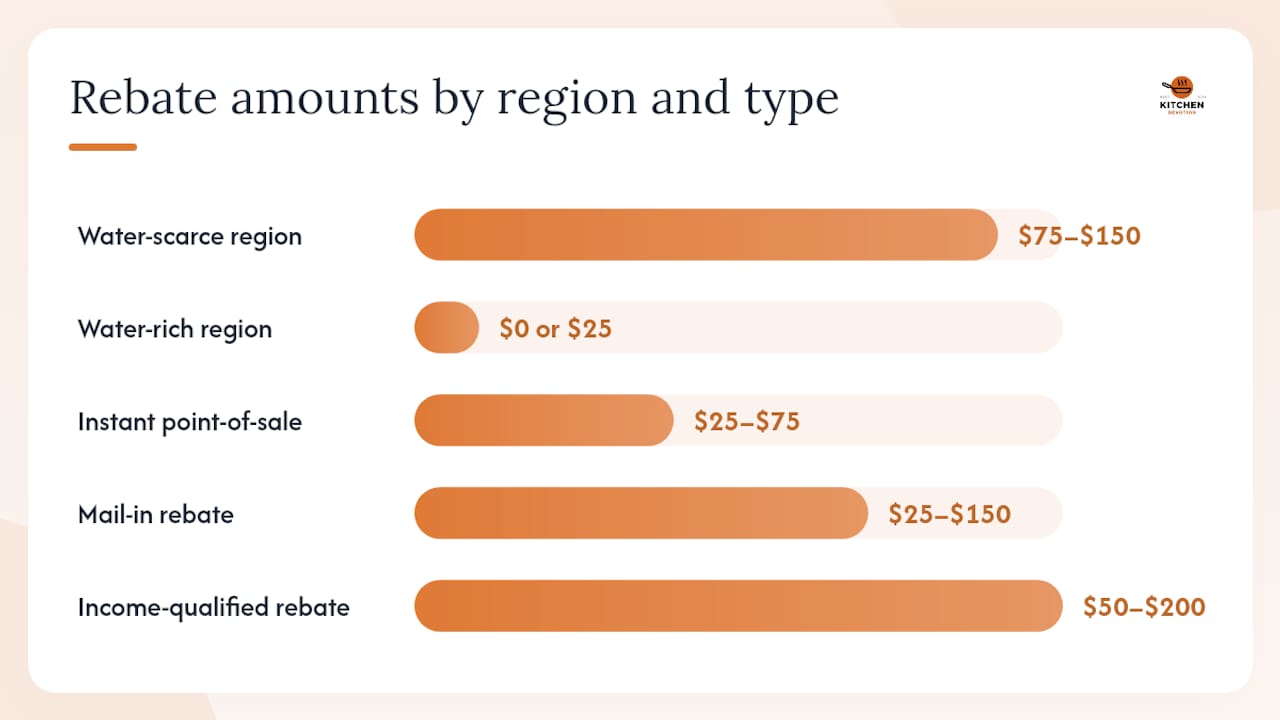
Rebate amounts vary more than most buyers expect. A utility in a water-scarce region might offer $75–$150 for a certified dishwasher, while a utility in a water-rich area might offer nothing at all or a flat $25 discount. The ENERGY STAR dIME database categorizes incentive types across programs nationally, and the range reflects how differently utilities prioritize appliance efficiency.
| Rebate type | Who typically offers it | Typical amount | How to claim | Processing time |
|---|---|---|---|---|
| Instant point-of-sale discount | Retailer or utility partner | $25–$75 | Applied at checkout; no paperwork | Immediate |
| Mail-in rebate | Electric or water utility | $25–$150 | Submit receipt, model number, and rebate form online or by mail | 6 to 12 weeks |
| Direct install program | Utility or municipal water authority | Varies; sometimes free unit | Utility schedules installation | Varies by program |
| Income-qualified rebate | State or utility low-income program | $50 to $200 | Application with income verification | 4 weeks to several weeks |
A few factors drive rebate size up or down:
- Local water scarcity. Utilities in drought-affected regions treat water-efficient appliances as infrastructure investments and fund rebates accordingly.
- Utility demand-response goals. Some programs target appliances that can run during off-peak hours, and a dishwasher with a delay-start feature may qualify for a higher tier.
- Budget windows. Many programs run on a fiscal-year budget and close when funds are exhausted. Applying in January rather than October can make the difference between getting a rebate and missing it.
- “Most Efficient” designation. Some utilities reserve their highest rebate tier for models on ENERGY STAR’s Most Efficient list, which represents the top performers in energy and water use each year.
How to claim a utility rebate for your ENERGY STAR dishwasher
Before you buy
Confirm the exact model number is on the rebate program’s eligible list — not just ENERGY STAR certified in general, but specifically listed by the utility or program you’re targeting. Some programs require the “Most Efficient” designation. Check whether the rebate is point-of-sale (applied at the register) or mail-in (you pay full price and submit for reimbursement). These two paths require different timing and documentation.
At purchase
Keep every piece of paper and digital record:
- Itemized receipt showing the model number, purchase date, and store name
- Model and serial number (photograph the label inside the door before installation)
- EnergyGuide label (photograph or save the PDF from the manufacturer’s site)
- Manufacturer’s ENERGY STAR certification statement if the rebate program requires it
Submitting the claim
Most utilities now accept online submissions through their rebate portal. You’ll upload your receipt, enter the model number, and confirm your account details. For mail-in programs, send copies — never originals — and use a method that gives you a delivery confirmation.
Note the application ID or confirmation number the moment you submit. Processing times range from a few weeks for online programs to 12 weeks for mail-in submissions.
Pro Tip: Document whether your rebate came from a utility, a manufacturer, or a retailer. The IRS treats these sources differently when computing qualified expense for any federal credit you might claim on a separate upgrade in the same tax year. A quick note in your records now saves confusion at tax time.
If you’re filing Form 5695 for a different qualifying upgrade in the same year, keep your dishwasher rebate documentation separate and clearly labeled by source.
Buying checklist: what to verify before you commit to a model
Most rebate denials come down to one of three things: the wrong model number, a missing label, or a floor model that was returned and lost its documentation. Here’s what to check before you pay:
- ENERGY STAR label on the unit itself. The blue label must be present on the physical appliance, not just mentioned in the listing.
- Model number matches the rebate program’s eligible list. Manufacturers often sell nearly identical models under slightly different numbers; only the exact listed number qualifies.
- EnergyGuide figures. The yellow EnergyGuide label shows estimated annual energy use in kWh and estimated annual operating cost. Some rebate programs set minimum efficiency thresholds based on these figures.
- “Most Efficient” designation if required. Check the ENERGY STAR certified dishwasher list — the Most Efficient models are flagged separately.
- Purchase date rules. Some programs only cover purchases made after a specific date or within the current program year.
- New units only. Floor models, open-box returns, and used appliances are almost universally ineligible, even if the model itself qualifies.
For compact or countertop models — which are increasingly popular in apartments and smaller homes — Kitchendevotion’s countertop dishwasher reviews include model-specific energy and water data that makes cross-checking rebate eligibility faster.
Official tools and pages worth bookmarking
These are the four resources you’ll actually use, and what each one does:
ENERGY STAR Rebate Finder: Enter your ZIP code, filter by “Dishwashers,” and see every active rebate offer in your area with direct links to apply. Start here.
ENERGY STAR Certified Dishwashers — Product Finder: Confirms whether a specific model is certified and shows its annual kWh use and gallons per cycle. Use this to verify model eligibility and compare efficiency specs before buying.
DOE Home Upgrades: The Department of Energy’s homeowner-facing hub for energy efficiency programs. It links to state energy offices and summarizes federal policy on home improvement incentives — useful for understanding what’s covered at the federal level and finding your state’s own programs.
IRS Energy Efficient Home Improvement Credit and Form 5695: The IRS page lists every qualifying product category and explains how subsidies affect qualified expenses. Form 5695 is what you file to claim the credit for eligible upgrades. Neither applies to dishwashers, but both matter if you’re doing a broader home upgrade in the same year.
Why utilities pay you to buy an efficient dishwasher
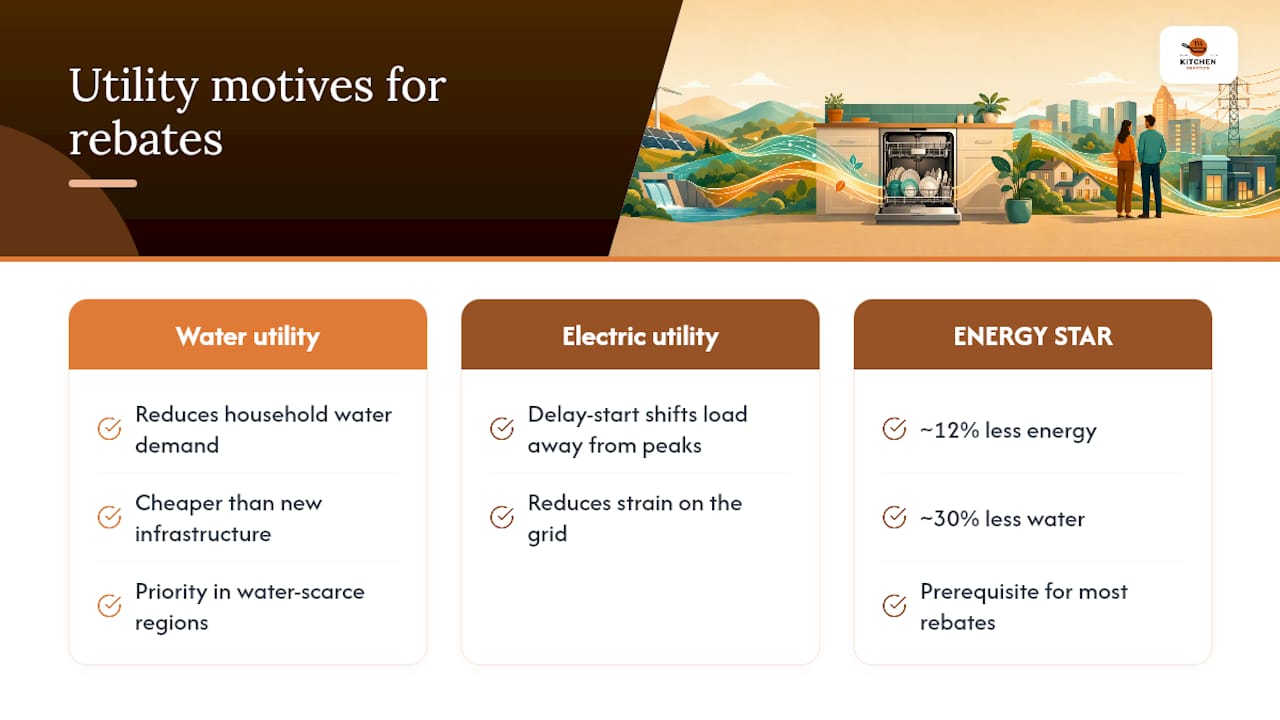
The rebate exists because the utility wants something too. ENERGY STAR certified dishwashers use about 12% less energy and 30% less water than non-certified models. For a water utility managing reservoir levels in a dry summer, getting thousands of households to switch to efficient appliances is cheaper than building new water infrastructure. For an electric utility, a dishwasher with a delay-start feature shifts load away from peak demand hours, which reduces strain on the grid.
That’s why rebate availability tracks regional priorities so closely. A utility in Phoenix or Los Angeles is far more likely to offer a meaningful water-efficiency rebate than one in the Pacific Northwest, where water is abundant. If you’re in a water-scarce region and your utility offers nothing, check your municipal water authority separately — they often run independent programs.
Pro Tip: ENERGY STAR certification is a product-comparison tool, not a federal tax-credit ticket. Treat it as a reliable signal of efficiency and a prerequisite for most utility rebates — but don’t assume certification alone unlocks any government payment.
Kitchendevotion’s dishwasher coverage focuses on models with strong energy and water specs precisely because those are the units most likely to qualify for available rebates and deliver real long-term savings.
The rebate playbook most homeowners get backwards
Most of the advice floating around on this topic starts with the product and works backward to the rebate. That’s the wrong order. The smarter move is to run your ZIP code through the ENERGY STAR Rebate Finder before you pick a model, find out exactly which models your utility will pay you to buy, and then choose from that list. You end up with a qualifying appliance and money back, instead of a great appliance and a rebate denial.
The federal credit question trips people up because ENERGY STAR certification sounds like it should connect to a tax break. It doesn’t, not for dishwashers. The IRS draws a clear line between appliances and structural or mechanical upgrades. That line isn’t going to move for a standard kitchen appliance anytime soon. Accepting that early saves a lot of wasted research.
One more thing most guides skip: rebate funds run out. A program that’s open in January may be exhausted by March. If you’re planning a kitchen renovation and a dishwasher is on the list, check rebate availability before you finalize your timeline, not after the appliance is already installed.
Kitchendevotion’s curated ENERGY STAR dishwasher picks
Sorting through hundreds of dishwasher models to find ones that are both ENERGY STAR certified and likely to qualify for your local rebate takes time most homeowners don’t have. Kitchendevotion does that filtering for you.

The Kitchendevotion dishwasher hub features curated picks organized by size, budget, and efficiency rating, with model numbers and EnergyGuide data included so you can cross-check rebate eligibility in seconds. If you’re a new homeowner figuring out which appliances to prioritize first, the kitchen appliance priority list walks through the decision in a practical, budget-aware order. All recommendations align with ENERGY STAR criteria. Kitchendevotion earns a commission when you purchase through affiliate links on the site, at no extra cost to you.
Sources
- Energy Efficient Home Improvement credit — IRS
- Home Upgrades — U.S. Department of Energy
- DOE Product Lookup / CEE tiers
FAQ
Do dishwashers qualify for federal energy tax credits?
No. Dishwashers are not listed as qualifying property under the Energy Efficient Home Improvement credit (Section 25C). Federal credits cover heat pumps, water heaters, insulation, windows, and doors, not standard kitchen appliances.
Are dishwashers ENERGY STAR rated?
Yes. The EPA certifies dishwashers under the ENERGY STAR program, and certified models use about 12% less energy and 30% less water than non-certified units. Certification is required for most utility rebate programs.
Is there a tax credit for energy-efficient appliances in 2026?
Not for standard appliances like dishwashers, refrigerators, or washing machines. The current federal credit under Section 25C applies to building-envelope upgrades and high-impact electrification equipment such as heat pumps and water heaters.
What appliances are eligible for the energy tax credit?
Qualifying items under the current IRS rules include heat pumps for heating and cooling, heat pump water heaters, central air conditioners meeting efficiency thresholds, insulation, exterior windows and doors, and certain electrical panel upgrades. Dishwashers and other standard kitchen appliances are not on the list.
How do I find a dishwasher rebate in my area?
Go to the ENERGY STAR Rebate Finder, enter your ZIP code, and filter by “Dishwashers.” Also check your electric and water utility websites directly, since some local programs don’t appear in the national database.





No comment