

The AHAM formula is the fastest way to a real number: 12 cubic feet for the first two people in your household, plus 4 cubic feet for each additional person. For example, a family of four has a minimum recommended capacity around 20 cubic feet. Before you shop, measure your kitchen opening’s width, depth, and height, since that number often overrides the math. Then use the ranges below to pick your target and confirm the fit.
TL;DR:
- The AHAM formula estimates minimum refrigerator capacity at about 12 cubic feet for two people, plus 4 cubic feet per additional person, but household habits require adjustments.
- Measuring interior dimensions and kitchen opening clearance is essential to confirm that the chosen refrigerator will actually fit, as spec sheet capacity often overstates usable space.
- Household size and cooking habits significantly influence capacity needs, with larger families or frequent bulk shopping requiring well above the minimum estimates.
- Style and configuration, such as French door or side-by-side models, impact usable space and should align with your storage needs, not just total cubic footage.
- A refrigerator must be sized to fit your kitchen’s delivery path and doorways, including additional clearance for ventilation and handle swing, to avoid costly returns or modifications.
Table of Contents
- What Is the AHAM Sizing Rule for Refrigerator Capacity?
- How Do You Measure and Calculate Cubic Feet?
- Refrigerator Capacity by Household Size
- Which Refrigerator Style Fits Your Capacity Target?
- Will Your Chosen Refrigerator Actually Fit? A Kitchen-Fit Checklist
- How Do You Maximize Usable Space Once You’ve Chosen a Size?
- Does a Bigger Refrigerator Cost More to Run?
- Where to Go Deeper on Sizing and Setup
- What Most Buying Guides Get Backwards About Fridge Sizing
- Not Sure Which Appliance to Buy First? Start Here
- Sources
- FAQ
What Is the AHAM Sizing Rule for Refrigerator Capacity?
The Association of Home Appliance Manufacturers built this formula because refrigerator shopping used to be guesswork dressed up as instinct. People bought whatever looked right in the showroom, then discovered six months later that the crisper drawers were jammed by Tuesday every week. The AHAM formula gives you a floor, not a ceiling: 12 cubic feet covers the first two people in a household, and each additional person adds 4 cubic feet.
Run the numbers and the pattern gets clear fast. A single person needs roughly 12 to 14 cubic feet. A couple sits at that same 12 cubic foot minimum, though most couples end up happier around 16 to 18. A family of four reaches a minimum near 20 cubic feet, with a more comfortable range slightly larger. Larger households require accordingly more capacity, adjusted for lifestyle factors.

Those habits matter more than most buying guides admit. Cook dinner from scratch most nights? Add 2 to 4 cubic feet to your baseline, since fresh ingredients take up more room than frozen shortcuts. Shop for a full month at a time or love hosting? Fridge suggests adding anywhere from 3 to 10 cubic feet, depending on how aggressively you stock up. A household of four that shops in bulk monthly and cooks every night could reasonably need 28 cubic feet or more, well above the bare AHAM minimum.
Treat the formula as a starting point, never a final answer. It tells you where to start looking. It does not know the shape of your kitchen.
How Do You Measure and Calculate Cubic Feet?
Manufacturer spec sheets list capacity, but that number reflects usable interior space, not the box’s exterior dimensions. Here’s how to check it yourself and make sure the model you’re eyeing actually fits.
- Measure the interior height, width, and depth of the refrigerator compartment in inches, using a tape measure pressed to the interior walls, not the door gasket.
- Multiply those three numbers together, then divide by 1,728 to convert cubic inches into cubic feet, since that’s how many cubic inches make up one cubic foot.
- Compare that figure against the manufacturer’s listed total capacity, and check whether that number covers the fridge and freezer combined or just the fridge side.
- Measure your kitchen opening separately, adding roughly an inch of clearance for ventilation and door swing per the manufacturer’s installation guide.
The most common mistake is confusing exterior footprint with usable capacity. Two 36 inch wide refrigerators can differ by 4 or more cubic feet depending on wall thickness and shelf design. Always check the split between fridge and freezer volume too. A 25 cubic foot French door model might allocate 18 cubic feet to fresh food and 7 to the freezer, which matters a lot if you’re a bulk freezer shopper.
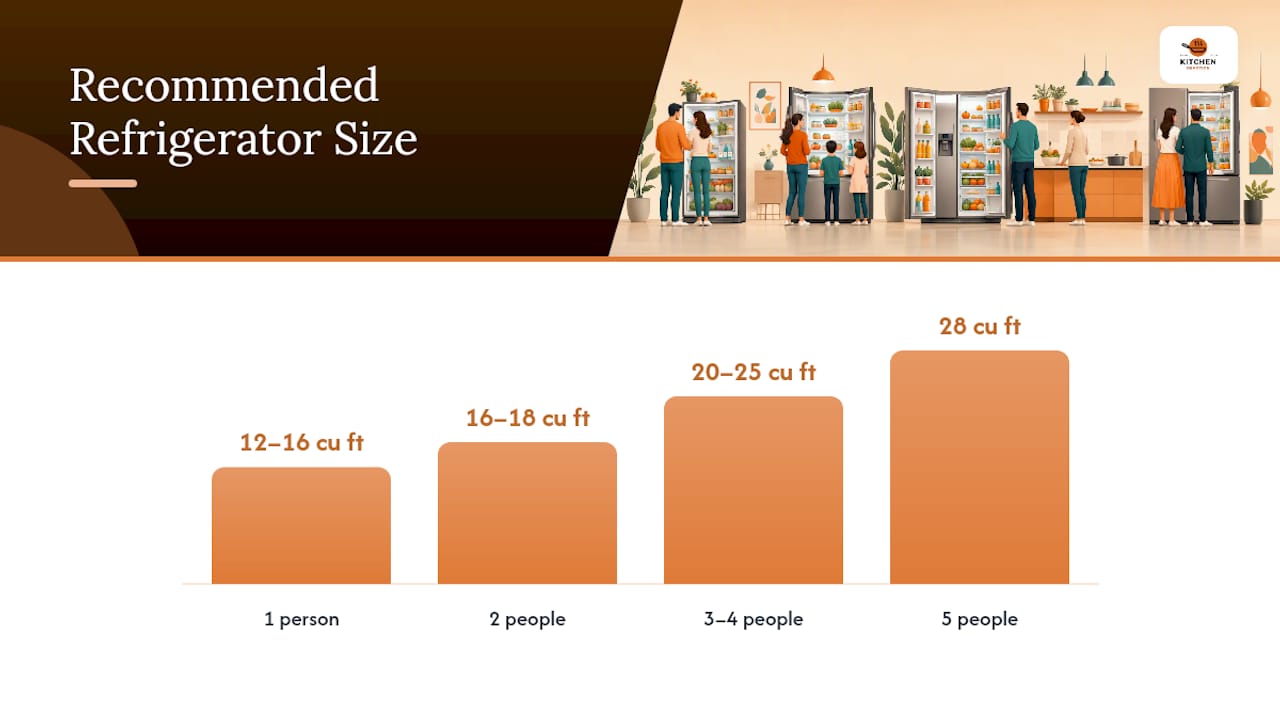
Refrigerator Capacity by Household Size
The AHAM minimums give you a floor. The recommended ranges below account for the fact that almost nobody actually wants to live at the bare minimum.
| Household size | AHAM minimum | Recommended range | Typical use case |
|---|---|---|---|
| 1 person | 12 cu ft | 12–16 cu ft | Light cooking, weekly small shops |
| 2 people | 12 cu ft | 16–18 cu ft | Daily cooking, weekly grocery runs |
| 3–4 people | 20 cu ft | 20–25 cu ft | Regular cooking, occasional bulk buys |
| 5 people | 28 cu ft | 28 cu ft | Frequent cooking, monthly bulk shopping, entertaining |
Size up from the recommended range when any of these apply to your kitchen: multiple people cooking at once, a chest freezer that broke and now everything lives in the fridge, or a household that hosts holiday dinners for extended family. Size toward the AHAM minimum instead if you eat out often, live alone with modest cooking habits, or work with a genuinely tight kitchen footprint where every extra cubic foot means a harder installation.
A 27 cubic foot refrigerator sits solidly in extra-large territory, typically built around 72 inches tall, 36 inches wide, and 36 inches deep. That size fits households of three to five comfortably, especially ones that shop in bulk or entertain regularly, but it’s overkill for a single person or a couple with modest habits.
Which Refrigerator Style Fits Your Capacity Target?
Cubic footage alone doesn’t tell the whole story. Two refrigerators with identical listed capacity can feel completely different to load and use, because the style dictates how that space gets carved up.
- French door models dominate the 20 to 30-plus cubic foot range and generally offer the best usable-to-listed-capacity ratio, since wide shelves and flexible bins make odd-shaped items easy to store.
- Side-by-side refrigerators often match French doors on paper capacity but deliver less usable fresh-food shelf space, because narrower doors mean narrower shelves that can’t hold a sheet pan or a large platter.
- Top-freezer and bottom-freezer units run efficient and compact, typically staying under 20 cubic feet, and they remain the best fit for smaller kitchens or households that don’t need freezer overflow.
- Counter-depth models sit flush with your cabinets for a built-in look, but that flush profile costs you roughly 5 to 7 cubic feet compared to a standard-depth unit of the same width.
If you love the counter-depth look but need real capacity, plan to size up in width or height to compensate, not just accept the smaller number.
Will Your Chosen Refrigerator Actually Fit? A Kitchen-Fit Checklist
Picking a cubic-foot target is the easy half. The number that actually determines whether a purchase goes smoothly is the width of your doorway, not the width of the spec sheet.
- Measure your kitchen opening’s width, height, and depth, and write down all three, not just the one that looks generous.
- Add the manufacturer’s recommended ventilation clearance, typically an inch on each side and above the unit, so the compressor doesn’t overheat.
- Check door swing and handle clearance against nearby cabinets, islands, or walls. A French door needs less swing room than a single-door side-by-side.
- Trace the full delivery path from your front door to the kitchen, measuring doorways, hallway turns, and stairwells, and check diagonal clearance if a straight walk-through isn’t possible.
- If you’re set on a counter-depth or built-in unit, confirm the cabinet depth constraint now, and budget for professional installation if the fit looks tight.
Pro Tip: Measure the diagonal of any tight doorway or stairwell turn, not just the straight width. Movers tilt refrigerators through corners on the diagonal, and that measurement is often the real limiting factor, not the doorway’s face width.
How Do You Maximize Usable Space Once You’ve Chosen a Size?
Getting more out of whatever capacity you land on comes down to how you organize the space, not just how much of it you have. Clear stackable bins group small items so you’re not hunting through loose jars every time you open the door. Shallow drawers work better than deep ones for produce, since nothing gets buried and forgotten at the back.
A few habits go a long way: rotate meal-prep containers so older food gets used first, reserve door storage for condiments that don’t need the coldest zone, and always keep raw meat on the lowest shelf to stop drips from contaminating anything below. If you’re debating between upsizing your main fridge and adding a compact second unit, a small chest freezer or mini fridge in the garage often solves a specific overflow problem for less money than jumping a whole capacity tier.
For deeper organization strategies, Kitchendevotion’s guide to fridge organization ideas and its roundup of refrigerator accessories cover specific bin and shelf systems. If pantry or cabinet overflow is part of the problem, One Day Doors & Closets’ home organization systems tackle the storage that lives outside the fridge entirely.
Does a Bigger Refrigerator Cost More to Run?
Capacity and energy use are linked, but not in the simple way most people assume. ENERGY STAR rates refrigerators on estimated yearly energy consumption, and a larger certified model can easily cost less to run than a smaller, older, uncertified one. Compare the estimated annual kilowatt-hour figure on the yellow EnergyGuide label, not just the cubic footage, before assuming bigger automatically means pricier. If you’re choosing between a 22 cubic foot standard model and a 25 cubic foot ENERGY STAR certified one, the certified unit frequently wins on lifetime operating cost despite the extra space. A detailed breakdown of how much energy a refrigerator uses walks through the math in more detail.
Where to Go Deeper on Sizing and Setup
A refrigerator size guide walks through measuring and buying with more detail than fits here, and the companion piece on choosing the right refrigerator style covers layout-specific fit questions this guide only touches on. Both build on the same AHAM logic and measurement steps outlined above.
Editorial guidance in this piece comes from K. Connors, drawing on AHAM sizing standards, ENERGY STAR product data, and manufacturer measurement conventions.
What Most Buying Guides Get Backwards About Fridge Sizing
Most advice treats refrigerator capacity like a shopping decision. It’s really a measuring decision that happens to end with a purchase. The AHAM formula gets you to a reasonable ballpark in about thirty seconds, and that’s genuinely useful. But the actual failure point in most refrigerator purchases isn’t picking the wrong cubic-foot number. It’s skipping the tape measure entirely and trusting that “it looked about right” in the store.
The conventional wisdom oversells the precision of capacity math while underselling the physical constraints that actually determine whether a fridge works in your kitchen. A 25 cubic foot unit that can’t clear your doorway is worthless. An 18 cubic foot unit that fits perfectly and gets organized well often outperforms a bigger one crammed with clutter.
Prioritize in this order: measure your opening and delivery path first, calculate your AHAM-based target second, then shop for style and features last. Readers who reverse that order are the ones stuck returning appliances or paying for emergency doorway removal. The math is the easy part. The tape measure is where deals actually fall apart.
— K. Connors
Not Sure Which Appliance to Buy First? Start Here
Once you’ve settled on a capacity target, the refrigerator is usually just one line item on a longer list of decisions new or upgrading homeowners face. A kitchen appliance priority list for new homeowners was created to solve that sequencing problem: which appliances to buy first, which to delay, and where a bigger budget actually pays off.

The list walks through the same practical logic used in this refrigerator guide, applied across your whole kitchen, so you’re not making six separate appliance decisions in isolation. If you’re furnishing a kitchen from scratch or replacing multiple units at once, that sequencing can save you from buying the wrong thing first and regretting it by the third purchase. Check the appliance priority list next, or browse the full site for guides on cookware, air fryers, and organization if the refrigerator is the only box left to check.
Sources
FAQ
Is 27 Cubic Feet a Large Refrigerator?
Yes, 27 cubic feet counts as large to extra-large, typically fitting households of three to five people, especially those who shop in bulk or entertain often.
Is 26 Cubic Feet a Big Refrigerator?
A refrigerator close to 27 cubic feet in usable space comfortably covers the same three-to-five person household range.
Is a 7.5 Cubic Foot Refrigerator Big Enough?
A unit that falls well below the AHAM minimum of 12 cubic feet for even a single person is more suitable as a secondary or compact fridge than a household’s main unit.
How Many Cubic Feet Should My Refrigerator Be?
Start with the AHAM formula: 12 cubic feet for the first two people plus 4 cubic feet per additional person, then adjust upward for frequent cooking or bulk shopping using the household capacity table above as your guide.





No comment