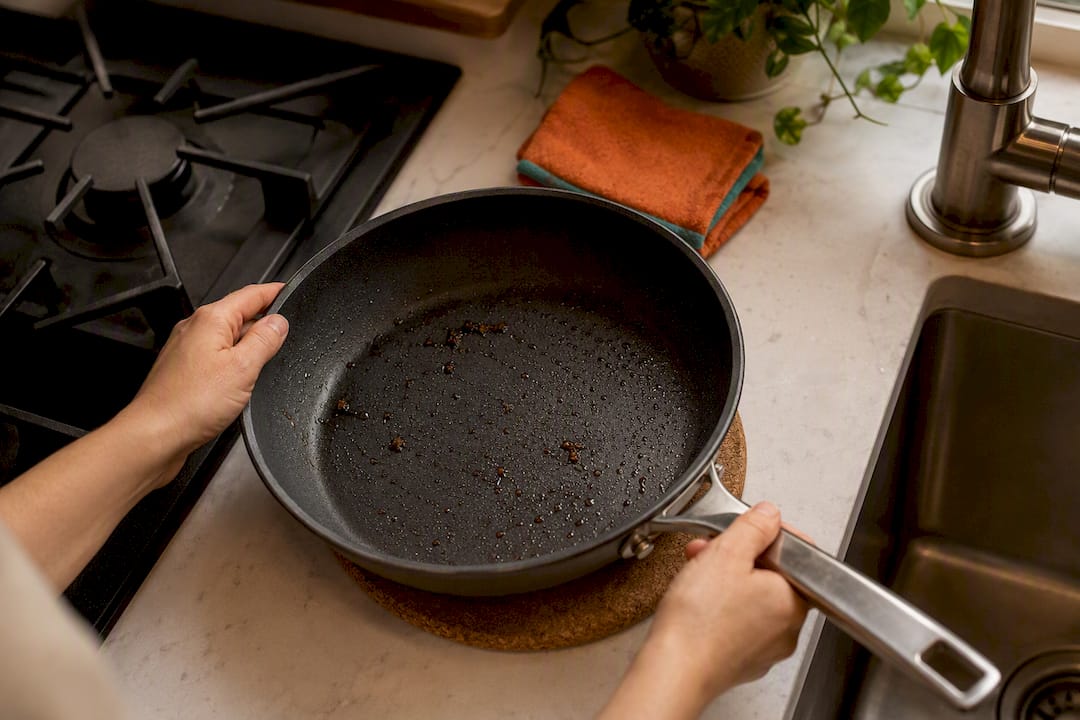
Stop cooking on it. If the coating on your nonstick pan is actively peeling, flaking, or bubbling, move your food to another pan right now and retire that one. Minor surface scratches are a judgment call rather than an emergency, but they’re still a warning sign, and most regular-use nonstick pans are due for replacement within 3 to 5 years anyway. The rest of this guide walks through why coatings fail, what the health research actually says, and how to pick a replacement that lasts longer.
TL;DR:
- Flaking or bubbling coatings indicate the pan is actively deteriorating and should be retired immediately to prevent further coating loss.
- Overheating, thermal shock, and metal utensils accelerate coating failure, so proper habits like cooling before rinsing and using gentle tools extend pan life.
- Ingested PTFE flakes are unlikely to cause harm, but fumes from overheating can lead to flu-like symptoms and pet dangers, especially for birds.
- Repairing and maintenance habits—including avoiding high heat, proper storage, and careful cleaning—can significantly prolong nonstick pan lifespan.
- For replacement, consider ceramic, stainless steel, cast iron, or carbon steel based on cooking needs, always checking oven safety, warranty, and care instructions.
Table of Contents
- Why Nonstick Pan Peeling Happens in the First Place
- What to Do the Moment You Spot Peeling or Flakes
- Is It Actually Dangerous to Eat Nonstick Flakes?
- When to Replace vs. When You Can Wait
- How to Make a Nonstick Pan Last Longer
- What to Buy Instead: Comparing Your Replacement Options
- A Practical Take on When Peeling Pans Should Go
- Where to Find a Safer Replacement Pan
- Sources
- FAQ
Why Nonstick Pan Peeling Happens in the First Place
Nonstick pans work because a thin layer of polytetrafluoroethylene, better known as PTFE, or a mineral-based ceramic coating gets bonded to an aluminum or steel base. That bond is mechanical, not chemical fusion. The coating sits on top of the metal, sprayed and baked on in layers, which means it’s only as durable as its weakest layer and the habits of whoever’s holding the spatula.
Heat is the biggest threat. PTFE and ceramic coatings are built for the low-to-medium heat range you’d use for eggs, pancakes, or a delicate piece of fish. Crank the burner to high with an empty pan, and you’re stressing the coating before food or oil even touches it. Research summarized by Medical News Today found that temperatures above roughly 482°F (250°C) start to change the internal structure of these coatings, accelerating breakdown and particle release. Ceramic coatings held up somewhat better under that stress than PTFE in the same testing, but neither is designed to shrug off repeated overheating.
Thermal shock does similar damage through a different mechanism. Pulling a hot pan straight off the burner and plunging it into cold water, or setting it in a cold sink, forces the metal base and the coating to contract at different rates. Do that often enough and the coating starts to lift at the edges, even if you never scratched it with a utensil. Letting a pan cool fully before it meets water is one of the simplest habits that slows this kind of failure.
Then there’s the everyday wear that adds up quietly:
- Metal utensils. Steel spatulas and whisks scrape microscopic grooves into the coating every time they touch it, even when you’re careful.
- Dishwasher cycles. The combination of high heat, harsh detergent, and jostling against other cookware wears down coatings faster than hand washing, even on pans labeled dishwasher safe.
- Abrasive scrubbers and cleaners. Steel wool, scouring powders, and anything gritty acts like sandpaper on a surface that’s only microns thick.
- Stacking without protection. Nesting pans directly on top of each other lets rims and bottoms grind against the coating in storage, not just at the stove.
None of these causes act alone. A pan that gets occasional dishwasher cycles, the occasional metal spatula, and a few too many high-heat sears is stacking multiple stresses at once. Peeling is rarely the result of one bad night. It’s the coating finally giving out after months or years of small insults it couldn’t fully recover from.
What to Do the Moment You Spot Peeling or Flakes
The response here is less about panic and more about a clean, quick sequence. Here’s the order that actually matters:
- Turn off the heat immediately. Don’t let the pan keep cooking while you decide what to do.
- Transfer your food to a different pan or dish. If you’re mid-recipe, finish cooking in stainless steel, cast iron, or another intact pan rather than continuing on the damaged one.
- Check for smoke or an unusual smell. If either is present, open a window or turn on your range hood and step back from the stove until the air clears.
- Let the damaged pan cool completely on the stovetop or a heatproof surface. Don’t run it under cold water while it’s still hot.
- Rinse gently by hand once cool. Skip the dishwasher and skip scrubbing at the peeling area, since more agitation just pulls off more coating.
- Set it aside for disposal or retirement. Most municipal recycling programs won’t take coated cookware curbside, so check your local guidelines rather than tossing it straight into a metal recycling bin.
Pro Tip: Keep a spare stainless steel or cast iron pan within easy reach on the stove. When a nonstick pan starts flaking mid-meal, you want somewhere to dump the food in the next ten seconds, not a five-minute cabinet search.
If you were searing something at high heat when you noticed the flakes, that’s worth remembering going forward. Overheating is one of the most common triggers for sudden, visible peeling, and it often shows up right after a session hotter than the pan was built to handle.
Is It Actually Dangerous to Eat Nonstick Flakes?
Probably not, if the flakes are solid PTFE and you swallowed them by accident. That’s the consistent position across reputable health sources. WebMD notes that PTFE is chemically inert, meaning your body isn’t set up to absorb or metabolize it, so small flakes typically pass through the digestive tract without incident. Columbia University’s student health service, Go Ask Alice, gives similar guidance: accidental ingestion is unlikely to cause serious harm, though they still recommend replacing a flaking pan rather than continuing to use it.
Solid PTFE flakes are considered chemically inert and are unlikely to be absorbed by the body if swallowed, according to health explainers reviewed for this guide, including WebMD.
Inhalation is a different story, and it’s the scenario that actually deserves caution. Overheating PTFE, especially on an empty pan left on high heat, can release fumes that cause a short-term illness sometimes called polymer fume fever. Symptoms resemble a mild flu: chills, headache, and chest tightness that typically resolve within a day or two. Birds are far more sensitive to these fumes than humans, and pet bird owners are routinely warned to keep nonstick cookware and self-cleaning ovens away from birds entirely, since even fumes that don’t bother a person can be lethal to them.
The newer question that safety researchers are actually chewing on isn’t flake ingestion. It’s microplastics. As nonstick coatings degrade from scratching, overheating, or general age, they can shed microscopic and even nanoscale particles into food, not just the visible flakes you’d notice and avoid. Scientific American’s reporting on this is candid about the uncertainty: the long-term health effects of chronic, low-level microplastic exposure from cookware are still being studied, and there isn’t a settled answer yet.
That gap in the research is exactly why the conservative habits matter more than any single reassuring statistic:
- Avoid overheating pans, especially with no food or oil in them.
- Retire any pan with visible peeling or bubbling rather than “wait and see.”
- Use lower heat settings for nonstick cookware and reserve high-heat searing for other materials.
- Keep pets, especially birds, out of the kitchen during high-heat cooking.
Regulatory bodies like the FDA and the EPA track PFAS and related fluorinated compounds at a broader chemical-exposure level, which is useful context if you’re worried about long-term accumulation from multiple sources, not just one frying pan. Neither agency frames occasional nonstick cookware use as an acute emergency, but both support the general principle that minimizing unnecessary exposure to degraded coatings is the sensible default.
When to Replace vs. When You Can Wait
Some damage means retire the pan today. Other damage just means keep an eye on it. The table below breaks down which category you’re dealing with.
| Sign | What it means | Action |
|---|---|---|
| Visible metal showing through the coating | The nonstick layer has fully worn away in that spot | Replace now |
| Active peeling or bubbling | The coating is delaminating from the base | Replace now |
| Deep gouges or cuts in the surface | Structural damage that will keep spreading | Replace now |
| Warped or uneven base | Pan no longer heats evenly, often from thermal shock | Replace now |
| Widespread fine scratches, no exposed metal | Cosmetic wear from utensils or stacking | Watch closely, downgrade to low-heat use |
| Persistent sticking despite fresh oil | Coating losing its nonstick properties | Consider replacing soon |
| Pan is older than 3 to 5 years with regular use | Normal lifespan for most nonstick cookware | Evaluate condition, plan for replacement |
If your pan falls into the “watch closely” category, cautious continued use is reasonable. That means low to medium heat only, sticking to non-acidic foods like eggs or pancakes rather than tomato sauce, and keeping it away from pets and birds. It does not mean searing steak on high heat in a pan you’re already babying.
The core signals worth memorizing are the same four the The Independent’s cookware experts point to: exposed metal, active peeling, bubbling, and deep gouges. See any of those, and the decision is already made for you.
How to Make a Nonstick Pan Last Longer
Most of what wrecks a nonstick pan comes down to five or six repeated habits, and every one of them is fixable starting with your next meal.
Choose the right utensils. Wood and silicone spatulas don’t scrape at the coating the way metal ones do. If you’re not sure your current tools are safe, these science-backed steps for using silicone utensils cover what to look for and what to avoid.
Manage your heat. Skip the habit of preheating an empty pan on high just to “get it hot fast.” Add oil or butter first, and keep the burner at low to medium for most nonstick cooking. If a recipe calls for the oven, confirm your pan’s actual temperature limit rather than guessing, since oven-safe ratings vary a lot by pan depending on the handle material and coating type.
Save the dishwasher for pans explicitly rated for it, and even then, hand washing will always be gentler on the coating long term.
Let it cool before it meets water. This one habit alone prevents a huge amount of thermal shock damage. Set the hot pan on a trivet or cool burner and give it a few minutes before rinsing.
Store it so nothing grinds against the coating. Stacking pans bare metal against bare coating is one of the sneakier causes of peeling, since the damage happens in the cabinet, not at the stove. A simple felt pan protector or hanging rack solves it, and these storage tips cover a few low-effort setups that work in tight kitchens.
Pro Tip: If you only fix one habit, fix the cold-water rinse. Thermal shock is one of the fastest ways to destroy a coating that’s otherwise in good shape, and it’s also the easiest habit to break because it just requires ninety seconds of patience.
What to Buy Instead: Comparing Your Replacement Options
Replacing a peeling pan is a chance to actually match the material to how you cook, rather than grabbing whatever’s cheapest on the shelf again.
Ceramic nonstick is the closest swap to what you’re used to, minus the PTFE. It handles eggs, fish, and other delicate foods well, tends to be lighter than cast iron, and doesn’t require seasoning. The tradeoff is a shorter nonstick lifespan than people expect. Ceramic coatings also degrade with heat and time, just without the same fume-related concerns as PTFE.
Stainless steel is close to indestructible in terms of coating failure, because there is no coating to fail. It takes a short learning curve to avoid sticking, but a quick preheat routine solves most of that. If you’ve been leaning on nonstick out of habit rather than necessity, a two-to-three-minute stove routine is often all it takes to stop food from sticking on stainless.
Cast iron rewards patience with a nonstick-like surface that actually improves with age, thanks to seasoning that builds up over repeated use. It’s heavier, needs occasional reseasoning, and isn’t the fastest choice for a weeknight scramble, but it can outlast several generations of nonstick pans.
Carbon steel splits the difference: lighter than cast iron, seasons in a similar way, and heats up faster, making it a favorite among cooks who want cast iron’s durability without the workout.
Before buying anything, run through a short checklist:
- Confirm oven-safe temperature limits if you bake or broil in the same pan.
- Check induction compatibility if that’s your cooktop, since not every material works.
- Look for a stated warranty period, which is often a decent proxy for how long the manufacturer expects the coating to last.
- Read the actual care instructions, not just the marketing copy, since dishwasher-safe claims vary widely in practice.
If you’re weighing PTFE-free options against a new PTFE pan, comparing the actual material tradeoffs side by side is more useful than picking based on price alone.
A Practical Take on When Peeling Pans Should Go
Most of the anxiety around nonstick pan peeling is misplaced. It’s not that eating a flake or two will hurt you. It’s that a pan already shedding coating is a pan that’s going to keep shedding it, and every meal after the first flake is one more small dose you didn’t need to take. My rule is simple: active peeling means retire it that day, no exceptions. Fine scratches without exposed metal are a judgment call based on the pan’s age and how hard you’ve been using it.
It is generally recommended to prioritize durability over price when choosing cookware, as a cheaper pan that needs frequent replacement can cost more in the long run than a higher-quality set. Ceramic works well for cooks who want an easy PTFE-free swap. Stainless and cast iron work better for anyone who cooks hot and hard on a regular basis.
Author credentials and full byline details for this piece will be completed on publication.
— K. Connors
Where to Find a Safer Replacement Pan
Once a nonstick pan starts flaking, the fastest way back to normal cooking is a set built to handle real kitchen habits, not just look good on a shelf. Kitchen Devotion curates cookware across materials instead of pushing one type on every cook, so you’re matching the pan to how you actually use your stove rather than settling for whatever’s on sale.

If you’re leaning ceramic, the SENSARTE Ceramic Cookware Set is a PTFE-free option worth a look. If you want another shot at traditional nonstick with better durability than a bargain pan, the T-fal Ultimate Hard Anodized set is built for longer service life, and the CAROTE Nonstick Cookware Set is a solid everyday option if you follow the care habits above. For a broader look across materials before deciding, the full cookware sets category lays out what’s available by type and price point.
Whichever direction you go, check the oven-safe rating, confirm the warranty length, and read the actual care instructions before you buy, not after your next pan starts flaking too.
This article is general information, not a substitute for advice from a qualified doctor. Consult a qualified healthcare professional about your own circumstances before acting on anything here.
Sources
- Experts reveal when you should replace your non-stick pans | The Independent
- Are nonstick pans toxic? Research, safety, and alternatives | Medical News Today
- Is Teflon coating safe? | WebMD
- PFAS and chemical contaminants information | FDA
- PFAS explained | EPA
FAQ
Is It Safe to Use a Nonstick Pan That’s Peeling?
No. Once the coating is actively peeling or bubbling, stop using that pan and switch to another one, since continued cooking just sheds more coating into your food and speeds up further damage.
My Nonstick Pan Is Peeling. What Should I Do?
Turn off the heat, move your food to a different pan, let the damaged one cool completely, and rinse it gently by hand before setting it aside for replacement.
My Nonstick Pan Is Flaking. Should I Be Concerned?
Swallowing a small solid flake is generally considered low risk since PTFE is chemically inert, but a flaking pan should still be retired because ongoing use means ongoing coating loss and possible microplastic release.
Is It Safe to Cook With Scratched Nonstick Pans?
Fine scratches without exposed metal are generally acceptable for low-heat cooking, but visible metal, active peeling, or deep gouges mean it’s time to replace the pan rather than keep cooking on it.




No comment