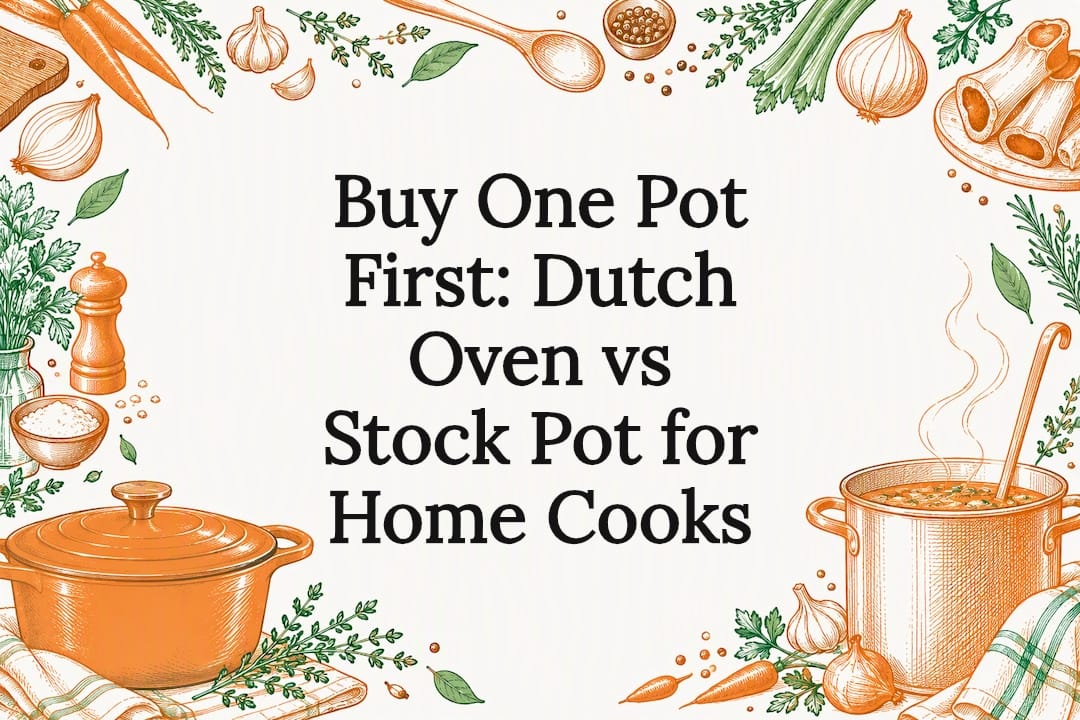
Use a stock pot for high-volume boiling and long-simmered stocks, and use a Dutch oven for searing, braising and oven-to-stovetop cooking. That split exists because a stock pot’s tall, lightweight build heats liquid fast and holds a lot of volume, while a Dutch oven’s thick cast iron or enameled walls hold steady heat for browning and slow cooking. The rest of this guide walks through why, with real recipes and sizing advice.
TL;DR:
- A stock pot is best for large-batch boiling, long-simmered stocks, and cooking pasta, with a design optimized for quick heating and high volume.
- A Dutch oven’s thick walls and tight lid make it ideal for searing meat, braising, and slow cooking, especially when trapping steam enhances flavor and crust formation.
- Enameled cast iron Dutch ovens prevent metallic reactions with acidic foods, while bare cast iron offers exceptional heat retention but reacts with certain ingredients.
- Long-simmered stock requires hours at moderate heat to properly extract flavor, with beef bones needing significantly longer than chicken carcasses.
- For first-time cookware purchases, a mid-sized Dutch oven is versatile enough for many recipes, but a large stock pot is essential for batch cooking and canning.
Table of Contents
- Quick Verdict: Boiling Volume vs. Braising Heat
- How Construction and Materials Shape Performance
- Which Recipes Favor Each Pot
- How Heat Retention and Distribution Affect Your Results
- Choosing the Right Size for Your Kitchen
- Cleaning, Seasoning and Storing Each Pot
- Food Safety Basics for Stocks and Long Simmers
- Our Take on Which Pot to Buy First
- Start Building Your Cookware Collection
- FAQ
- Sources
Quick Verdict: Boiling Volume vs. Braising Heat
If your recipe calls for a lot of liquid or needs to simmer for hours unattended, reach for a stock pot. If it calls for browning meat first, then cooking low and slow with the lid on, a Dutch oven wins almost every time.
- Stock pot jobs: large-batch chicken stock, boiling pasta, blanching vegetables, cooking big pots of soup for a crowd.
- Dutch oven jobs: braised short ribs, pot roast, stews that start with a sear, no-knead bread baked with the lid on.
- Overlap zone: a basic vegetable soup or chili works in either, though a Dutch oven gives you deeper flavor from the initial sear.
The difference shows up clearly with bread. A Dutch oven traps steam against the dough and produces a crackling crust, something a stock pot’s thinner, looser-fitting lid rarely matches.
How Construction and Materials Shape Performance
Most stock pots are made from stainless steel, sometimes with an aluminum or copper disc bonded to the base for faster, more even heating. That build is light, heats quickly and cools quickly, which is exactly what you want when you’re bringing twelve quarts of water to a boil.
Dutch ovens are a different animal. Traditional ones are bare cast iron; most on the market today are cast iron with an enameled coating fused over it. The thick walls store heat and release it slowly, which is why a Dutch oven keeps simmering gently even after you turn the burner down.
- Stainless/aluminum-clad stock pots: quick to heat, quick to cool, lightweight enough to lift when full.
- Bare cast iron: heats slowly, holds heat exceptionally well, reacts with acidic foods unless well seasoned.
- Enameled cast iron: keeps the heat retention of cast iron without the metallic reaction, so tomato-based braises and wine sauces are safe to cook in it.
Lid fit matters too. A Dutch oven’s heavier, snugger lid returns condensation to the pot, concentrating flavor during a long braise.
Pro Tip: Check your stove type before buying: bare cast iron and enameled cast iron both work on induction, but some ultra-light stock pots without a magnetic base will not.
Which Recipes Favor Each Pot
Matching the pot to the technique saves time and improves the result.
- Chicken stock: a tall stock pot keeps bones submerged in less liquid and reduces evaporation over a long simmer.
- Boiling pasta or blanching vegetables: volume and fast reheating after adding cold food make a stock pot the obvious choice.
- Braised short ribs or pot roast: a Dutch oven lets you sear the meat, then move straight to low, even heat without switching vessels.
- No-knead bread: the heavy lid traps steam, giving the loaf an oven-spring and crust that a stock pot can’t replicate.
- Stews and chilis: either pot works, but a Dutch oven’s sear-first start builds a deeper base of flavor before the liquid goes in.
The main tradeoff is evaporation. A wide, heavy Dutch oven reduces liquid faster than a tall, narrow stock pot, which is useful for thickening a braise but counterproductive when you’re trying to extract a full pot of stock. For a closer look at how simmer time affects extraction in stocks versus bone broths, see this comparison of simmering approaches.
How Heat Retention and Distribution Affect Your Results
Stock pots are built for fast heat transfer, not heat storage. Thin stainless walls let the burner’s heat reach the liquid quickly, but the pot also loses heat fast once you turn the flame down, which is fine for boiling and less ideal for a slow braise.
Dutch ovens work the opposite way. Thick cast iron takes longer to heat up but holds that heat steadily once it’s there, which is why a sear in a Dutch oven browns more evenly and a braise simmers gently for hours without scorching.
- Searing: a Dutch oven’s retained heat browns meat consistently; a stock pot tends to lose too much heat the moment food hits the surface.
- Lids and moisture: a Dutch oven’s tight lid concentrates steam and flavor; a looser stock pot lid lets more moisture escape, which suits reducing a stock.
- Stove type: gas and induction both heat cast iron evenly over time, while electric coil stoves can create hot spots that a stock pot’s thinner base will show more than a Dutch oven’s thick base.
Choosing the Right Size for Your Kitchen
Dutch ovens typically run 4 to 6 quarts, enough for a braise or a loaf of bread for a family of four to six. Stock pots range much wider, from 8 quarts for everyday soup-making up to 20 quarts or more for large batches of stock or canning prep.
Shape affects more than capacity. A tall, narrow stock pot slows evaporation, which helps when you want a full yield of stock rather than a reduced, concentrated one. A wide, shallow Dutch oven exposes more surface area, speeding reduction and browning.
- Check oven clearance: a large Dutch oven with its lid on needs enough vertical room to close the door.
- Check burner coverage: an undersized burner under an oversized stock pot wastes heat around the edges.
- Check lift and sink fit: a full 12-quart stock pot can be heavy; make sure your sink and counter can handle draining it safely.
Cleaning, Seasoning and Storing Each Pot
Enameled cast iron should be hand-washed and never shocked with cold water while still hot, since rapid temperature swings can crack the coating. Stubborn stains lift with a soak and a gentle scrub rather than metal scouring pads, which can chip the enamel.
Bare cast iron needs a different routine: skip the soap, dry it fully, and rub in a thin layer of oil after each wash to maintain the seasoning. Stainless and aluminum stock pots are more forgiving. Most stuck-on starches release with a soak, and many are dishwasher-safe, though hand-washing extends the finish’s life.
- Enameled cast iron: hand-wash, avoid thermal shock, soak out stains instead of scraping.
- Bare cast iron: no soap, dry immediately, re-oil after each use.
- Stainless/aluminum: dishwasher-safe in most cases, but check the manufacturer’s care label first.
Pro Tip: Store Dutch oven lids slightly propped or with a paper towel between lid and rim to prevent trapped moisture and warping.
Food Safety Basics for Stocks and Long Simmers
Long-simmered stock is a food safety blind spot for many home cooks, since bones and poultry carcasses spend hours at moderate heat. Guidance from the National Center for Home Food Preservation calls for simmering a chicken carcass 30 to 45 minutes and beef bones 3 to 4 hours to properly extract flavor and gelatin.

Beef stock bones need roughly four times longer at a simmer than a chicken carcass does, which is worth planning around if you’re starting dinner with a stock base.
If you plan to can stock for storage, USDA canning guidance is clear that meats require a pressure canner; a boiling water canner does not reach a high enough temperature to control botulism risk. For frozen poultry going into either pot, FSIS thawing guidance recommends thawing in the refrigerator, in cold water, or in the microwave, and cooking microwave- or cold-water-thawed poultry immediately rather than holding it.
Our Take on Which Pot to Buy First
If you’re stocking a kitchen with one pot, we’d put a mid-size Dutch oven first. It sears, braises, bakes bread and holds heat better than almost anything else in a home kitchen. A stock pot earns its spot the moment you start making large batches of broth, canning, or cooking pasta for a crowd. Durability and ease of cleaning matter more than looks when a pot works this hard.
— K. Connors
Start Building Your Cookware Collection
We’ve curated a cookware sets selection built for exactly this kind of decision: pieces chosen for durability and everyday usability rather than looks alone. If a Dutch oven is your next purchase, our cast iron cookware picks are a solid place to start comparing options before you buy.
FAQ
What is a Dutch oven?
A Dutch oven is a heavy pot, usually cast iron or enameled cast iron, with thick walls and a tight-fitting lid designed to hold steady heat for searing, braising and oven baking. Its weight and material make it well suited to long, slow cooking methods that benefit from even heat retention.
How do I make chicken stock in a Dutch oven?
A Dutch oven can work for a smaller batch of chicken stock, though a tall stock pot usually gives a better yield since it keeps bones submerged with less liquid. Either way, USDA guidance recommends simmering a chicken carcass for 30 to 45 minutes to properly extract flavor.
What is a stock pot used for?
A stock pot is built for high-volume liquid tasks: boiling pasta, blanching vegetables, making soup for a crowd, and simmering stocks or broths over several hours. Its tall, narrow shape slows evaporation, which helps keep ingredients covered during a long simmer.
What are the key differences between a cast iron Dutch oven and a stock pot?
A cast iron Dutch oven holds and distributes heat evenly for searing and slow braising, while a stock pot heats and cools quickly, making it better for boiling and large-volume liquid cooking. Weight, material and lid fit are the main differences: Dutch ovens are heavier with tighter lids, and stock pots are lighter with looser ones for faster evaporation.
Sources
- Preparing and Canning Poultry, Red Meats and Seafoods (chicken or turkey stock)
- Canning Meat, Poultry and Game (NIFA/USDA resource)
- Chicken: From Farm to Table (FSIS)


No comment