
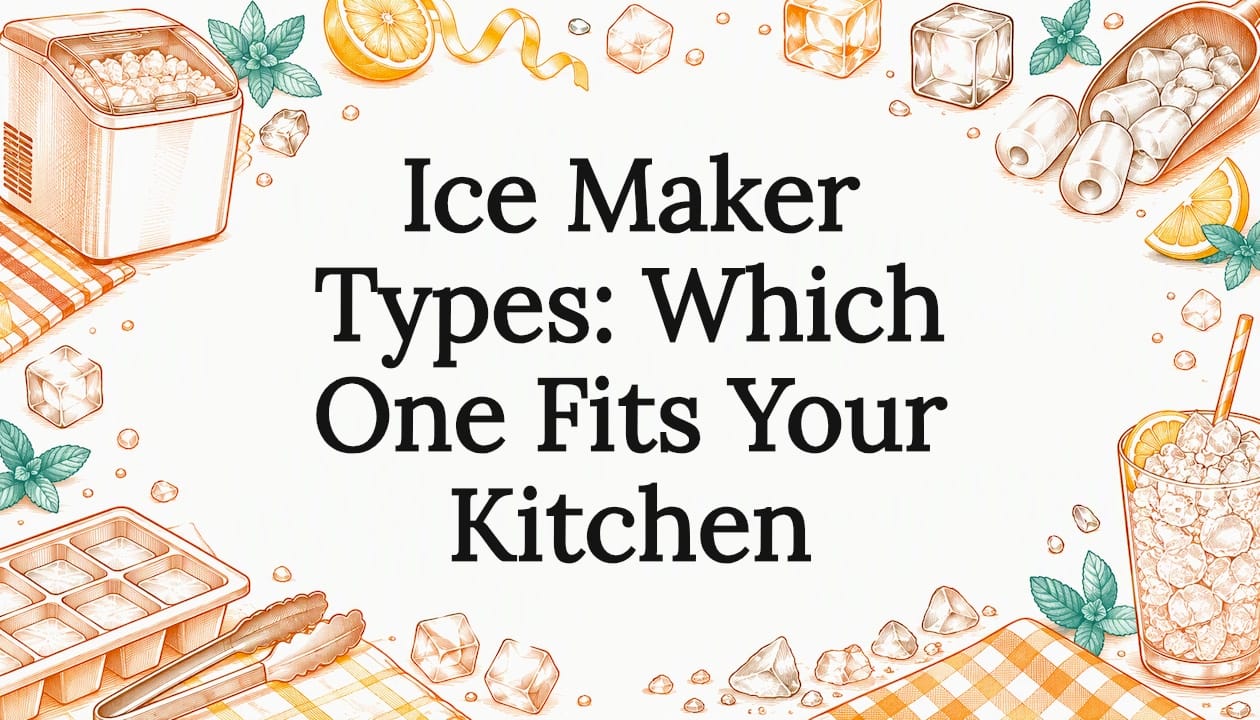
There are really two ways to sort ice makers: by where the machine lives (inside a refrigerator, on the counter, or built in under it) and by the ice it produces (cube, bullet, nugget or flake). Pick the ice first, because it decides how your drinks feel. Then pick the format, because it decides how much work the machine asks of you. This guide walks through both, so you can match a machine to the way your household actually uses ice.
TL;DR
- Ice makers come in three home formats: the one built into your refrigerator, a countertop machine you plug in and fill, and a built-in or undercounter unit installed in cabinetry.
- Ice shape matters more than most buyers expect. Square cubes suit slow-sipping cocktails, nugget ice is soft and crunchy for sodas and spritzes, and bullet ice is softer and melts faster.
- Countertop machines are not freezers. Ice you do not use melts, and the meltwater is recirculated to make more.
- Refrigerator ice makers add a measurable share to the appliance’s energy use, so design and controls are worth checking.
- Decide on ice type, daily volume, water access and cleaning habits, in that order.
Table of Contents
- The main kinds of ice, and what they are good for
- How each ice type is made
- Nugget ice vs. cube ice: how to choose
- Ice maker types by format
- What an ice maker costs to run
- How to choose: five questions
- Our perspective
- Find the right fit in our kitchen picks
- FAQ
- Sources
The main kinds of ice, and what they are good for
Before you compare machines, know what comes out of them. Home and light-commercial machines make a handful of shapes, and each one behaves differently in a glass.
| Ice type | What it looks like | Feels and behaves like | Best for |
|---|---|---|---|
| Square or cube | Solid, thick pieces | Dense, slow to melt | Cocktails, whiskey, iced coffee you sip over time |
| Bullet | Hollow-ish, rounded pieces with a rod-shaped hole | Softer, melts faster | Everyday water, quick-chill drinks, party pitchers |
| Nugget (pellet) | Small, porous, compressed pieces | Soft, chewable, absorbs flavor | Sodas, seltzers, spritzes, smoothies |
| Flake | Fine, soft shavings | Packs tightly, melts fast | Displays, cold compresses, blended drinks (mostly commercial) |
America’s Test Kitchen tested countertop machines in 2025 and described how the shapes differ in use: square ice came out thick and substantial for cocktails, nugget ice was pleasant to crunch and well suited to seltzers, spritzes and sodas, and bullet ice was softer and melted faster. That lines up with what most people notice at home: the ice you want in a negroni is not the ice you want in a cherry cola.
How each ice type is made
The shape comes from the freezing method, and the method also explains why some machines are louder, slower or pricier than others.
Bullet ice
In a bullet-style countertop machine, water fills small molds and chilled metal rods freeze it from the inside. That is why the pieces have a rounded end and a small hollow. According to America’s Test Kitchen’s testing, bullet ice is made in water-filled molds around chilled rods. It is the fastest and most common approach in compact machines, which is why bullet makers dominate the entry-level end of the market.
Square (cube) ice
Square ice forms when water freezes over a cold grid. The same testing notes that square ice forms as water freezes over a cold grid. Because the cubes are thicker and more solid, they dilute a drink more slowly, which is the whole point for a cocktail or a glass of whiskey.
Nugget ice
Nugget ice takes more engineering. Water freezes on the inside of a cylinder, a mechanism shaves it off, and the flakes are compressed and pushed through holes. America’s Test Kitchen describes it as shaved from a freezing cylinder, compressed and extruded through holes. The compression leaves tiny air pockets, which is where the soft, chewable bite comes from.
Flake ice
Flake ice uses a similar scraping idea but without compressing the result into pellets. It is common in restaurants, seafood displays and healthcare settings. For a home kitchen it is rarely the right choice unless you blend a lot of drinks or want ice to pack around items.
Nugget ice vs. cube ice: how to choose
This is the question behind many searches, and the honest answer is that it comes down to how you drink.
Choose nugget ice if you drink a lot of sodas, seltzers, iced tea or sparkling water, or you like to chew ice. Its porous structure soaks up the flavor of the drink, so the last few pieces taste like the beverage rather than plain water. It also fills a glass densely, so drinks stay cold with small pieces.

Choose cube or square ice if you pour cocktails, spirits or slow-sipped iced coffee. A thicker piece has less surface area for its volume, so it melts more slowly and keeps the drink from watering down.
Choose bullet ice if you want the quickest, cheapest route to a bin of ice for everyday water and party pitchers, and you do not mind that it melts sooner.
A practical rule: if the drinks in your house are mostly fizzy or fruity, lean nugget. If they are mostly stirred and sipped, lean cube. If you just want cold water without a trip to the freezer, bullet is plenty.
If you are leaning toward nugget and want a look at one specific model, our GE Profile Opal 2.0 nugget ice maker review covers how it performs in daily use.
Ice maker types by format
Now the other way to sort: where the machine sits and how it gets water.
Refrigerator ice makers
Most American households already own one. These are automatic machines tucked into the freezer compartment or a freezer door, fed by a water line, and they make a batch, harvest it into a bin and repeat. NIST describes the sequence: automatic refrigerator ice makers deliver water, freeze it and harvest it into a low-temperature bin, stopping when a sensor detects a full bin.
The layout varies by refrigerator style. NIST’s study of four US domestic configurations found that top-mount, side-by-side and two French-door designs used different ice-maker placements and cooling arrangements. In practice that means:
- Top-mount models keep the ice maker in the freezer compartment, with the bin beneath it.
- Side-by-side models often place the maker in the freezer door or upper freezer area, which allows dispensing through the door.
- French-door models may put the maker in the fresh-food section’s door or in the freezer drawer, depending on the design, to save freezer space.
The ice is usually the cube or crescent style, though some refrigerators now offer other shapes. If you are shopping for a refrigerator and the ice maker matters, check where it sits and how much freezer volume it takes. Our refrigerator size guide helps you measure before you commit, and the LG French door refrigerator review shows what a large-kitchen model looks like in practice.
When the built-in maker stops producing, it is usually a small fix. Start with our fast fixes for a refrigerator ice maker that is not working before calling for service.
Countertop ice makers
Countertop machines are self-contained. You pour water into a reservoir, plug the unit in, and it starts producing ice in minutes to a short while, depending on the model. There is no plumbing, which makes them popular in apartments, dorm rooms, RVs and patios.
Two things surprise first-time owners. First, they are not freezers. America’s Test Kitchen explains that unused ice melts, the water collects below the bin and is recirculated to make more ice. If you want to stockpile ice for a party, scoop it into a freezer bag and store it in the freezer. Second, they are not silent. Expect fan, pump and ice-drop noise, so think about where the unit will sit.
Setup is simple. America’s Test Kitchen says it commonly involves running a cleaning cycle, adding water and switching the machine on, after which sensors monitor the ice level and restart production when the bin runs low. Many also let you choose a larger or smaller ice size. The same testing notes that larger ice settings take longer but melt more slowly, and that size selection is useful but not essential.
For more on how these machines work day to day, including cleaning and automatic production, this guide to countertop ice makers is a handy companion. And since they take up real counter space, our countertop appliance placement tips help you find a spot that keeps the work zone clear.

Built-in and undercounter ice makers
Built-in units slide under a counter, often next to a beverage fridge or in a home bar. Most connect to a water line and a drain, so they are a plumbing project rather than a plug-and-play purchase. In return you get a bigger bin, a cleaner look and ice that is always ready. Models differ in whether they produce clear, cloudy or nugget-style ice, and some melt-drain automatically while others hold ice cold. Check the manufacturer’s specification sheet for ice type, bin capacity and drain requirements before you plan the cabinet.
This format makes sense if you entertain often, you are renovating, or you want ice without giving up counter space. If you are redoing the room, the refrigerators and mini fridges category is a good place to see what pairs well with a home bar.
Quick comparison
| Format | Water source | Installation | Typical strength | Typical trade-off |
|---|---|---|---|---|
| Refrigerator | Water line | Comes with the fridge | Always on, no extra space | Limited ice types, uses freezer space |
| Countertop | Manual fill | Plug in | Flexible, fast, portable | Uses counter space, ice melts if unused |
| Built-in or undercounter | Water line and drain | Plumbing and cabinetry | Large bin, clean look | Higher cost and installation effort |
What an ice maker costs to run
Ice is not free energy-wise, and refrigerator ice makers are where the cost hides. NIST measured automatic ice-making energy at approximately 0.249 to 0.652 kWh per kilogram across tested products, and estimated that ice making added about 12% to 20% to rated refrigerator energy consumption under its test assumptions. The study is from 2011, so treat the figures as a guide to the scale of the effect, not as a number for a current model.
The NIST authors point out that efficiency depends heavily on design and controls, especially the energy used to release frozen pieces from the molds. That is useful when you compare machines: a model that heats the mold briefly and harvests cleanly wastes less than one that over-heats.
If running cost is a concern, these pages help:
- How much energy a refrigerator uses
- Cutting refrigerator running cost
- Making your refrigerator more energy efficient without replacing it
For countertop machines, the same logic applies in a smaller way: a unit that keeps running to replace melted ice uses more power than one you empty and switch off when you are done.
How to choose: five questions
- What will you drink? Fizzy and fruity drinks point to nugget. Spirits and sipped drinks point to square ice. Everyday water points to bullet.
- How much ice do you use in a day? A couple of glasses is a very different load from a weekend of entertaining. Match the machine’s output and bin size to your busiest day, not your average one. Remember a countertop bin will not hold ice for long.
- Can you run a water line? If yes, a refrigerator or built-in unit removes the refilling chore. If not, a countertop machine with a reservoir is the practical choice.
- Where will it sit? Measure the space and allow for ventilation and the lid or door swing. Noise carries in open-plan rooms.
- Will you clean it? Every ice maker needs periodic cleaning, and a machine that is easy to open, drain and wipe is one you will actually maintain. Run the cleaning cycle before first use, as the machine’s manual directs, and follow its schedule afterward.
If you only need ice occasionally, a good tray might be enough. Our piece on what makes an ice cube tray easier to use covers the trade-offs.
Our perspective
We spend our days looking at kitchen appliances, and ice makers are one of the categories where buyers most often pay for a feature they never use. The common pattern is a shopper who buys on speed or capacity and then discovers the ice itself is the thing they notice every day. So we start with the glass: what are you pouring, and how do you want it to feel?
We also think of an ice maker as part of a kitchen workflow, not a standalone gadget. A countertop machine that has no good place to sit ends up unplugged. A refrigerator with a great ice maker but a layout that does not fit your doorway is not a bargain. That is why we pair ice guidance with size, placement and energy information, and why we would rather you buy the plainer machine that fits your routine than the impressive one that does not.
Finally, we like appliances that are easy to clean. Ice touches your drinks directly, so a machine you can open, drain and wipe without a struggle is worth more than a spec-sheet advantage.
— K. Connors
Find the right fit in our kitchen picks
If your ice maker decision is part of a bigger kitchen upgrade, start with our refrigerators and mini fridges collection, where we group models by size and style. Planning a beverage corner or home bar? Our tableware, accessories and dining sets page has glassware and serving pieces to go with it.
You can browse everything else we curate, from air fryers to blenders, on the Kitchen Devotion home page.
FAQ
What are the main types of ice makers?
For homes, there are refrigerator ice makers, countertop machines and built-in or undercounter units. By ice shape, the main kinds are square or cube, bullet, nugget and flake. Most buyers choose the shape first and the format second.
What is the difference between nugget ice and cube ice?
Nugget ice is small, porous and compressed, so it is soft to chew and soaks up flavor, which suits sodas and seltzers. Cube or square ice is denser and melts more slowly, which suits cocktails and sipped drinks. America’s Test Kitchen’s 2025 testing reached the same split.
Does a countertop ice maker keep ice frozen?
No. A countertop machine is not a freezer, so ice you do not use melts and the water is recirculated to make more. If you need a stockpile, move the ice to a freezer bag and keep it in your freezer.
Do refrigerator ice makers use a lot of energy?
They add a noticeable amount. A 2011 NIST study estimated that ice making added roughly 12% to 20% to rated refrigerator energy use under its test assumptions. Design and controls matter, so compare current models rather than assuming the old figures apply.
Which ice maker type is best for a small apartment?
A countertop machine is usually the easiest, since it needs no plumbing and moves with you. Choose the ice shape that fits your drinks, and find a spot with room for ventilation and for filling the reservoir.
Sources
- The Best Countertop Ice Makers of 2025, America’s Test Kitchen
- Energy Consumption of Automatic Ice Makers Installed in Domestic Refrigerators, NIST

No comment