
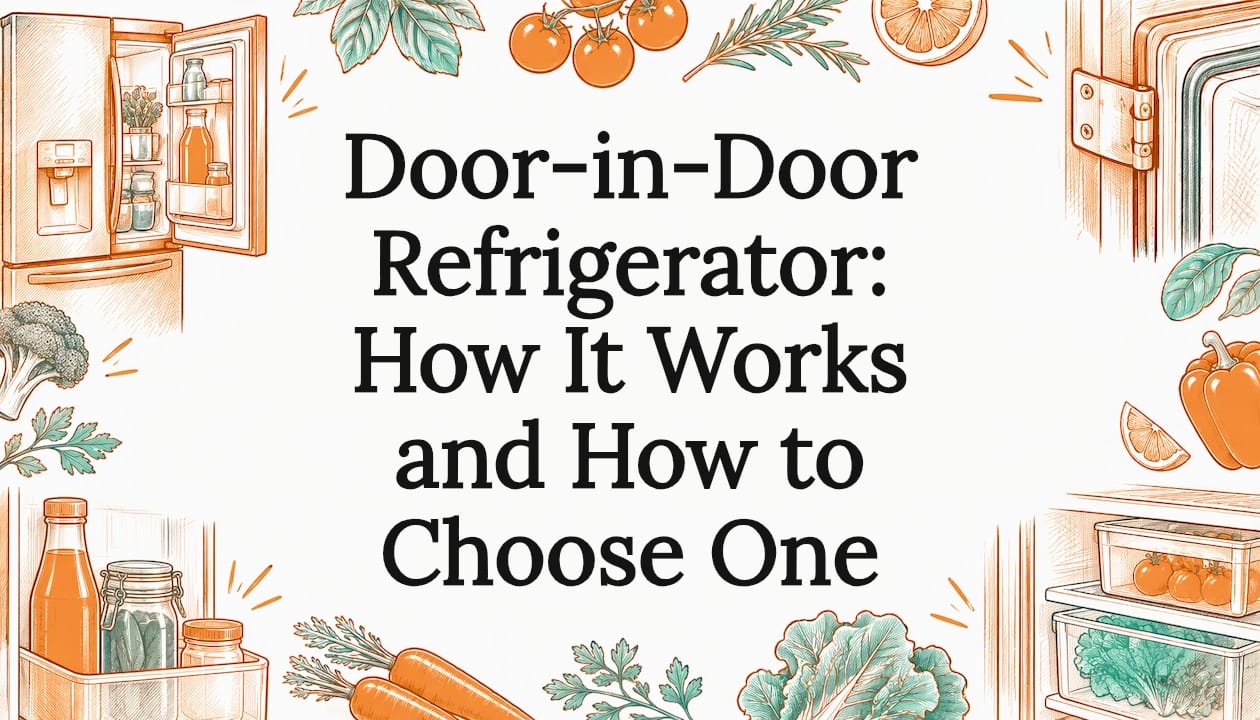
A door-in-door refrigerator has a second compartment built into one of its doors. Press a button or pull a handle and a panel opens, giving you the drinks, condiments and snacks you reach for all day without swinging the whole door wide. Consumer Reports describes it as a hidden compartment behind an exterior panel, typically on a French-door model. This guide explains how the feature works, what it is good for, which specs matter, and how to keep it clean.
TL;DR
- A door-in-door is a small outer compartment in the door. It lets you grab everyday items without opening the main refrigerator.
- Consumer Reports says the design does not really change refrigerator performance. It adds convenience on top of a fridge that cools like any other.
- Judge the whole refrigerator, not just the feature: tested capacity, the EnergyGuide label, the dispenser type and whether it fits your space.
- Keep it clean with warm water and baking soda, never bleach or abrasives, and wipe the gasket dry.
- Measure your doorway, your cutout and your door swing before you order.
Table of Contents
- What a door-in-door refrigerator is
- How the feature works day to day
- Who a door-in-door refrigerator suits
- What to compare before you buy
- A quick comparison table
- Before you order: measuring and delivery
- Cleaning and caring for the compartment
- Our perspective
- Find the right refrigerator
- Smart ways to use the compartment
- Door-in-door or something else?
- FAQ
- Sources
What a door-in-door refrigerator is
Think of a cabinet door inside a refrigerator door. On the outside you see one large door. Behind a smaller panel in it sits a shallow compartment with its own shelves or bins. Open the panel and you reach the items inside. The main refrigerator compartment stays closed.
The idea is simple. Most of what people grab during the day is small: a jug of milk, a jar of pickles, sparkling water, yogurt cups, a bottle of salad dressing. Moving those to a dedicated compartment means the big door opens less often.
Which styles have it
The feature is usually found on French-door refrigerators, where the two upper doors are narrow and the freezer is a drawer below. You will also see it on some side-by-side models. Manufacturer materials for a side-by-side version say the compartment is meant for easy access to beverages and snacks and comes with extra door bins for organization.
Some versions add a glass panel you can knock on to light up the interior, so you can see what is inside without opening anything. Others are plain panels with a push-button release. If you see a model advertised with a see-through panel, that is the same compartment with a window.
What the compartment can hold
Manufacturer spec sheets describe the compartment as a home for healthy snacks, beverages and frequently used items, and the same sheet lists several door baskets in gallon, half-gallon and small sizes. In practice that means:
- Bottled water, juice boxes, canned drinks
- Condiments and sauces
- Yogurt, string cheese, snack packs
- Butter, eggs or a half-gallon of milk, depending on the bin layout
- Lunchbox items for the kids
Because door shelves are warmer than the back of the fridge, keep the most perishable foods, such as raw meat and open dairy you plan to keep for a week, on interior shelves. Put the grab-and-go items in the compartment.
How the feature works day to day
The compartment is an insulated pocket with a gasket seal, a latch and a hinge. When you press the release, the panel swings open. The cold air in the main cabinet stays mostly where it is, because the main door has not moved.

The benefit is easiest to picture in a busy household. A family of four might open the fridge dozens of times a day. Each full-door opening lets warm room air in, and the compressor works to cool it back down. Opening a small panel instead is a smaller disturbance.
Does it save energy?
The evidence here is worth stating carefully. Manufacturers say the design reduces cold air loss. Consumer Reports’ refrigerator buying guide says that reaching frequently used beverages and condiments without opening the entire door will save on energy costs in the long run. The same publication’s lab view is that these designs don’t really affect performance and are mainly about convenience.
Put those together and the practical takeaway is good news: you get a fridge that tests as well as comparable models, plus an easier way to reach everyday items. Any energy benefit depends on how often you use the compartment instead of the main door. If you want to see what a refrigerator costs to run, our guide to how much energy a refrigerator uses walks through the numbers.
Who a door-in-door refrigerator suits
The feature earns its place in some kitchens more than others.
Busy families. Kids who open the fridge for a drink, a snack or a yogurt can be pointed to one compartment. The rest of the fridge stays organized for dinner ingredients.
Meal preppers and entertainers. If the main shelves are full of containers or party trays, you do not have to dig through them to find a bottle of water or a lime.
Anyone who likes order. Dedicated door bins keep condiments out of the main shelves. The main compartment then has more room for tall items and big dishes.
Households that open the fridge constantly. Work-from-home cooks and teenagers are the classic case. If you open the door twenty times before noon, a quicker option appeals.
It is a nice-to-have in a single-person household that opens the fridge a handful of times a day, but even there the extra bins add useful organization.
What to compare before you buy
The door-in-door panel is one feature of a larger machine. The refrigerator still needs the right size, efficiency and layout. Here is how to compare.
Start with usable capacity
A published cubic-foot figure is a starting point. Consumer Reports notes that with French-door models actual storage capacities may be much less than claimed. The practical response is to compare the tested or usable capacity, think about how you shop, and check shelf depth and bin height against the items you buy. If you keep tall bottles or large platters, look at shelf spacing.
Our refrigerator size guide covers width, depth, height and clearances so you can match a model to your space before you commit.
Read the EnergyGuide label
Consumer Reports recommends using the EnergyGuide label to compare estimated yearly operating cost and annual kilowatt-hours, and also looking at Energy Star status. The same guide says a refrigerator can add roughly $50 to $60 a year to an energy bill, over $500 across the life of the unit, and that refrigerators should last about 10 years. That is why a small difference in yearly cost is worth checking: it repeats for a decade.
French-door models, the most common home for this feature, tend to use more energy and cost more to run than some other layouts, so the label is the fair way to compare two models side by side. Once you own one, small habits help. Our guide on making a refrigerator more energy efficient and our running cost breakdown show where the savings are.
Decide on the dispenser
Many door-in-door models also offer ice and water through the door. Consumer Reports notes that through-the-door dispensers add convenience but can be repair-prone and use more energy. If you drink a lot of filtered water, the dispenser pays you back every day. If you rarely use it, a model with an internal ice maker and water pitcher can be the simpler pick. We compare both options in internal vs external water dispensers.
Check the layout and the little things
- Door bins: Are they adjustable? Can they hold a gallon jug?
- Latch and handle: Open it in the store or watch a demo video. A panel that is easy to open matters when your hands are full.
- Shelf material: Glass and spill-catching rims make cleaning easier.
- Freezer layout: Drawer, with a top basket, or side column. Match it to how you freeze food.
- Counter-depth or standard depth: Counter-depth looks flush with cabinets, while standard depth often holds more. Our Samsung Bespoke counter-depth review shows how style and performance trade off in that category.
A quick comparison table
| What you compare | Door-in-door French door | Standard French door | Side-by-side |
|---|---|---|---|
| Everyday-item access | Outer compartment, main door stays closed | Open a full door | Open a narrow full-height door |
| Door storage | Extra bins plus compartment | Standard door bins | Standard door bins, often gallon-size |
| Freezer | Usually bottom drawer | Bottom drawer | Side column |
| What to check | Tested capacity, latch ease | Tested capacity | Shelf width for large platters |
| Energy check | EnergyGuide label | EnergyGuide label | EnergyGuide label |
The layouts differ, but the process is the same: confirm fit, check the label, then pick the features you will use.
Before you order: measuring and delivery
A door-in-door refrigerator is usually a full-size unit, and the question people ask most is whether it will get into the house. Do this before you pay:
- Measure the path. Front door, hallway, turns, stairs, and any door you will take off its hinges. Compare the narrowest point to the refrigerator’s width and depth, with packaging.
- Measure the cutout. Width, height and depth, including the wall behind the fridge.
- Allow space around it. Manufacturers specify gaps at the sides, top and back for airflow. Check the spec sheet of the model you want.
- Check the door swing. A French-door model has narrow doors, but you still need room to open drawers and to open the door-in-door panel fully.
- Plan for water. If the model has a dispenser or ice maker, you need a water line nearby.
If the fridge fits the opening but the doors collide with a wall, you can often remove doors for delivery. Ask the delivery team what they can do. Our size guide goes through each measurement.
Cleaning and caring for the compartment
The compartment has gaskets and bins, so it needs a little routine care. Manufacturer instructions agree on the basics.
- Unplug first. The Electrolux owner’s guide, for instance, tells you to unplug the refrigerator before cleaning and not to wash removable parts in the dishwasher.
- Use warm water and baking soda. For mildew on the interior or gasket, a mixture of 1 quart warm water and 1 tablespoon baking soda, then a thorough rinse of the gasket and a dry wipe.
- Skip harsh products. The same care instructions say not to use petroleum distillates, detergent, bleach or ammonia, and not to clean plastic parts in a dishwasher.
- Avoid abrasives. Another manufacturer’s manual says not to use scouring sponges or steel wool.
For a door-in-door, pay attention to the seal around the panel. A clean, dry gasket closes well. If a door ever stops latching, work through our checklist for a fridge door that won’t close.
A simple monthly routine
- Empty the compartment bins and wash them by hand in warm soapy water.
- Wipe the compartment liner and the gasket with a soft cloth and the baking-soda mixture.
- Rinse with a clean damp cloth and dry.
- Put items back, with the oldest at the front.
Remove spills as they happen. Sticky bottles are the usual culprit for dirty door shelves.
Our perspective
We curate kitchen gear for people who want it to look good and work every day, and a door-in-door refrigerator fits that brief when the household matches the feature. The best reason to want one is organization. A dedicated compartment gives your most-used items a home, and the main shelves stay free for groceries and meal prep.
We also like that the independent testing is reassuring. Consumer Reports found these designs do not change how well a refrigerator performs, so choosing one means gaining a convenience without giving up the cooling you expect.
Our advice is to treat the door-in-door as a layer on a well-chosen refrigerator. Start with the size that fits your space, look at the EnergyGuide label, decide on the water dispenser, and then enjoy the panel. When we review a refrigerator, such as our look at the LG LFDS22520S French door model, we ask the questions a home cook would: does it hold what I buy, is it easy to use, and does it suit a family’s routine?
A kitchen works best when the things you reach for most are the easiest to reach. That is the idea behind the feature, and it is why we think it is worth a look.
K. Connors
Find the right refrigerator
Ready to compare models? Our refrigerators and mini fridges page collects the options we have curated, with guides that help you match size, style and features to your kitchen. If you are renovating, you can browse dishwashers and tableware and dining sets alongside your refrigerator.
We link to online retailers, so you can check current prices and availability on the retailer’s page.
Smart ways to use the compartment
A few habits make the feature earn its keep.
Set it up as a drink and snack station. Fill it on grocery day with what the household reaches for most. Kids learn quickly where their yogurt and juice are.

Keep a stock of lunch items. Cheese sticks, fruit cups and small drinks in one place speed up school-morning packing.
Label the bins. A strip of removable tape works. You are less likely to leave the door open hunting for something.
Do not overfill. If the panel cannot close easily, the seal cannot do its job. Leave a little room.
Rotate regularly. Because the compartment is where things are most visible, it is easy to rotate stock. Check dates weekly.
Door-in-door or something else?
If you want fast access to everyday items, a door-in-door is a natural answer. If your priority is lowest purchase cost or the most interior volume, other layouts may line up better with your goals, and you can still organize well with bins and lazy Susans. Our refrigerator guides cover other layouts. If your space is a garage, see our guide to garage-ready refrigerators, and for a smaller kitchen, a compact top-freezer model may be the right size.
FAQ
What does door-in-door mean on a refrigerator?
It means the door has a smaller compartment built in, behind its own panel. You open the panel to get snacks, drinks and condiments, and the main refrigerator stays closed. Consumer Reports describes it as a hidden compartment that opens with the press of a button.
Does a door-in-door refrigerator keep food cold as well as other models?
Yes. Consumer Reports says these designs do not really affect refrigerator performance and mainly add convenience. Compare the EnergyGuide label and tested capacity like you would for any refrigerator.
Will a door-in-door refrigerator lower my electric bill?
It can help if you use the compartment instead of opening the main door. Consumer Reports says reaching everyday items this way can save on energy costs over time. Your result depends on habits, so compare the yearly cost on the EnergyGuide label as well.
How do I clean the door-in-door compartment?
Unplug the refrigerator, wash removable bins by hand, and wipe the liner and gasket with a mix of 1 quart warm water and 1 tablespoon baking soda. Rinse and dry. Avoid bleach, ammonia and abrasive pads, and keep plastic parts out of the dishwasher.
How do I know if a refrigerator will fit through my doorway?
Measure the narrowest point on the delivery path and compare it to the refrigerator’s width and depth, then plan for the cutout and clearances. Our refrigerator size guide lists each measurement to take.
Sources
- Best Door-in-Door Refrigerators, Consumer Reports (2023)
- Best Door-in-Door Refrigerators, Consumer Reports (2025)
- Choose the Right Refrigerator for Your Kitchen, Consumer Reports
- Door-in-Door side-by-side spec sheet, LSXS26366
- Door-in-Door spec sheet, LFX31945
- Door-in-Door Refrigerators, manufacturer overview
- Electrolux Use & Care guide
- Refrigerator care and cleaning instructions, GEA
- Liebherr operating instructions CN 3033





No comment