
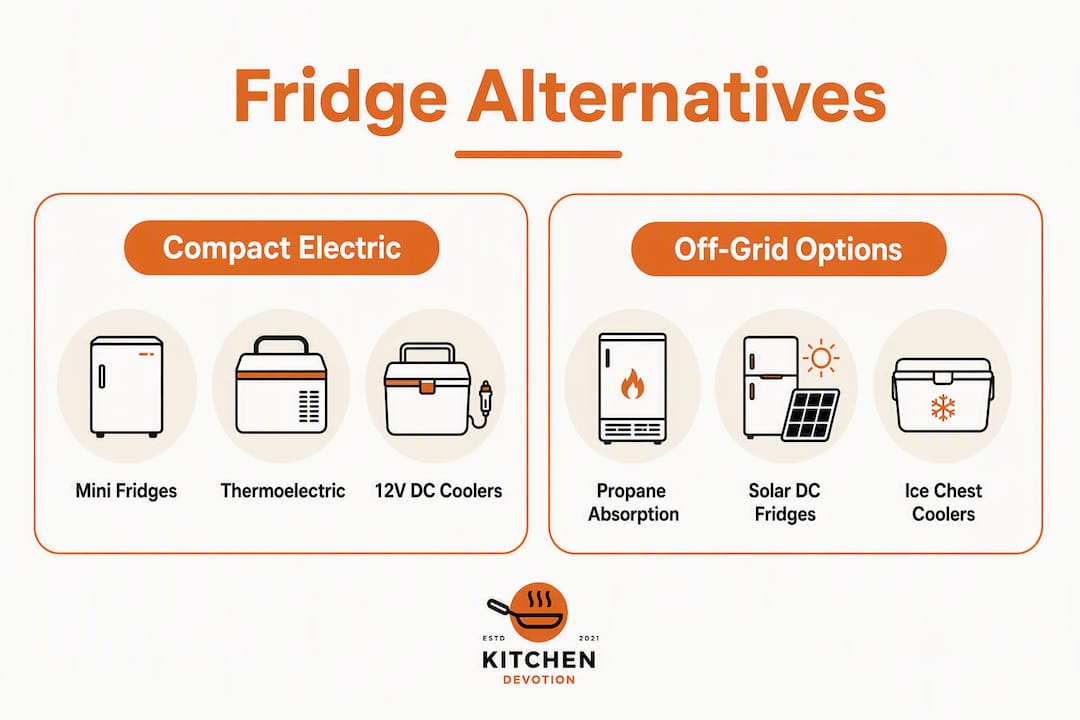
The most practical alternatives to a full-size refrigerator fall into four groups: compact low-energy electric units (mini fridges, 12V coolers), off-grid appliances (propane/absorption fridges, solar-ready DC models), chest coolers and ice-based systems, and passive earth-based solutions (root cellars, Evaptainers). Before choosing any of them, one rule overrides everything else: USDA/FSIS guidance requires perishables to stay at 40 °F or below, and any food held above that temperature for more than 2 hours is unsafe to eat.
Here is a quick-reference shortlist by use case:
- Mini fridge (compressor type): small apartments, dorms, offices
- 12V/DC cooler: vans, trucks, boat cabins
- Propane/absorption fridge: RVs, remote cabins without solar
- Solar-ready DC fridge: off-grid homesteads with battery banks
- Chest cooler with ice: camping, short-term or seasonal use
- Root cellar: rural properties storing root vegetables and preserves
- Evaptainer/evaporative cooler: dry climates, short-term produce storage
Pro Tip: Place a digital appliance thermometer inside any alternative cooling unit on day one and log the temperature every 8 hours for 48 hours. Touch is not a valid test. If the unit cannot hold 40 °F consistently, it is not safe for perishables.
Table of Contents
- 1. Compact electric options that fit small spaces
- 2. Off-grid appliances that work without grid power
- 3. Passive cooling and earth-based solutions
- 4. Food-safety limits every alternative must meet
- 5. Preservation-first strategies that reduce refrigeration needs
- 6. How to choose the right alternative for your situation
- Key Takeaways
- The case for right-sizing over eliminating refrigeration
- Kitchendevotion’s curated compact fridge guides
- Useful sources
- FAQ
1. Compact electric options that fit small spaces
Mini fridges, thermoelectric coolers, and 12V direct-drive units cover most of the “smaller footprint” use cases that drive people to search for fridge.com alternatives in the first place.
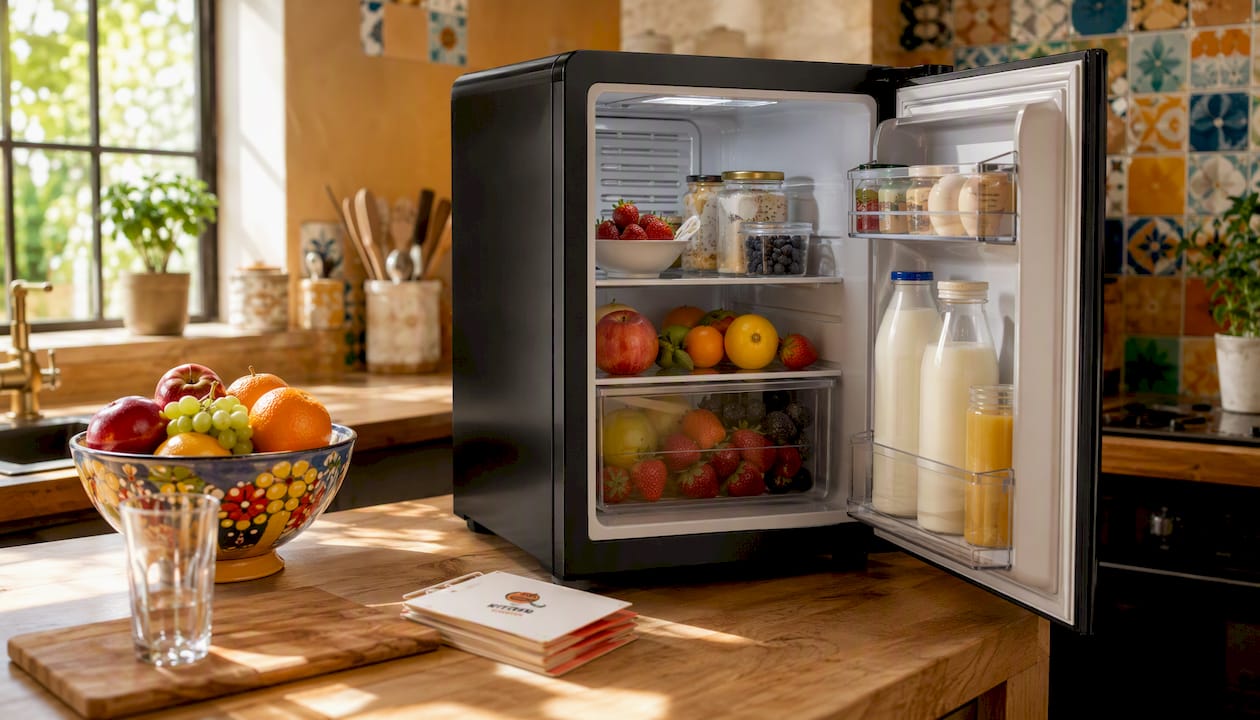
Compressor mini fridges work exactly like a full-size refrigerator, just scaled down. They reliably hold 35–38 °F, run on standard 120V AC, and cost $80–$300 for a 1.7–4.5 cu. ft. unit. The Frigidaire 11.6 cu. ft. compact top-freezer model is a good example of what you get at the upper end of the compact range: a real freezer compartment, consistent temps, and a footprint that fits tight kitchens.
Thermoelectric coolers use a Peltier chip instead of a compressor. They are quiet, cheap ($30–$80), and draw very little power, but they can only cool about 40 °F below ambient temperature. In a 75 °F room, that means roughly 35 °F, which is borderline. On a hot summer day at 90 °F, you are looking at 50 °F, which is above the safe threshold for perishables. Use them for drinks and non-perishables only.
12V DC coolers (also called compressor coolers) run directly off a car battery or a 12V solar system without an inverter. They hold 32–40 °F reliably, cost $150–$600, and are the go-to for van lifers and boat owners. The DC-direct operation matters: running an AC fridge through an inverter wastes 10–15% of your battery capacity in conversion losses.
| Unit type | Typical power draw | Cost range | Capacity | Safe for perishables? |
|---|---|---|---|---|
| Compressor mini fridge | 80–150W (cycling) | $80–$300 | 1.7–4.5 cu. ft. | Yes |
| Thermoelectric cooler | 40–60W (continuous) | $30–$80 | 1.7–4.5 cu. ft. | Only in cool ambient temps |
| 12V DC compressor cooler | 30–60W (cycling) | $150–$600 | 1.7–4.5 cu. ft. | Yes |
| Undercounter beverage drawer | 80–120W (cycling) | $200–$600 | 2–5 cu. ft. | Yes (35–42 °F range) |
Pro Tip: A thermoelectric cooler is fine for road-trip drinks or office snacks. The moment you are storing raw meat, dairy, or leftovers overnight, step up to a compressor-based unit. The price difference is $50–$100 and the safety difference is significant.
For dorm-specific picks, the best mini fridges for dorm rooms guide at Kitchendevotion walks through the top compressor models by size and noise level.
2. Off-grid appliances that work without grid power
For cabins, RVs, and homesteads, the practical options are propane/absorption fridges, solar-ready DC refrigerators, and chest coolers with ice. Each has a different cost structure and labor demand.
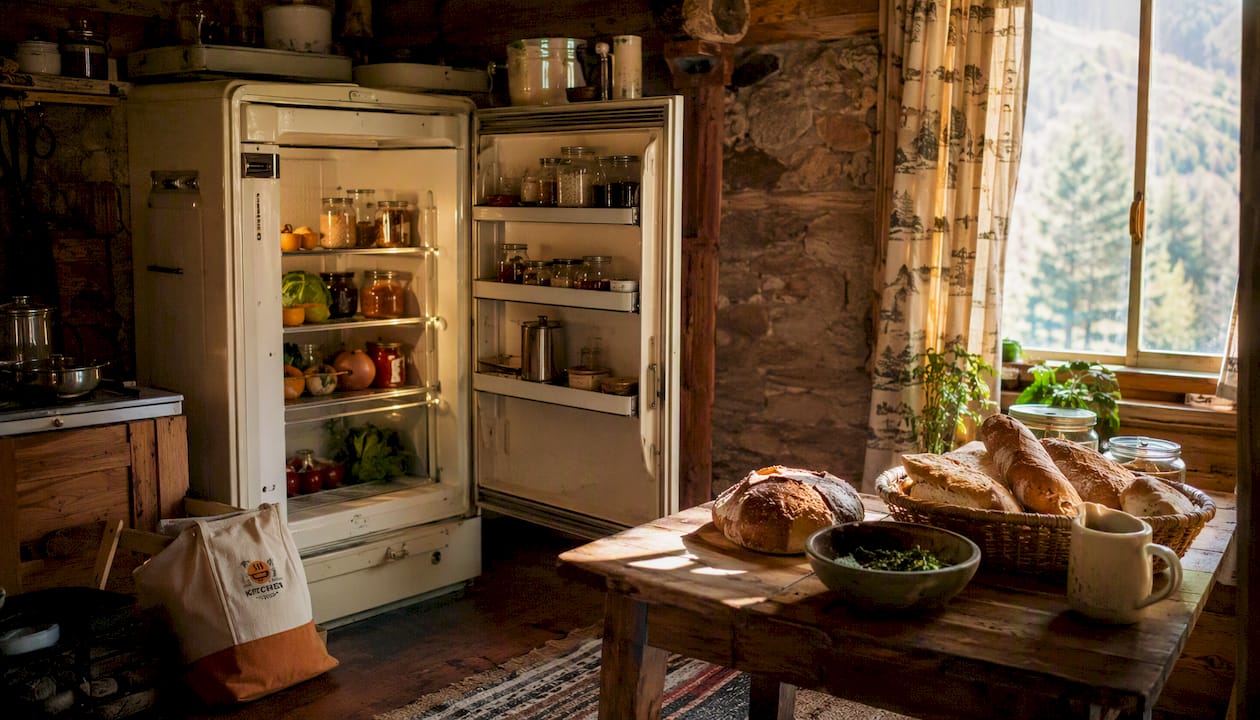
Propane absorption refrigerators have no compressor and no moving parts. A small flame drives an ammonia-water cooling cycle that can hold 35–42 °F. They are standard equipment in RVs and off-grid cabins, cost $600–$1,500 new, and run on propane or natural gas. The critical requirement: proper venting to the outside is non-negotiable. Carbon monoxide buildup from an unvented or poorly vented unit is a genuine hazard. Never install one in an unventilated space.
Solar-ready DC refrigerators pair directly with a 12V or 24V battery bank charged by photovoltaic panels. Because they run DC-direct, they skip the inverter step that wastes energy when powering AC appliances from a battery. A 50-liter DC fridge typically draws moderate power cycling, which a suitable battery bank and solar panels can sustain through most of the year in sun-rich regions.
Chest coolers and ice-based systems are the lowest-cost entry point. A quality rotomolded cooler with a full load of block ice can maintain cool temperatures for several days. Daily ice top-ups are labor-intensive and add recurring costs that accumulate quickly. Ice houses used by Amish communities take this further: harvested winter ice layered with sawdust or straw in an insulated vault can last through summer, but the setup requires land, labor, and a cold enough winter to harvest.
| Option | Purchase cost | Operating cost | Off-grid suitability | CO risk |
|---|---|---|---|---|
| Propane absorption fridge | $600–$1,500 | $15–$40/month (propane) | Excellent | Yes, requires venting |
| Solar-ready DC fridge | $600–$1,500 + solar setup | Near-zero (sun permitting) | Excellent | None |
| Chest cooler with ice | $30–$300 | $3–$8/day (ice) | Good (short-term) | None |
| Ice house | $500–$3,000 (build) | Near-zero (labor) | Seasonal/limited | None |
A note on Amish and homesteading communities rarely rely on a single method. The practical approach combines root cellars, propane fridges, ice storage, and canning depending on the season and food type.
3. Passive cooling and earth-based solutions
No-electricity cooling works, but only for the right foods in the right climate. These methods are best understood as complements to active cooling, not full replacements for perishables.
Root cellars use the earth’s stable underground temperature (50–60 °F year-round in most of the continental U.S.) to store root vegetables, apples, cabbages, and preserves for months. They do not reach 40 °F in most climates, so they are not safe for raw meat or dairy beyond a day or two. Construction requires good drainage, ventilation to prevent mold, and insulation at the entry point. A basic dug-out root cellar costs $500–$3,000 to build depending on size and materials.
Groundfridge is a prefabricated spherical underground cellar (a Dutch product available in the U.S. through specialty importers) that maintains 50–54 °F passively. It holds roughly 500 liters of produce and requires no electricity. Setup involves excavation, which adds to cost.
Evaptainers and evaporative pots work on the same principle as a swamp cooler: water evaporating from a porous surface pulls heat away and drops the interior temperature. In dry climates, Evaptainers can keep produce meaningfully cooler than ambient temperature without any electricity. In humid climates (above 60% relative humidity), evaporation slows dramatically and the cooling effect nearly disappears.
Spring houses channel cold spring water under or around a storage structure to maintain cool temperatures. Effective where a natural spring exists, but obviously not portable or universally available.
| Method | Typical temp range | Climate fit | Best foods | Setup cost |
|---|---|---|---|---|
| Root cellar | 50–60 °F | All climates (seasonal) | Root veg, preserves, apples | $500–$3,000 |
| Groundfridge | 50–54 °F | All climates | Produce, preserves | $3,000+ (with excavation) |
| Evaptainer/evaporative pot | About 40 °F below ambient | Dry only (<40% RH) | Produce (short-term) | $30–$150 |
| Spring house | 50–60 °F | Rural with spring access | Dairy (short-term), produce | $500–$3,000+ |
None of these methods reliably hit 40 °F. They are excellent for extending produce life and storing shelf-stable goods, but raw meat and dairy need an active cooling solution.
4. Food-safety limits every alternative must meet
The USDA/FSIS food-safety threshold is 40 °F or below for perishables. Foods held above 40 °F for more than 2 hours enter the “danger zone” where bacterial growth accelerates rapidly. That 2-hour window drops to 1 hour when ambient temperature exceeds 90 °F.
| Alternative group | Reliably reaches 40 °F? | Safe for raw meat/dairy? | Monitoring frequency |
|---|---|---|---|
| Compressor mini fridge / DC fridge | Yes (consistently holds 40 °F or below) | Yes | Weekly thermometer check |
| Propane/absorption fridge | Yes (consistently holds 40 °F or below when properly set) | Yes | Daily check first week |
| Thermoelectric cooler | Only in cool ambient | No (in warm conditions) | Every 4–6 hours |
| Chest cooler with ice | Yes (when ice is present) | Yes (short-term) | Every 12 hours |
| Root cellar / Groundfridge | No (50–60 °F) | No | Daily |
| Evaptainer | No | No | Every 4–6 hours |
Safety verification checklist:
- Buy a digital appliance thermometer (not a meat thermometer) before using any alternative unit.
- Place the thermometer in the warmest spot in the unit, usually near the door or top.
- Log the temperature every 8 hours for the first 48 hours.
- If the unit cannot hold 40 °F consistently, do not store raw meat, dairy, eggs, or cooked leftovers in it.
- If temperatures exceed 40 °F for more than 2 hours, discard perishables. Do not taste-test.
- For propane and fuel-driven units, install a CO detector within 10 feet of the unit.
For guidance on storing meat specifically in small units, the raw meat in a mini fridge guide at Kitchendevotion covers safe placement, wrapping, and temperature zones.
5. Preservation-first strategies that reduce refrigeration needs
The most underused approach to refrigerator alternatives is reducing what needs refrigeration in the first place. Canning, drying, fermenting, and freezing can shift a large portion of your food supply to shelf-stable or long-term frozen storage.
Homesteading practitioners consistently note that reducing cold-storage dependence through preservation is often more practical than trying to recreate refrigerator temperatures without reliable power. Canning a summer tomato harvest, for example, eliminates the need to refrigerate dozens of pounds of produce that would otherwise spoil within days.
- Pressure canning: — shelf-stable storage for low-acid foods (meats, beans, vegetables). Requires a pressure canner, not a water-bath canner, for safety. The USDA and the National Center for Home Food Preservation publish tested recipes that are the only safe reference for processing times.
For hands-on how-tos on each method, Kitchendevotion’s food preservation guide covers canning, pickling, drying, and smoking with equipment recommendations.
6. How to choose the right alternative for your situation
Start with these four questions before spending anything:
- Do you need to store perishables (raw meat, dairy, eggs, leftovers)? If yes, your alternative must reliably hold 40 °F. That rules out evaporative coolers, root cellars, and thermoelectric units in warm climates.
- Is grid power available? If yes, a compressor mini fridge is almost always the most cost-effective and reliable choice.
- Is fuel or battery power practical? If you have propane access or a solar setup, a propane absorption fridge or DC compressor fridge is the right off-grid answer.
- What is your monthly budget for operating costs? Ice-based systems look cheap upfront but cost $90–$240/month in ice. Propane runs $15–$40/month. Solar-powered DC fridges approach near-zero after the initial setup.
Decision checklist:
- Confirm power source availability (grid, propane, solar/battery, none).
- List the food types you need to store and whether any require 40 °F.
- Estimate required capacity in cubic feet (a single person typically needs 1.5–3 cu. ft. of refrigerated space).
- Set a purchase budget and a monthly operating budget separately.
- Check your climate: humid climates eliminate evaporative options; very cold climates can make a root cellar more effective seasonally.
- Verify ventilation requirements for any fuel-driven unit before purchasing.
Red flags to avoid:
- No thermometer in the unit. Temperature guessing is not food safety.
- Fuel-driven units in enclosed, unventilated spaces (CO risk).
- Relying on an evaporative cooler for perishables in a humid climate.
- Assuming a chest cooler is safe without checking ice levels every 12 hours.
- Skipping the 48-hour temperature test before loading perishables.
Pro Tip: Before committing $300+ to an off-grid solution, borrow or rent a similar unit for a week. Set up your thermometer, load it with the foods you actually eat, and see whether it holds temperature in your specific space and climate. One week of real-world testing beats any spec sheet.
Cleaning coils and checking door seals on an existing fridge can also cut energy use meaningfully before you replace it entirely. The refrigerator energy efficiency guide at Kitchendevotion walks through the maintenance steps that make the biggest difference.
Key Takeaways
For most people, a compressor-based mini fridge or 12V DC cooler is the most practical and safe fridge alternative, with propane or solar-ready DC fridges as the best off-grid options for perishables.
| Point | Details |
|---|---|
| USDA 40 °F rule is non-negotiable | Any alternative storing perishables must hold 40 °F or below; foods above that for 2+ hours are unsafe. |
| Compressor units beat thermoelectric | Thermoelectric coolers cannot reliably hold 40 °F in warm ambient conditions; use compressor-based units for perishables. |
| Off-grid best options | Propane absorption fridges and solar-ready DC fridges both reach safe perishable temps; propane requires venting. |
| Passive cooling has real limits | Root cellars and evaporative coolers hold 50–60 °F at best; they work for produce and preserves, not raw meat or dairy. |
| Kitchendevotion for curated picks | Kitchendevotion’s mini fridge and compact refrigerator guides help you compare energy-efficient models by size, cost, and use case. |
The case for right-sizing over eliminating refrigeration
Most people searching for refrigerator alternatives are not trying to live without cold storage. They want less of it: a smaller footprint, a lower energy bill, or a unit that works in a van or cabin. That distinction matters for how you shop.
The zero-fridge lifestyle gets a lot of attention in homesteading circles, but it works only when you have either the land for passive systems or the discipline to preserve everything. For the other 95% of people, the practical answer is right-sizing: a 3 cu. ft. compressor mini fridge uses a fraction of the energy of a 25 cu. ft. side-by-side, holds the same 40 °F, and costs under $200. That is not a compromise. That is a better fit for the actual amount of food most households refrigerate at any given time.
The one thing I see people consistently underestimate is the monitoring step. Every alternative cooling method, from a propane fridge to a chest cooler, requires more active attention than a standard refrigerator. A standard fridge is a set-it-and-forget-it appliance. A propane unit needs its flame checked, its temperature verified, and its venting inspected. A chest cooler needs ice levels monitored twice a day. Build that monitoring habit before you commit to any alternative, and you will avoid the food-safety mistakes that make these systems get a bad reputation.
Kitchendevotion’s curated compact fridge guides
Sorting through dozens of mini fridges and DC coolers to find one that actually holds temperature, fits your space, and does not run up your electricity bill is the part most buyers skip until after a bad purchase.

Kitchendevotion’s refrigerators and mini fridges category pulls together compressor-based compact models with side-by-side comparisons on energy draw, capacity, and price. If you are building out a new kitchen or deciding which appliances to prioritize first, the kitchen appliance priority list for new homeowners gives you a practical sequencing guide so you spend where it counts. Browse both pages to find the compact cooling solution that fits your space, budget, and food-storage needs.
Useful sources
The sources below back the specific claims in this article and are worth bookmarking for deeper reading.
| Source | What it covers |
|---|---|
| USDA/FSIS Refrigeration & Food Safety | Official 40 °F threshold, 2-hour rule, and safe-holding times for perishables |
| Coldmercial: How Amish Keep Food Cold | Overview of mixed traditional strategies: root cellars, ice houses, propane, canning |
| The Hearthside Haven: Amish Cold Storage | Propane absorption fridge mechanics, venting requirements, and solar DC integration |
| Survival World: No-Fridge Amish Hacks | Evaporative cooling, Evaptainers, and climate suitability for passive methods |
| Amish: How Amish Keep Food Cold | Ice house construction, harvesting, and labor considerations |
Internal Kitchendevotion resources referenced in this article:
- Food preservation guide: canning, pickling, drying, and smoking how-tos
- Refrigerator energy efficiency tips: coil cleaning, seal checks, and layout improvements
- Raw meat in a mini fridge: safe storage limits for small units
- Best mini fridges for dorm rooms: compressor models by size and noise level
Authority note: For legal food-safety thresholds in the United States, the USDA/FSIS is the primary source. Homesteading and off-grid sites offer practical context, but USDA guidance governs what is safe for perishables.
FAQ
Is there any real alternative to a refrigerator for storing perishables?
Yes, but the options are limited. Propane absorption fridges and 12V DC compressor coolers both hold 40 °F reliably and are the most practical alternatives for perishables when grid power is unavailable. Passive methods like root cellars and evaporative coolers do not reach safe perishable temperatures.
How do the Amish keep food cold without electricity?
Amish communities typically combine multiple methods: propane or solar-powered refrigerators for perishables, root cellars for produce and preserves, ice houses for seasonal cold storage, and canning to reduce what needs refrigeration at all.
What fridge brands have the fewest reliability problems?
Consumer Reports consistently ranks brands like LG, Samsung, and Whirlpool at the top for reliability, though performance varies by model line. Checking current owner-satisfaction data from Consumer Reports before buying is the most reliable way to compare.
Can you store raw meat in a mini fridge safely?
Yes, provided the mini fridge holds 40 °F or below consistently. Place raw meat on the lowest shelf in a sealed container to prevent cross-contamination, and verify the temperature with an appliance thermometer rather than relying on the unit’s dial setting.
What is the USDA rule for food left out of refrigeration?
USDA/FSIS guidance states that perishable foods held above 40 °F for more than 2 hours should be discarded. That window drops to 1 hour when the ambient temperature is above 90 °F.





No comment