
For everyday prep in a small kitchen, an expandable bamboo over the sink cutting board handles the widest range of sink sizes and doubles as a serving board. If raw meat prep or dishwasher convenience matters more to you, a fixed poly or composite board wins instead. Either way, measure your sink before you buy anything. Getting that number right reclaims real counter space and sends peels and scraps straight into the basin.
TL;DR:
- Proper measurement of the sink interior is crucial for fit; focus on width, front-to-back depth, faucet clearance, and obstructions.
- Plastic boards excel for dishwasher sanitation and raw meat prep, while wood and bamboo offer better knife care but require hand washing.
- Durability is driven by material choice and maintenance, with fixed boards lasting longer than expandable or telescoping options prone to corrosion.
- The best-fitting boards have wide contact patches and rubberized feet, with features like juice grooves and drain notches improving everyday usability.
- Buyers should prioritize fit and durability over price, ensuring the board suits their sink type and cleaning habits for long-term satisfaction.
Table of Contents
- Who Actually Benefits From a Sink Cutting Board?
- How Do You Measure Your Sink for a Secure Fit?
- Wood or Plastic: Which Material Should You Choose?
- What Design Features Actually Matter Day to Day?
- How Do You Keep a Sink Board From Warping or Rusting?
- Your 90-Second Buying Checklist
- What Should You Expect to Pay?
- How Long Should a Sink Cutting Board Last?
- Will a Sink Board Fit Your Sink Type?
- What Do Buyers Actually Say About These Boards?
- Where Can You Buy One?
- Do You Need to Plan for Storage?
- Why Fit Matters More Than Anything Else on the Spec Sheet
- Find the Right Sink Setup With Kitchen Devotion
- Sources
- FAQ
Who Actually Benefits From a Sink Cutting Board?
An over the sink cutting board earns its cabinet space in a specific set of kitchens; not every kitchen. If your countertop runs out before your recipe does, this is one of the cheapest fixes in the entire kitchen aisle.
The core benefit is simple: it turns dead air over your basin into a working surface, and it lets you scrape trimmings, peels, and rinse water straight down without a bowl in the way. That’s the whole appeal of a workstation cutting board approach, whether you buy a purpose-built workstation sink accessory or a standalone board that just happens to sit on the rim.
Here’s where this actually pays off:
- Small apartment and galley kitchens where the counter-to-sink ratio is brutal and every square inch counts.
- RVs, campers, and tiny homes where a sink cutting board for sink basins essentially doubles as your only real prep station.
- Entertaining and charcuterie service, since a nice wood board can go straight from prep surface to serving platter without a wash in between, based on how well-finished wood boards get used in practice.
- Occasional heavy prep like holiday cooking, where you need a burst of extra space for a few hours, not a permanent fixture.
Where it falls short: if you’re breaking down a whole chicken or doing daily high-volume vegetable prep, a board balanced over a sink flexes more than a countertop ever will. And if you’ve got a workstation sink with integrated ledges, a generic over sink prep station board usually won’t seat the same way a purpose-built one does. Fit geometry differs enough between sink styles that swapping boards between them can leave you with something that rocks or won’t seat at all.
How Do You Measure Your Sink for a Secure Fit?
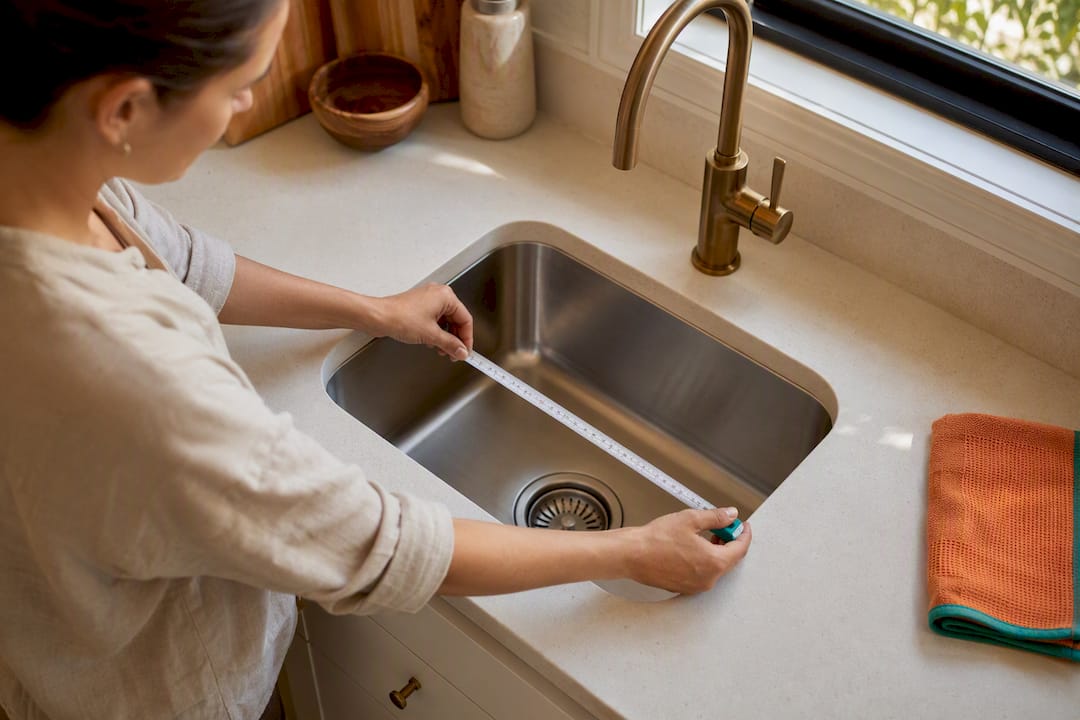
Fit failure is the single most common complaint with sink cutting boards, and it’s almost always a measurement error, not a product defect. Most people measure the countertop cutout instead of the interior basin, which explains a lot of one-star reviews that have nothing to do with build quality.
Here’s the sequence that actually works:
- Measure the inner usable width, lip to lip, at the narrowest point of the basin opening. This is the number that determines whether a fixed-span board will drop in at all.
- Measure front-to-back depth of the sink interior, then add roughly 1 inch. A board that’s too shallow will slide forward into the basin the moment you lean on it while chopping.
- Check faucet clearance. Swing the faucet through its full arc and note where the spout, handle, or sprayer hose would collide with a board resting on the rim.
- Inspect under-sink obstructions like soap dispenser stems, disposal switches, or a garbage disposal collar that sits higher than expected.
- Cut a paper template to your measured dimensions and set it across the sink for a few days of normal use before you commit to a purchase.
As a rule of thumb, board depth should exceed the sink’s front-to-back interior opening by about an inch to prevent slipping, and you want roughly 1/16 to 1/8 inch of clearance per side, with a 1 to 2 inch front overhang for a stable seat. For sizing context, a lot of single-basin kitchen sinks land around 16 by 12 inches, while larger trough or farmhouse basins often need boards closer to 21 by 10 inches or bigger, with thicker construction to resist flex across that longer span.
Workstation sinks deserve their own callout here. They’re built with integrated ledges cut at a specific depth to hold purpose-made accessories flush, and a board designed for a standard undermount sink generally won’t seat correctly on a workstation ledge, and vice versa. If you’ve got a workstation sink, buy the accessory made for that exact model line.
Pro Tip: Measure twice, on two different days. Countertops and sink rims aren’t always perfectly level, and a board that seats fine in the morning light can reveal a wobble once you’ve got both hands full of onions at dinnertime.
Wood or Plastic: Which Material Should You Choose?
Your cleaning habits should decide this, not your kitchen’s color scheme. Wood and bamboo boards are gentler on knife edges, look better on a counter, and can pull double duty as a serving board once dinner is ready. But they demand hand washing every time.
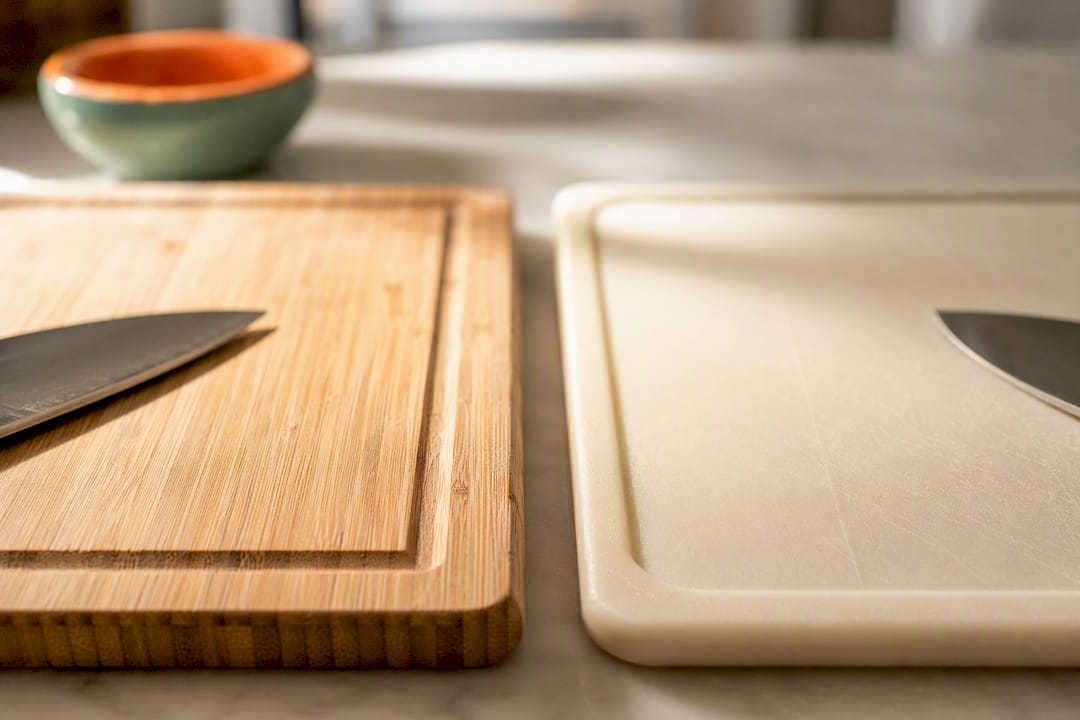
Plastic, polyfiber, and composite boards trade that warmth for convenience: most are dishwasher safe, and plastic generally sanitizes more reliably at dishwasher temperatures, which is why it’s the safer pick for raw meat and poultry prep. The tradeoff is that plastic scars more visibly over time, and deep knife grooves become bacteria traps if you don’t replace the board once the surface gets chewed up.
Quick breakdown of the tradeoffs:
- Bamboo/wood: knife-friendly, good looks, doubles as a serving platter, but hand-wash only and needs periodic oiling.
- Plastic/composite: dishwasher-safe, easier to sanitize after raw meat, but scars and needs replacing sooner.
- Expandable mechanisms: great for fitting variable sink widths, but the sliding rails can trap moisture inside the channel.
- Fixed-span boards: fewer moving parts, so fewer places for corrosion or gunk to build up over years of use.
The sanitation rule worth internalizing: keep a dedicated plastic board for raw meat, poultry, and fish, and reserve your wood or bamboo board for produce, bread, and cheese, washing it immediately after each use rather than letting it sit. Wooden boards will warp, splinter, or split if they go through a dishwasher cycle, so that line in the manual isn’t a suggestion. If you’re drawn to wood for its look and knife feel but want an eco-conscious option, it’s worth browsing recycled cutting board materials built to hold up under hand-wash routines.
What Design Features Actually Matter Day to Day?
A board that measures right on paper can still be miserable to use if it lacks the right physical features. The details below separate a board you’ll use daily from one that ends up in the cabinet after a month.
Contact patch matters more than most buyers expect. A board with a narrow contact edge and no rubberized feet will slide and rock under knife pressure, no matter how perfectly it’s sized. Look for a wide, continuous contact strip along both long edges, ideally with rubber or silicone feet set into the underside for grip against a wet countertop lip. Thickness helps too. Anything under 3/4 inch tends to flex when you’re bearing down on a squash or a dense root vegetable, while boards with underside ribs stay rigid even at thinner profiles.
Drainage features are where a workstation cutting board really separates from a flat slab. A perimeter juice groove keeps liquid from running off the edge onto your floor, a drain notch channels waste straight into the basin, and some models include a removable colander insert that fits into a cutout for rinsing produce mid-prep.
- Faucet notches cut into the board’s back edge let you seat it closer to the wall without fighting the spout.
- Telescoping arms expand the board’s reach across wider sinks but introduce a mechanism that needs occasional drying.
- Under-lip nesting keeps the board from sliding forward when you push down while chopping.
- Glued laminate seams on wood boards are the first spot to watch for separation over years of moisture exposure.
Pro Tip: If a listing photo shows a telescoping arm, zoom in on the rail material. Plastic-on-plastic rails tend to outlast metal-on-metal ones in a humid sink environment, since bare metal rails are the first thing to show rust.
How Do You Keep a Sink Board From Warping or Rusting?
Maintenance habits determine whether your board lasts two years or ten, more than the price tag does.
- Hand-wash wood and bamboo boards immediately after use, dry them standing up rather than flat, and rub in food-grade mineral oil every few weeks to keep the grain from drying out and cracking.
- Never put a wood or bamboo board in the dishwasher. The combination of heat and standing water breaks down the glue in laminated seams and warps the wood permanently.
- Run plastic and composite boards through the dishwasher regularly, but inspect the cutting surface every few months. Once deep grooves form, the board is harder to sanitize and it’s time to replace it.
- Dry telescoping channels and any moving hardware by hand. Trapped moisture in an expandable mechanism is the top cause of rail corrosion.
- Do small repairs as they come up. Light sanding followed by fresh oil revives a dry wood surface, and swapping out worn silicone feet restores the grip that keeps the whole board from sliding.
Your 90-Second Buying Checklist
Before you add anything to your cart, run through this list. It takes less time than reading a single product review.
- Confirm inner usable width, front-to-back depth, and faucet clearance against your own sink, not the countertop opening.
- Pick material based on how you’ll actually clean it: dishwasher convenience points to plastic, hand-wash tolerance opens the door to wood or bamboo.
- Check for rubberized feet, a wide contact patch, and adequate thickness (3/4 inch or more) to resist flex.
- Look for a juice groove or drain notch if you want mess containment, and a colander insert if you rinse produce often.
- Consider where you’ll store it when it’s not on the sink. Flat storage against a cabinet wall works for most fixed boards.
| What to check | What “good” looks like |
|---|---|
| Inner sink width | Board sits flush with 1/16 to 1/8 inch clearance per side |
| Front-to-back depth | Board depth exceeds sink opening by about 1 inch |
| Material vs. cleaning habit | Plastic for dishwasher use, wood for hand-wash and serving |
| Contact and feet | Wide contact patch, rubber or silicone feet on the underside |
| Drainage | Juice groove or drain notch aimed toward the basin |
What Should You Expect to Pay?
Over the sink cutting boards span a wide price range, and the gap usually tracks material and moving parts rather than brand name. Basic fixed plastic or bamboo boards sit at the entry end, priced for buyers who want the space-saving benefit without paying for extra features. Mid-range boards add telescoping arms, integrated colanders, or juice grooves, which pushes the price up because you’re paying for hardware, not just a bigger slab of material.
At the top end, you’ll find thick hardwood boards with reinforced laminate construction, sometimes bundled with matching colanders or serving accessories designed to look good on a counter as well as function over a sink. These cost more, but the extra spend usually buys thicker stock that resists warping and a finish that holds up to repeated oiling.
Value for money comes down to matching spend to actual use. If you’re using the board daily for real prep work, paying more for a thicker, well-finished board makes sense because you’ll replace a cheap one within a year of grooves and warping. If you only need it occasionally for entertaining or holiday cooking, a mid-range fixed board covers the job without the premium price of expandable hardware you’ll rarely adjust.
How Long Should a Sink Cutting Board Last?
Durability depends almost entirely on material choice and moving parts, not the sticker price alone. A well-maintained fixed-span wood board can last many years with regular oiling, since it has no mechanical parts to fail. Plastic boards last until the surface grooves become too deep to sanitize reliably, which for a heavily used board might be a year or two, and for occasional use can stretch much longer.
Expandable and telescoping boards introduce the biggest durability wildcard. The rails that let the board adjust to different sink widths are also the part most likely to corrode or stick if moisture gets trapped inside the channel and isn’t dried out. Buyer-guide testing on expandable bamboo boards has flagged this exact tradeoff: wide fit flexibility, but a mechanism that needs more attention than a fixed board ever does.
Warranty coverage in this category tends to be modest. Most kitchen accessory brands offer coverage in the range of 30 days to one year against manufacturing defects like cracked laminate or a stuck mechanism straight out of the box, rather than long-term coverage against normal wear like knife grooves or oil dry-out. Read the warranty terms on the specific listing before you buy, since coverage varies more between individual products than it does by material type. If a board arrives warped or with a rail that won’t extend, that’s exactly the kind of defect a short warranty window is meant to catch.
Will a Sink Board Fit Your Sink Type?
Sink geometry is the real variable here, more than brand or price. Single-bowl sinks are the easiest match: measure the one basin opening, and most fixed or expandable boards will seat across it without much trouble.
Double-bowl sinks split into two camps. Some over the sink boards are designed to span the entire sink, resting across both basins and the center divider, which works well if you want maximum surface area. Others are sized to sit over just one bowl, leaving the second bowl free for rinsing or drying while you prep. Know which style you’re buying before you measure, since the two require completely different width numbers.
Farmhouse and apron-front sinks tend to run deeper and wider than standard basins, which is why the larger sizing bracket around 21 by 10 inches or more, mentioned earlier for trough-style sinks, applies here too. Thicker board stock also matters more on farmhouse spans, since a thin board bridging that much open space will flex noticeably under knife pressure.
Workstation sinks are their own category entirely, built with molded ledges at a specific depth to hold purpose-made accessories flush against the basin wall. A standard over-the-sink board, fixed or expandable, generally won’t seat correctly on a workstation ledge, and a workstation-specific accessory won’t sit right on a standard undermount sink either. If you’ve got a workstation sink, shop specifically within that product line rather than assuming a universal board will work. Our kitchen sink guide breaks down sink styles in more detail if you’re not sure which category yours falls into.
What Do Buyers Actually Say About These Boards?
Common praise across owner reviews centers on the same theme: reclaimed counter space during meal prep, especially in kitchens where the sink sits next to a narrow stretch of counter. Buyers also frequently mention the mess-containment benefit, since scraping vegetable peels and trimmings straight into the basin cuts down on cleanup time noticeably.
The recurring complaints cluster around three issues. Fit problems top the list, almost always traced back to measuring the countertop cutout instead of the actual sink basin interior. Stability comes second: boards without rubberized feet or a wide contact patch tend to rock during heavy chopping, which buyers understandably find frustrating given the price. Corrosion or sticking in telescoping mechanisms is the third common thread, usually reported after several months of regular use without drying the rails between sessions.
The pattern that emerges from reviews is fairly consistent: buyers who measured carefully before ordering report high satisfaction, while buyers who guessed at sizing report the most returns. That single variable, measurement accuracy, seems to predict satisfaction better than material choice, price point, or brand.
Where Can You Buy One?
Over the sink cutting boards are widely available through general online marketplaces like Amazon, where the selection spans budget fixed boards to premium expandable hardwood models with integrated colanders. Big-box home retailers such as Target and Walmart carry a smaller in-store selection, useful if you want to physically check board thickness and feel the contact patch before buying. Specialty kitchen retailers and housewares stores tend to stock the higher-end wood and bamboo options, often with better finish quality than mass-market versions.
Buying online gives you the advantage of checking exact listed dimensions against your own measurements before committing, which matters more for this product category than almost any other kitchen accessory. Look for listings that specify inner width, depth, and expansion range rather than just an overall footprint, since that’s the data you actually need to match against your sink.
Do You Need to Plan for Storage?
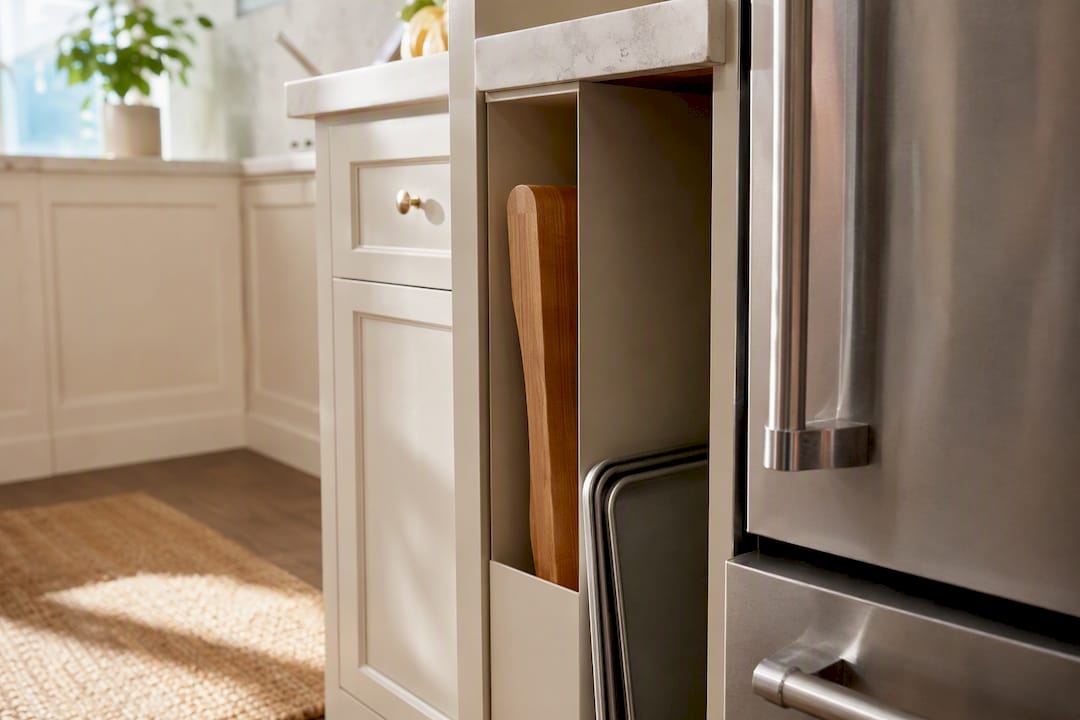
Portability matters more than most buyers think about until after the board arrives. A fixed-span board, especially a longer farmhouse-sized one, needs a flat storage spot: leaning it against a cabinet wall, sliding it into a vertical slot next to the fridge, or storing it flat under a stack of baking sheets are the common solutions.
Expandable boards collapse down for storage, which helps in tight kitchens, but the telescoping rails need to dry fully before you tuck the board away, or you’re inviting the corrosion risk mentioned earlier. Weight is worth checking too: a thick hardwood board built for a farmhouse sink can run heavy enough that lifting it in and out daily becomes its own small chore, while thinner composite boards stay light enough for one-handed placement. If storage space is already tight in your kitchen, our guide to sink organization ideas covers ways to carve out a dedicated slot for a board this size.
Why Fit Matters More Than Anything Else on the Spec Sheet
Our editorial position on this category is simple: fit and durability come before every other spec, including price and finish. A gorgeous bamboo board that rocks on your sink rim is worse than a plain plastic one that sits flush, every time.
Our recommendations lean toward boards with wide contact patches and minimal moving parts, because those two things predict long-term satisfaction better than material or brand. Cost matters too, but we’d rather see you spend slightly more on a board that fits correctly than save $10 on one you’ll return. Pair that mindset with our broader prep tool guides for a kitchen setup built around what actually works over years of daily use, not just what photographs well.
— K. Connors
Find the Right Sink Setup With Kitchen Devotion
This site is a practical starting point once you’ve measured your sink and know which board type fits, because curated pages skip straight to the options worth considering instead of an endless scroll of unfiltered listings.
If you’re still working out your sink type or considering a swap entirely, our Kitchen Sinks category covers single-bowl, double-bowl, farmhouse, and workstation styles with the fit details that matter for accessories like this one. Pairing a new board with better organization habits also pays off, so it’s worth a look at our kitchen prep tool recommendations for what belongs on your counter alongside it. And if this whole project has you rethinking your broader kitchen setup, our kitchen appliance priority list for new homeowners is a solid next stop for figuring out what to tackle next and in what order.
Sources
The measurement steps, material guidance, and sanitation rules in this guide draw on a handful of primary sources worth bookmarking if you want to dig deeper:
- Which is safer: wood vs plastic cutting boards? — NC State Extension
- Cutting boards — USDA Food Safety and Inspection Service
- How to measure for an over sink cutting board — ToolsPure
FAQ
What Is the Best Over-the-Sink Cutting Board?
There’s no single best model, since the right choice depends on your sink’s exact dimensions and your cleaning habits. An expandable bamboo board suits variable sink widths and doubles as a serving piece. A fixed plastic or composite board suits dishwasher convenience and raw meat prep.
What Is the Most Sanitary Type of Cutting Board?
Plastic boards are generally considered more sanitary for raw meat and poultry because they withstand high-temperature dishwasher sanitization, while wood boards remain suitable for produce and bread as long as you hand-wash them immediately after each use.
What Can I Put Above My Kitchen Sink?
An over the sink cutting board is the most common accessory, but many kitchens also add a drying rack, a small shelf for soap and sponges, or a colander insert that nests into the board itself for rinsing produce during prep.
What Do Japanese Cooks Traditionally Use for Cutting Boards?
Traditional Japanese kitchens commonly use hinoki (Japanese cypress) cutting boards, prized for their softness on knife edges and natural antibacterial properties, though these are hand-wash only boards rather than dishwasher-safe options.





No comment