
Measure your drawer’s interior before you buy anything. Shallow drawers under 3 inches deep need a flat tray; anything with 3.5 inches of clearance or more can handle a tiered insert with far more capacity. Group your spices by how often you actually cook with them, then label their tops. Grab a tape measure and a trash bag, and start with a purge and a measurement pass tonight.
TL;DR:
- Measure your drawer’s interior dimensions carefully, focusing on width, depth, and especially clearance height to determine the appropriate organizer type.
- Use flat trays for drawers under 3 inches deep and opt for tiered or vertical inserts only if your clearance exceeds 3.5 inches; test with a jar before buying.
- Square glass jars with airtight lids and top or front labels last longer, especially when labels are waterproof and labeled with refill dates.
- Keep frequently used spices at the front, group by cuisine or category, and regularly check for clumping, label fading, or jar rolling to maintain order.
- Avoid buying organizers without measuring first; substituting a simple flat tray can solve most shallow drawer needs instantly.
Table of Contents
- How Do You Measure a Spice Drawer for Organization?
- Flat, Vertical, or Hybrid: Which Spice Drawer System Fits You?
- What Containers and Labels Actually Hold Up Over Time?
- How Do You Set Up a Spice Drawer in One Afternoon?
- Why Do Spice Drawers Fall Apart After a Few Months?
- Why a Measurement-First Approach Beats Buying on Instinct
- An Editorial Take on Drawer-First Organizing
- Get Your Spice Drawer Set Up With the Right Kit
- Sources
- FAQ
How Do You Measure a Spice Drawer for Organization?
Interior width, front-to-back depth, and clearance height are the three numbers that decide everything else. Skip this step and you’ll end up returning whatever organizer you bought, which is the single most common mistake behind failed drawer setups, according to Pro Closet & Cabinetry.
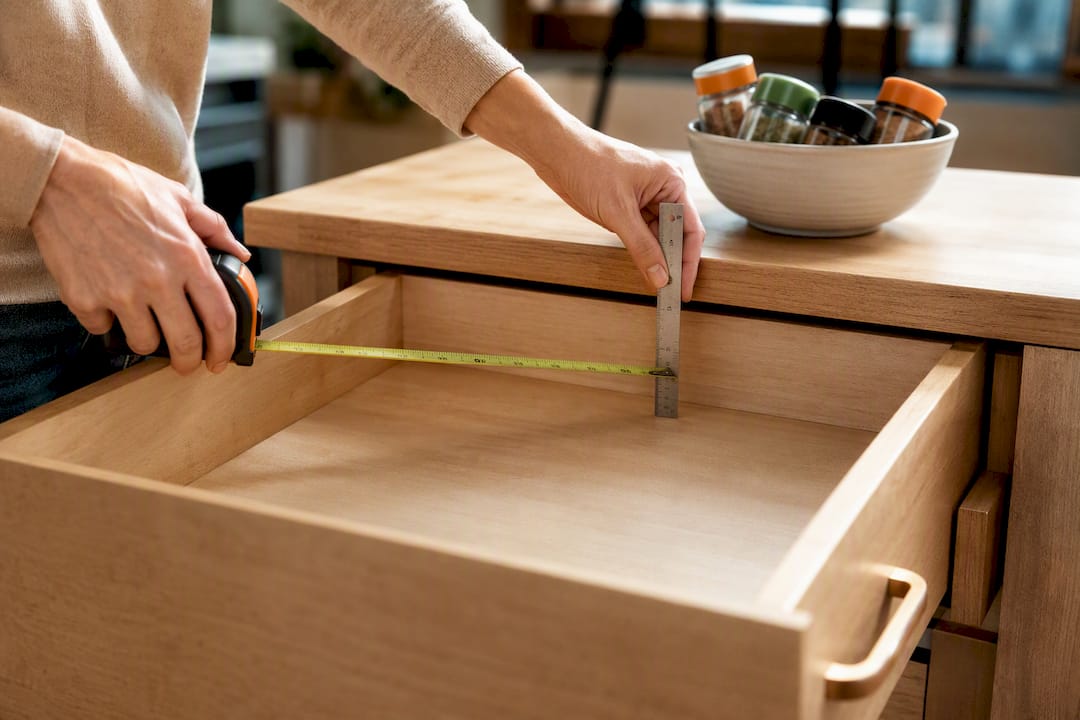
Width and depth are straightforward: measure the inside of the drawer box, not the outer cabinet frame. Height is where people get it wrong. You need the clearance from the drawer’s bottom to the underside of whatever sits above it, whether that’s a countertop overhang, a rail, or the drawer face itself when closed.
Once you have your numbers, these rules apply:
- Under 3.0 inches: Go flat. A low-profile tray is your only real option here.
- 3.0 to 3.5 inches: Measure twice. A slim, low-profile tiered tray might just fit, but a flat layout is the safer bet.
- 3.5 inches or more: Tiered and vertical inserts become realistic, giving you two or three visible rows instead of one.
Test before you commit. Set a dummy jar (or a stack of coins the same height as your tallest spice container) inside and close the drawer fully. Rails, hinges, and drawer stops eat into clearance in ways a tape measure alone won’t show you. A standard flat tray holds a moderate number of jars depending on jar diameter; a tiered insert of the same footprint can hold significantly more, since round jars waste more space than square ones.
Flat, Vertical, or Hybrid: Which Spice Drawer System Fits You?
The right system depends less on style and more on what your drawer will physically allow, plus how many spices you actually own.
Flat or angled trays work best in shallow drawers and install in minutes. You lose some capacity, capping out around 9 to 20 jars, but they’re the fastest fix for someone who just wants order by dinnertime. House Digest points out that a shallow drawer near your prep zone also does double duty protecting spices from heat and light, which matters more than most people realize.
Vertical or tiered inserts need at least 3.5 inches of clearance but reward you with far better visibility and capacity, often 24 to 48 jars in the same drawer footprint. The catch: they only work well when your jars are a consistent height. Mix a stubby cumin jar with a tall cinnamon stick jar and the tiers stop doing their job.
Hybrid setups split the difference. Keep a small flat tray up front for your daily drivers (salt, pepper, garlic powder, cumin) and a tiered insert further back or in a second drawer for the overflow. This is often the most realistic solution for anyone with more than 25 spices and only one drawer to spare.
If you don’t have a drawer that fits any of these, a narrow pull-out rack next to the range, a door-mounted rack on a pantry or cabinet door, or a countertop tray near the stove are reasonable fallbacks, though all three sacrifice the out-of-sight tidiness a drawer gives you.
Pro Tip: If you’re torn between flat and tiered, buy one tiered riser first and test it in the drawer for a week before committing to a full insert. It’s a $10 way to avoid a $40 mistake.
What Containers and Labels Actually Hold Up Over Time?
Square jars beat round ones in almost every drawer layout. They sit flush against each other, don’t roll when you slide the drawer open, and pack a noticeably larger number of jars into the same footprint than cylindrical containers do.
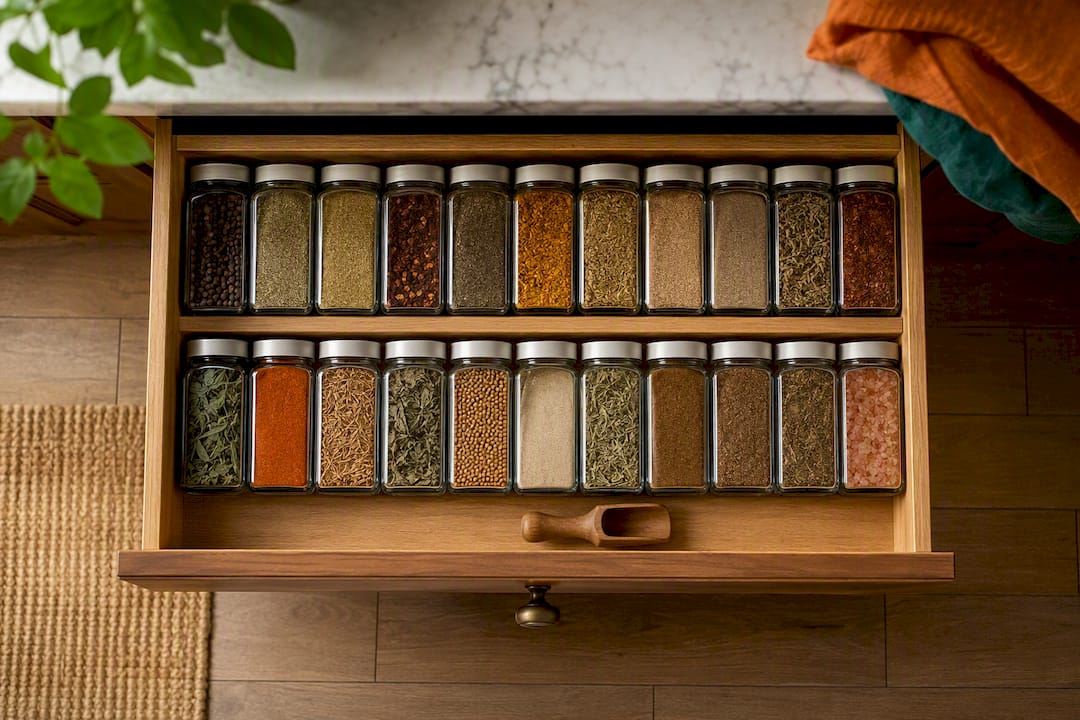
Glass containers with airtight lids protect flavor and aroma better than plastic over the long run, though plastic is lighter and won’t shatter if a jar tips during a fast drawer close. Savvy & Sorted recommends building your whole system around three components: a tiered acrylic tray, matching glass jars, and waterproof pre-printed labels, which together are what separates a system that lasts from one that falls apart in a few months.
Label placement depends entirely on how the jars sit in your drawer. The Kitchn recommends:
- Top/lid labels for flat trays and upright jars, since that’s the only surface visible when you look down into an open drawer.
- Front-face labels for angled tiered inserts, where the jar leans toward you and the lid is out of view.
- Waterproof, pre-printed labels over handwritten ones, since permanent marker ink fades or smears under normal kitchen humidity and handling.
One habit worth stealing: write the purchase or refill date somewhere on the label, then keep a spare sheet of blank labels tucked in a corner of the drawer for the next refill. It turns a one-time labeling project into a five-minute routine.
How Do You Set Up a Spice Drawer in One Afternoon?
- Empty the drawer and purge. Toss anything that’s clumped, faded, or lost its smell when you crush a pinch between your fingers. Ground spices lose potency around the one-year mark; whole spices last longer but still fade.
- Measure and record. Note width, depth, and interior height, then test with a trial jar and a full drawer close before you buy anything.
- Choose your system and decant. Pick flat, tiered, or hybrid based on your numbers, then transfer spices into uniform jars using a small funnel to avoid spills. Label each jar before it goes back in the drawer, not after.
- Load and arrange. Put your most-used spices in the front row, group the rest by category or cuisine behind them, and alphabetize within each group if it helps you find things faster. Close the drawer fully to confirm nothing catches.
Set a recurring 10 to 15 minute monthly check to refill low jars and scan for anything that’s drifted out of place. That single habit is what keeps the whole system from sliding back into chaos by month three. If you’re rethinking storage across the whole kitchen while you’re at it, this is a natural moment to look at drawer setup ideas for cleaner utensil access too.
Pro Tip: Decant everything before you label, not after. Labeling empty jars first means you’re guessing at spacing and often end up with crooked, mismatched labels once the jars are full.
Why Do Spice Drawers Fall Apart After a Few Months?
Most problems trace back to three things: rolling jars, faded labels, and heat exposure. A five-minute monthly audit fixes most of it. Sniff a few jars, top off anything low, check that labels are still legible, and toss anything that’s gone flat or clumped.
- Rolling jars: Add dividers between rows or switch round jars for square ones, and put a thin non-slip liner under any tray that shifts when the drawer opens.
- Heat and steam damage: Keep the spice drawer away from the space directly above or beside the stove, and away from the dishwasher’s exhaust vent if your layout puts a drawer nearby.
- Outgrown systems: Re-measure and adjust whenever you buy jars with a different lid height, add a new cuisine’s worth of spices, or move your main prep zone to a different part of the kitchen.
Why a Measurement-First Approach Beats Buying on Instinct
K. Connors has walked through this exact problem with home cooks who bought a beautiful tiered organizer only to find it wouldn’t clear the drawer above it by half an inch. That’s the failure mode Kitchendevotion’s guides are built to prevent: pick the space first, then the containers, not the other way around.
The measurement-first principle exists because returns are expensive and annoying, and a wrong-sized insert usually means starting over. One reader’s shallow rental-kitchen drawer, barely 2.5 inches deep, got fixed in twenty minutes with a $15 flat tray and nothing fancier. A different reader with an island prep drawer and nearly 4 inches of clearance went tiered and cut her cooking prep time noticeably just by seeing every jar at a glance instead of digging.
An Editorial Take on Drawer-First Organizing
Most spice organization content treats this as a decor project: matching jars, chalkboard labels, color-coded rows for the camera. That’s backwards. The system that survives real cooking is the one built around your drawer’s actual clearance, not around what looked good in someone else’s kitchen photo.
The conventional advice oversells vertical tiered racks as the universal answer. They’re genuinely great, but only if your drawer clears 3.5 inches and your jars are close to uniform height. Push a tiered insert into a 3.1 inch drawer and you’ll spend six months fighting a drawer that won’t close flush.
If you take one thing from this guide, measure before you shop, and buy the boring flat tray if that’s what your drawer actually demands. A tidy shallow drawer beats a jammed fancy one every time. Grouping by frequency of use, not alphabetically first, also matters more than most guides admit: your oregano and garlic powder should never be buried behind spices you use twice a year.
— K. Connors
Get Your Spice Drawer Set Up With the Right Kit
This site offers matching jar sets, waterproof label kits, and tiered or flat drawer inserts designed to fit measurement-based clearance rules, helping buyers select organizers that match their drawer dimensions.

Once you’ve measured your drawer, browsing organization solutions and matching accessories on the cookware sets and general kitchen category pages takes about ten minutes, and most of these kits ship and assemble in an afternoon, the same one-session timeline this whole guide is built around. If your drawer situation is tighter than you’d like, a partner service like One Day Doors & Closets can install custom cabinetry organization when a stock insert just won’t fit. Start with your tape measure, then head to Kitchendevotion to find the jars and inserts that match the numbers you just took.
Sources
- House Digest — kitchen cabinet storage mistake: spices lose flavor
- The Kitchn — Label the tops of spice jars for better drawer organization
- Pro Closet & Cabinetry — Spice drawer organizer ideas for built-in kitchens
- Savvy & Sorted — How to organize your spice drawer
FAQ
What Is the Best Way to Organize a Spice Drawer?
Measure the interior width, depth, and clearance height first, then choose a flat tray for shallow drawers or a tiered insert for 3.5 inches or more of clearance, decant into uniform jars, and label the tops.
What Is the Best Spice Drawer Organizer?
The best organizer is whichever one matches your measured clearance: a low-profile flat tray under 3 inches, or a tiered acrylic insert above 3.5 inches, paired with square glass jars and waterproof labels.
What Are the Dimensions of a Standard Spice Drawer Organizer?
There’s no single standard size since drawers vary by cabinet brand, but the key threshold is interior clearance height: under 3 inches calls for a flat tray, while 3.5 inches or more allows for tiered designs.
What Should Every Spice Rack Have?
A functional spice rack needs uniform, airtight containers (square jars work best), legible top or front-facing labels, and a layout that puts your most-used spices in the front row for quick access.




No comment