
A kitchen scale is a precision measuring device that reads the weight of food ingredients in grams, ounces, or pounds, giving you exact measurements every time you cook. Volume tools like measuring cups and spoons introduce error because they depend on how tightly you pack an ingredient. A kitchen scale removes that variable entirely. Models like the OXO Good Grips and Escali Primo have made accurate home weighing affordable and simple, with most quality options priced between $20 and $30. Whether you bake bread every weekend or just want your recipes to turn out right the first time, a kitchen scale is one of the most reliable tools you can add to your kitchen.
What is a kitchen scale, and what types are available?
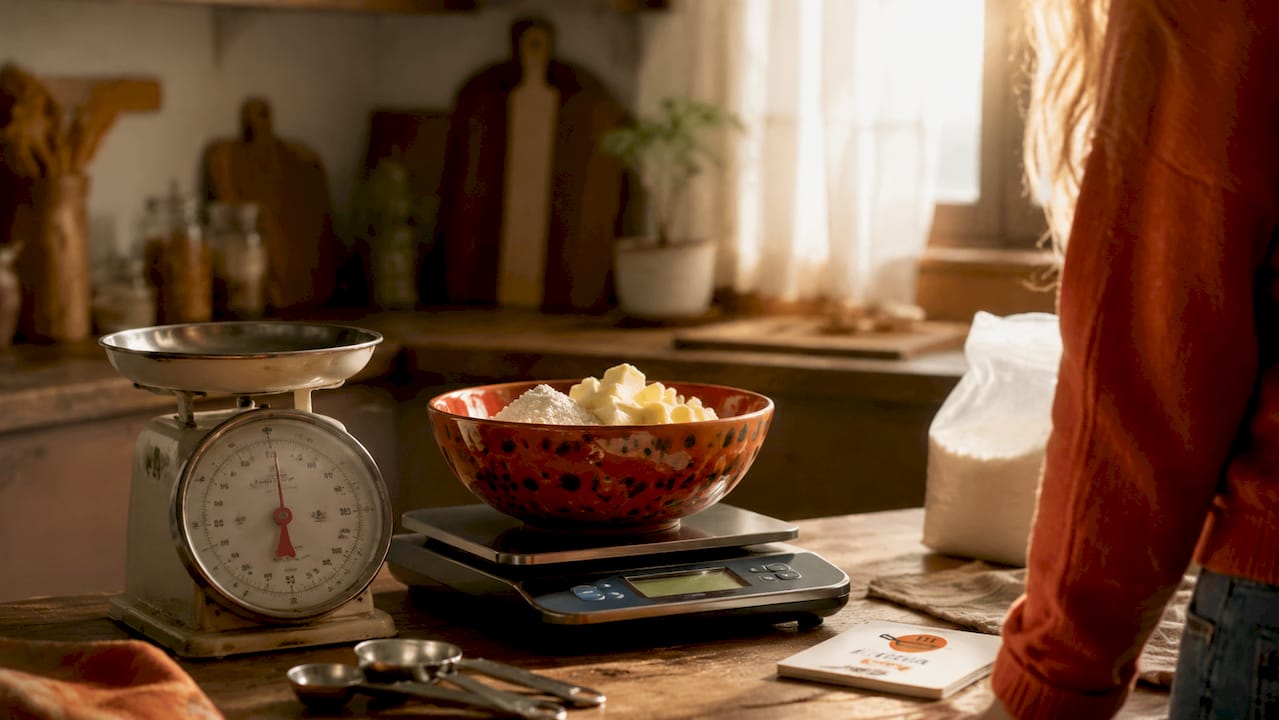
A kitchen scale is any device that measures the mass of food, and the two main categories are digital and analog. Digital scales display a number on an electronic screen. Analog scales use a spring mechanism and a dial. The difference matters more than most home cooks realize.
Digital vs. analog kitchen scale
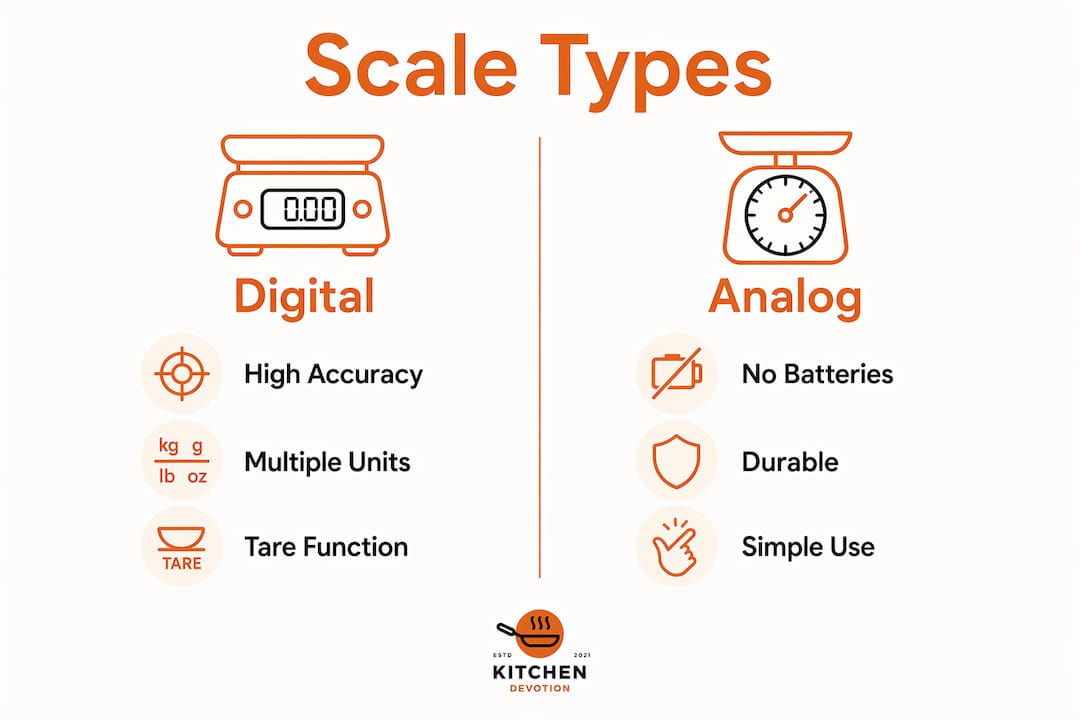
Digital scales win on accuracy. They measure between 5 kg and 11 kg and offer precision at either 0.1 g or 1 g increments. That precision gap is significant. A 0.1 g scale is the right choice for spices, yeast, or baking powder where a small difference changes the result. A 1 g scale works fine for portioning meat or measuring pasta.
Analog scales have no batteries to replace and no screen to crack. They are durable and simple. The tradeoff is that their dial markings are harder to read accurately, and they rarely offer the fine precision that baking demands.
Beyond the basic digital vs. analog split, specialty options exist. Waterproof scales handle splashes without damage. Smart scales connect to apps like Yummly or MyFitnessPal via Bluetooth, logging nutritional data automatically. These are useful for meal preppers tracking macros, though they cost more than a standard model.
| Scale type | Best use | Precision | Price range |
|---|---|---|---|
| Digital (standard) | Baking, general cooking | 0.1 g or 1 g | $20–$30 |
| Analog | Casual portioning | 1–5 g | $10–$20 |
| Waterproof digital | Wet kitchens, liquids | 0.1 g or 1 g | $25–$50 |
| Smart (app-connected) | Macro tracking, meal prep | 0.1 g | $40–$80 |
The three features no digital scale should be without are a tare function, multiple unit switching, and long battery life. These three features separate a genuinely useful scale from a frustrating one. Lithium batteries outlast alkaline in scales, so check what your model requires before you buy.
Pro Tip: Display resolution and accuracy are not the same thing. A scale showing 0.1 g increments may still carry a meaningful error tolerance. Always check the manufacturer’s stated accuracy spec, not just the resolution.
How do you use a kitchen scale effectively?
Using a kitchen scale correctly takes about two minutes to learn and saves hours of inconsistent results. The process is the same whether you are baking sourdough or portioning chicken thighs.
- Place your bowl or container on the scale. Turn the scale on first, then set the container down. Some scales auto-calibrate on startup, so the order matters.
- Press the tare button. Tare zeroes out the container’s weight so only the ingredient registers. This is the single most useful function on any scale. Top culinary schools point to tare as the primary reason scales reduce dirty dishes. You can add multiple ingredients to the same bowl, taring between each one.
- Select your unit. Most digital scales switch between grams, ounces, pounds, and milliliters. Choose the unit your recipe uses. Switching mid-recipe is easy with the unit button.
- Add your ingredient slowly. Pour or spoon the ingredient in until the display hits your target weight. Stop before you overshoot. With volume cups, overshooting means starting over. With a scale, you just remove a little.
- Record or proceed. For complex recipes, note each weight as you go. This makes scaling a recipe up or down much easier next time.
Measuring liquids on a scale
Digital scales measure liquids in milliliters, and the math is straightforward: 1 ml of water equals 1 g. Switch your scale to liquid mode, tare your measuring cup or bowl, and pour. This works for water, milk, and most thin liquids. Oils and thick liquids like honey have different densities, so check a conversion reference for those.
Weighing eggs, spices, and small quantities
Eggs are a common recipe variable. A standard large egg without the shell weighs about 50 g. Knowing this lets you scale recipes accurately when a recipe calls for “3 eggs” but you only have medium or extra-large eggs on hand. For spices, use a 0.1 g scale. One gram of cayenne versus two grams is a meaningful difference in heat level.
Pro Tip: For spices under 1 g, tare a small piece of parchment paper on the scale. Spoon the spice onto the paper. The paper prevents residue from sticking to the platform and makes cleanup instant.
Baking benefits most from a scale. Flour is the clearest example, and the next section explains exactly why.
Why are kitchen scales better than measuring cups?
Weight measurement beats volume measurement because it removes human error from the equation. The problem with cups is physical: the same cup can hold very different amounts depending on how you fill it.
One cup of flour varies between 120 g and 150 g depending on whether you scooped it, spooned it, or sifted it first. That 30 g swing is a 25% difference. In bread baking, that gap produces a dense loaf versus a light one. Weight locks the number down every time.
| Ingredient | Volume measure | Weight range | Variation |
|---|---|---|---|
| All-purpose flour | 1 cup | 120 g–150 g | Up to 25% |
| Brown sugar | 1 cup packed | 180 g–220 g | Up to 22% |
| Rolled oats | 1 cup | 80 g–100 g | Up to 20% |
| Cocoa powder | 1 cup | 85 g–120 g | Up to 41% |
The variation in cocoa powder is striking. A recipe that calls for one cup of cocoa could receive nearly half again as much as intended, making the result far more bitter than planned.
“Weighing ingredients is the single most reliable way to replicate a recipe result. Professional kitchens do not use volume measures for this reason.”
Scales also speed up prep. Using the tare function means you measure every ingredient into one bowl without washing a cup between each addition. Fewer tools, faster cleanup, and better results are not a tradeoff. You get all three.
A common misconception is that scales are only for baking. Portioning protein for meal prep, dividing dough evenly, and measuring coffee grounds for a consistent brew all benefit from a scale. The benefits of kitchen scales extend to nearly every cooking task that requires consistency.
How do you maintain and calibrate a kitchen scale?
Calibration is the process of verifying that your scale reads accurately and correcting it if it does not. Calibration is a simple maintenance step, not a technical repair. Most home cooks never do it, which is why their scale drifts over time without them noticing.
The easiest accuracy check uses a US nickel. One nickel weighs exactly 5 g. Place it on your scale and check the reading. If the display shows anything other than 5.0 g, your scale needs recalibration or replacement. This test takes ten seconds and costs nothing.
Common maintenance mistakes to avoid:
- Submerging the scale in water. Moisture inside the housing permanently damages the circuit board. Clean with a lightly damp cloth only.
- Leaving batteries in a stored scale. Battery leakage corrodes the contacts. Remove batteries if you store the scale for more than a few weeks.
- Placing the scale on an uneven surface. An unlevel surface throws off readings. Always use the scale on a flat, stable counter.
- Ignoring the auto-off function. Most scales shut off after 60–90 seconds of inactivity. If yours turns off mid-recipe, look for a model with an adjustable auto-off setting.
Pro Tip: The terms “food scale” and “kitchen scale” are used interchangeably and refer to the same product category. Do not let different labeling confuse your buying decision. Focus on capacity and precision instead.
One more storage tip: keep the scale in a drawer or cabinet away from heat sources. Prolonged exposure to oven heat warps the platform and affects sensor accuracy. A common kitchen tool mistake is storing the scale on top of the stove for convenience, which shortens its lifespan significantly.
Key takeaways
A kitchen scale is the single most reliable tool for consistent cooking results because it replaces variable volume measures with fixed weight readings.
| Point | Details |
|---|---|
| Weight beats volume | One cup of flour varies by up to 25% depending on how it is packed; weight does not vary. |
| Tare function is critical | Tare lets you measure multiple ingredients in one bowl, cutting cleanup time significantly. |
| Digital outperforms analog | Digital scales offer 0.1 g precision and unit switching that analog models cannot match. |
| Calibrate with a nickel | A US nickel weighs exactly 5 g; use it to verify your scale’s accuracy in seconds. |
| Clean carefully | Never submerge a digital scale; wipe with a lightly damp cloth to avoid circuit damage. |
The tool I wish I had started using sooner
I spent years treating measuring cups as good enough. My biscuits were inconsistent, my bread was unpredictable, and I blamed the recipes. The problem was never the recipe.
The first time I weighed flour instead of scooping it, the difference was immediate. The dough felt right. The bake came out exactly as described. That result was not luck. It was what happens when you remove the biggest variable in home baking.
What I see most often with home cooks who are new to scales is hesitation around the tare button. They weigh each ingredient separately and then add them together, which defeats half the purpose. Tare between each ingredient, keep everything in one bowl, and you will cut your prep time noticeably.
My other observation: people buy a scale with 0.1 g resolution and assume it is accurate to 0.1 g. Display resolution and actual accuracy are different things. Read the spec sheet before you buy. For most home cooking, a quality scale in the $20–$30 range performs better than a cheap $10 model with impressive-sounding specs.
If you are just starting out, look at the best tools for baking at home before you commit to a model. Matching the scale to your actual cooking habits matters more than chasing the highest resolution number.
— K. Connors
Kitchendevotion’s picks for kitchen prep tools
Kitchendevotion curates kitchen tools with home cooks in mind, and kitchen scales sit near the top of every prep tool list for good reason. A reliable scale pairs naturally with the other time-saving tools that make weeknight cooking faster and less stressful.
The time-saving kitchen appliances list at Kitchendevotion includes scales alongside tools that work together to cut prep time and reduce cleanup. Each recommendation is chosen for real-world usability, not just spec sheet performance. If you want a curated starting point rather than hours of research, that list is the right place to begin.
FAQ
What does a kitchen scale measure?
A kitchen scale measures the weight or mass of food ingredients, typically in grams, ounces, or pounds. Digital models also measure liquids in milliliters, where 1 ml of water equals 1 g.
How accurate are kitchen scales for home use?
Most quality home digital scales are accurate to within 1 g, and models with 0.1 g resolution are accurate enough for spices and small baking quantities. Display resolution and actual accuracy differ, so check the manufacturer’s stated tolerance before buying.
Do I need a kitchen scale for baking?
A scale is the most reliable tool for baking because volume measures like cups vary by up to 25% depending on how you fill them. Weight measurements are consistent every time, which directly improves baking results.
What is the tare function on a kitchen scale?
The tare function zeroes out the weight of a container so only the ingredient registers on the display. This lets you measure multiple ingredients into one bowl without doing any math between additions.
How do I know if my kitchen scale is accurate?
Place a US nickel on the scale. It weighs exactly 5 g. If your scale reads anything other than 5.0 g, it needs recalibration or replacement.




No comment