

A typical modern refrigerator uses roughly 300–600 kWh per year. At the national average residential rate of about $0.16/kWh, that works out to around $48–$96 annually. An older unit from the 1990s can easily triple that. Here’s what to check right now:
- Modern ENERGY STAR fridge (2015+): Uses a few hundred kWh per year, costing a moderate amount annually.
- Average fridge (2000–2014): Uses more energy than newer models, leading to somewhat higher operating costs.
- Pre-2000 unit: Older refrigerators often use considerably more energy.
- Running wattage while the compressor cycles: Typically varies widely; peak wattage differs from average usage.
- Best next step: Find the yellow EnergyGuide label on your fridge door jamb, note the annual kWh, and multiply by your utility rate from your electric bill
Key Takeaways
A refrigerator using 300–500 kWh/year at $0.16/kWh costs roughly $48–$80 annually, while a pre-2000 unit using 800–1,500 kWh/year can cost $128–$240 or more, making the EnergyGuide label your fastest tool for knowing where you stand.
| Point | Details |
|---|---|
| Check the EnergyGuide label first | Multiply the annual kWh by your utility rate for an accurate monthly cost estimate. |
| Measure if the label is missing | A plug-in watt meter run for 48–72 hours gives reliable real-world consumption data. |
| Clean coils and fix gaskets now | These two free or low-cost fixes can recover 10–20% of lost efficiency on any fridge. |
| Replace units older than 15 years | Swapping a pre-2000 fridge for an ENERGY STAR model can cut annual kWh by 800 or more. |
| Kitchendevotion buying guides | Use Kitchendevotion’s refrigerator guides and size selector to find an efficient replacement. |
Table of Contents
- How does refrigerator energy use translate from watts to kWh?
- Three ways to calculate your fridge’s actual kWh and cost
- What does typical annual kWh look like by fridge type and age?
- What actually raises or lowers a refrigerator’s power consumption?
- How to measure real-world consumption correctly
- What do the EnergyGuide label, ENERGY STAR, and DOE standards actually tell you?
- Prioritized actions to cut refrigerator energy use
- Can a refrigerator run on solar power?
- When does replacing your refrigerator actually make financial sense?
- Ready to find a more efficient refrigerator?
- Sources
- FAQ
How does refrigerator energy use translate from watts to kWh?
Watts measure the rate of power draw at any instant. Kilowatt-hours measure how much energy is actually consumed over time. The conversion is straightforward:
Watts ÷ 1,000 = kilowatts (kW)
kW × hours of operation = kWh
The catch is that a refrigerator doesn’t run at full wattage continuously. The compressor cycles on and off, typically running 30–50% of the time depending on ambient temperature and how often you open the door. That cycling fraction is called the duty cycle.
Worked example A (measured average wattage): A plug-in meter might show an average draw that can be converted to daily and annual kWh use.
Worked example B (nameplate wattage with duty cycle): Using nameplate wattage combined with an estimated duty cycle can approximate average energy use, though actual usage varies widely by model and conditions.
Nameplate wattage is the compressor’s peak draw, not its average. Using it without a duty-cycle correction overstates real consumption significantly.
Key figure: EIA residential electricity data shows the average U.S. household pays roughly $0.16/kWh, but rates range from under $0.10 in Louisiana to over $0.30 in Hawaii. Always use your own bill.
Pro Tip: The annual kWh printed on the yellow EnergyGuide label already accounts for the duty cycle and is tested under standardized conditions. When that number is available, use it instead of nameplate math.
Three ways to calculate your fridge’s actual kWh and cost
You don’t need special software. Pick whichever method matches what you have on hand.
-
Use the EnergyGuide label. Find the yellow label on the door jamb or inside the kickplate. It shows an estimated annual kWh. Multiply that number by your utility’s $/kWh rate (found on your monthly electric bill) and divide by 12 for a monthly cost. Example: 450 kWh/year × $0.16/kWh = $72/year, or $6/month. Using the EnergyGuide label with your actual utility rate gives a more accurate estimate than any national average.
-
Measure with a plug-in watt meter. Plug a device like a Kill A Watt meter between the fridge and the outlet. Let it run for at least 24 hours; 48–72 hours is better because it captures multiple compressor cycles and a defrost cycle. Read the cumulative kWh display, divide by the number of days measured, and multiply by 365 for an annual figure. Then multiply by your $/kWh rate for cost.
-
Cross-check with RECS household averages. If you can’t measure directly and the label is missing, RECS data from the EIA provides household-level end-use consumption estimates by region and housing type. These are modeling-derived averages, not your specific unit, but they give a reasonable sanity check.
Pro Tip: Your utility bill shows your exact $/kWh rate, often listed as “energy charge” or “rate per kWh.” National averages can be off by 50% or more depending on your state. Plug in your real number.
ENERGY STAR also offers a Flip Your Fridge calculator that estimates annual savings from replacing an older unit and can connect you with local utility rebates.
What does typical annual kWh look like by fridge type and age?
The ranges below reflect field-metered studies, DOE rulemaking analysis, and RECS-derived modeling. Your actual number depends on size, location, and usage habits.

| Fridge type / age | Typical annual kWh | Notes |
|---|---|---|
| Mini/compact (under 5 cu ft) | 100–150 kWh | Varies widely by insulation quality |
| Top-freezer, modern (2015+) | 300–450 kWh | Most efficient full-size configuration |
| Top-freezer, 2000–2014 | 450 kWh | Still reasonable; check the label |
| French-door / bottom-freezer | 400–600 kWh | Larger volume; ENERGY STAR models stay low |
| Side-by-side | 500 kWh | Through-door ice/water adds 100–150 kWh |
| Large built-in (24+ cu ft) | 600 kWh | Size drives consumption more than style |
| Pre-2000 unit (any type) | 800–1,500+ kWh | Compressor tech and insulation were far less efficient |
| Secondary garage fridge (older) | 1,000–1,500 kWh | Hot ambient temps in summer dramatically raise use |
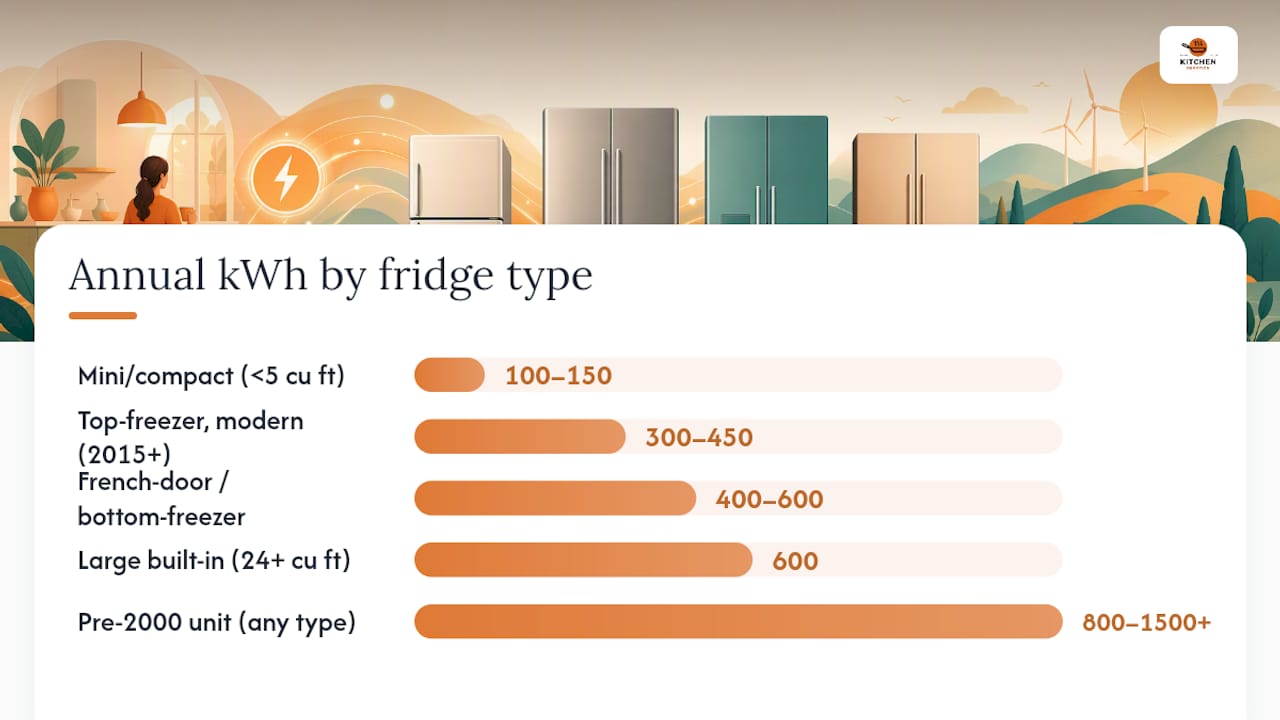
Field-metered data and DOE/RECS modeling consistently show that a 1990s unit can use 1,000–1,500 kWh/year while a current ENERGY STAR model often runs 300–500 kWh/year. That gap produces real savings at any U.S. electricity rate.
ENERGY STAR-certified models sit toward the low end of each range above. ENERGY STAR recommends refrigerators sized in a moderate cubic feet range as optimal for balancing capacity and energy efficiency in many households.
What actually raises or lowers a refrigerator’s power consumption?
Several factors push consumption up or pull it down, and most are within your control.
- Size and volume: A larger interior requires more cooling work. Every additional cubic foot adds to the baseline load.
- Ambient temperature: A fridge in a 90°F garage works far harder than one in a 70°F kitchen. The compressor runs longer and more frequently.
- Door-open frequency and duration: Each opening floods the interior with warm air. Frequent or long openings force the compressor to recover.
- Door gasket condition: A worn or cracked gasket leaks cold air continuously, even when the door is closed. Run your hand along the seal; you’ll feel the draft.
- Condenser coil cleanliness: Dusty coils on the back or bottom of the unit trap heat and force the compressor to work harder. Energy.gov recommends cleaning coils at least once a year.
- Defrost method: Manual-defrost models use less energy than automatic-defrost units, but only if you actually defrost them before frost builds up significantly.
- Ice maker and through-door dispenser: These features add roughly 100–150 kWh/year to a side-by-side or French-door unit.
- Compressor type: Inverter (variable-speed) compressors run continuously at low power rather than cycling on and off at full power. This approach reduces compressor energy compared to fixed-speed designs, though the exact savings vary by model and conditions.
Quick household tests:
- Gasket test: Close the door on a dollar bill. If it slides out easily, the seal is failing.
- Coil check: Pull the fridge out and look at the back or remove the kickplate. Dusty coils are visible immediately.
- Thermostat check: Place a thermometer in a glass of water in the center of the fridge compartment for 8 hours. It should read 35–38°F.
Pro Tip: Setting your fridge colder than necessary does not improve food safety but increases energy use. Keeping the temperature at or below common food safety recommendations balances safety and efficiency.
How to measure real-world consumption correctly
Short measurements mislead. A 10-minute reading catches the compressor mid-cycle and gives you either peak draw or near-zero draw, neither of which reflects average consumption.
Recommended tools:
- Plug-in watt meter (Kill A Watt, Poniie PN1500): Inexpensive, accurate, and purpose-built for this. Shows cumulative kWh over the measurement period.
- Smart plugs with energy monitoring (Kasa EP25, Emporia Vue): Convenient for long-term tracking and remote reading, but verify the plug’s amperage rating before using it with a large compressor.
- Whole-home energy monitors (Emporia Energy, Sense): Capture all circuits simultaneously and can isolate the fridge’s circuit over weeks. More expensive but useful for a full household energy audit.
Measurement duration: 24 hours is the minimum. 48–72 hours captures at least one automatic defrost cycle, which adds a short burst of heater energy. A full week gives the most reliable average.
Safety notes: Never plug a refrigerator into a GFCI outlet for measurement purposes if the compressor’s startup surge trips the GFCI. Don’t use a smart plug rated below 15 amps with a large compressor. Startup surge can reach 3–5 times running wattage for a fraction of a second.
Interpreting the readings: Wattage will fluctuate between near-zero (compressor off) and 100–400 watts (compressor running). Ignore the peaks and valleys. The cumulative kWh reading divided by elapsed hours gives the true average draw, which is the number that matters for cost calculations.
Pro Tip: Run the measurement during a typical week, not during a holiday when the door opens constantly or when the house is unusually hot. Atypical conditions produce atypical numbers.
What do the EnergyGuide label, ENERGY STAR, and DOE standards actually tell you?
These three sources work together, and each answers a different question.
The yellow EnergyGuide label is issued under FTC rules and appears on every new refrigerator sold in the U.S. It shows the model’s estimated annual kWh under standardized test conditions and places that number on a scale showing the range for similar-sized models. The label also shows an estimated annual operating cost using a national average electricity rate. Replace that national rate with your own $/kWh for a more accurate figure.
ENERGY STAR certification means the model uses at least 9% less energy than the federal minimum standard. The ENERGY STAR Most Efficient designation goes further, recognizing models that significantly exceed the standard in a given year. ENERGY STAR also runs a rebate finder that connects buyers with utility incentives, which can offset purchase cost meaningfully.
DOE efficiency standards set the legal maximum annual energy consumption for each product class, calculated using equations that account for adjusted volume and configuration. The DOE’s amended conservation standards mean that even the least efficient new refrigerator on the market today must meet a minimum that would have been considered efficient a decade ago. ENERGY STAR Version 5.0 builds on those DOE baselines with its own AEC (annual energy consumption) formulas and qualification criteria by product class.
Where to find the label: On the unit itself (door jamb or inside the kickplate), on the manufacturer’s website by model number, or through the ENERGY STAR product database.
Prioritized actions to cut refrigerator energy use
Start with the free fixes. They often recover more efficiency than people expect.
- Set the right temperatures. Fridge at 35–38°F, freezer at 0°F. Every degree colder than necessary adds to the compressor load.
- Clean the condenser coils. Dusty coils are one of the most common causes of elevated consumption. Vacuum or brush them annually.
- Check and replace door gaskets. A failing gasket leaks cold air 24 hours a day. Replacement gaskets for most models cost $20–$50 and take under an hour to install.
- Limit door openings. Know what you want before you open the door. This sounds trivial but makes a measurable difference in households with frequent snackers.
- Move the fridge away from heat sources. Keep at least 2 inches of clearance on the sides and back, and don’t place it next to the oven or in direct sunlight.
- Enable adaptive defrost if your model has it. This feature runs defrost cycles only when needed rather than on a fixed timer, reducing heater energy.
- Replace a unit that’s 15+ years old. Gasket and coil cleaning can recover 10–20% of lost efficiency on a well-maintained unit. But a 1990s fridge using 1,200 kWh/year replaced by a 400 kWh/year ENERGY STAR model saves roughly 800 kWh/year, or about $128 at $0.16/kWh. The payback on a mid-range replacement is often 3–5 years, faster with a utility rebate.
Savings callout: Replacing older refrigerators with current ENERGY STAR models typically results in significant annual energy savings, varying by original unit size and condition.
Kitchendevotion’s maintenance guide walks through coil cleaning, gasket replacement, and temperature calibration in detail if you want step-by-step instructions.
Can a refrigerator run on solar power?
Yes, but sizing matters. A fridge drawing 450 kWh/year uses about 1.23 kWh/day on average.
Quick sizing example: At 4.5 peak sun hours per day (a reasonable average for much of the U.S.), a 300-watt solar panel produces roughly 1.35 kWh/day under ideal conditions. One panel covers a modern efficient fridge in theory, but real-world losses from wiring, inverter efficiency, and cloudy days mean two panels is a more practical minimum. For overnight and cloudy-day coverage, you’d need roughly 100–150 amp-hours of battery storage at 12V (or equivalent in a 24V or 48V system).
Critical warnings:
- Compressor startup surge can reach 3–5 times running wattage. Size your inverter’s surge rating to handle it, not just the continuous draw.
- A modified-sine-wave inverter can damage some modern compressors. Use a pure-sine-wave inverter.
- Seasonal solar variability in northern states means a system sized for summer may fall short in December.
A top-freezer ENERGY STAR model is the best choice for an off-grid or solar setup because it draws the least power of any full-size configuration. For budget and off-grid options, Kitchendevotion’s off-grid fridge guide covers compact and efficient alternatives worth considering.
Pro Tip: Size your solar system for your fridge’s actual measured kWh, not the nameplate wattage. The difference can mean buying one panel instead of three.
When does replacing your refrigerator actually make financial sense?
The repair-versus-replace question has a practical answer. If a repair costs more than half the price of a comparable new unit, and the fridge is already 10–12 years old, replacement almost always wins financially. A new ENERGY STAR model not only fixes the immediate problem but also cuts annual electricity costs by $50–$130 or more compared to an aging unit, and many utilities offer rebates that reduce the upfront cost further.
The trickier call is a fridge that still runs fine but is 15–20 years old. The math usually favors replacement even without a breakdown, because the energy savings alone often pay back the cost difference within a few years. Check the EnergyGuide label on your current unit, compare it to a new ENERGY STAR model of similar size, and run the numbers with your actual electricity rate.
Kitchendevotion’s refrigerator buying guides and size and style selector can help you narrow down the right replacement without wading through hundreds of specs.
Ready to find a more efficient refrigerator?
If the numbers in this article convinced you that your current fridge is costing more than it should, the next step is finding a replacement that fits your kitchen and your budget.

Kitchendevotion curates energy-efficient refrigerators and full appliance guides specifically for homeowners who want clear, practical buying help without the spec-sheet overload. Whether you’re replacing a 20-year-old unit or outfitting a new kitchen from scratch, the Kitchen Appliance Priority List for New Homeowners is a good place to start. It walks through which appliances to prioritize, what to look for in an energy-efficient fridge, and how to make the most of available rebates. Browse the full refrigerator selection and buying guides at Kitchendevotion to find a model that matches your household’s size, layout, and efficiency goals.
Sources
ENERGY STAR Refrigerators — Model-level efficiency data, certification criteria, and a rebate finder for qualifying purchases.
DOE Energy Conservation Standards for Refrigerators (final rule) — Federal maximum annual energy use equations by product class and projected consumer savings from stricter standards.
EIA Residential Energy Consumption Survey (RECS) — Household-level end-use consumption estimates and modeling data for refrigerators across U.S. regions.
Energy Saver: Purchasing and Maintaining Refrigerators and Freezers — Practical guidance on temperature settings, coil cleaning, and label interpretation from the U.S. Department of Energy.
ENERGY STAR Version 5.0 Specification — AEC formulas, qualification criteria, and test methods for residential refrigerators and freezers.
- Energy Conservation Program: Energy Conservation Standards for Refrigerators, Refrigerator-Freezers, and Freezers (DOE final rule PDF)
- How Much Electricity Does My Refrigerator Use? | Direct Energy
- ENERGY STAR Final Version 5.0 Residential Refrigerators and Freezers Specification
FAQ
How much does it cost to run a refrigerator for 24 hours?
A modern ENERGY STAR fridge uses moderate energy costing tens of cents per day at typical residential rates, while an older unit may cost several times as much due to higher power draw.
Do refrigerators use a lot of electricity?
They use a moderate but continuous amount. A typical modern fridge accounts for roughly 300–500 kWh/year, making it one of the larger single-appliance loads in most homes, though it’s usually surpassed by HVAC and water heating.
What appliance is the biggest energy waster in most homes?
Heating and cooling systems consume the most energy overall, but among kitchen appliances, an old refrigerator is typically the biggest waster because it runs 24 hours a day. A pre-2000 unit can use three to four times more electricity than a current ENERGY STAR model of the same size.
How much electricity does a 20-year-old refrigerator use per year?
A refrigerator manufactured before 2000 commonly uses 800–1,500 kWh/year depending on size and configuration, compared to 300–500 kWh/year for a current ENERGY STAR model. Field-metered data and RECS modeling consistently show this vintage gap.
Where do I find the annual kWh for my specific refrigerator model?
Check the yellow EnergyGuide label on the door jamb or kickplate. If the label is missing, search the model number on the manufacturer’s website or the ENERGY STAR product database at energystar.gov.





No comment