

A panel-ready dishwasher is a built-in unit with a blank front designed to accept a custom cabinet panel, so it disappears into your cabinetry instead of standing out as an appliance. The main trade-off is coordination: you’re now managing panel fabrication, hardware alignment, and often hidden controls, not just picking a finish off a shelf. What follows covers the types, the buying checklist, and where this design choice pays off versus where it just adds cost.
TL;DR:
- Panel-ready dishwashers are ideal for full kitchen renovations aiming for seamless cabinetry, with custom panels that match existing cabinet styles and finishes.
- They require precise measurements, control placement decisions, and alignment efforts during installation to ensure a flush fit and proper functionality.
- Costs increase significantly when accounting for custom panels and hardware, which are separate from the appliance price, making them less suitable for quick or budget-oriented swaps.
- Fully integrated models hide controls inside the door for maximum concealment, while semi-integrated models keep a visible control strip accessible for easier daily operation.
- Material choice and panel mounting considerations are critical for long-term durability, with homeowners able to fix minor alignment issues using simple tools.
Table of Contents
- Panel Ready Dishwasher At A Glance
- What Is A Panel Ready Dishwasher, Exactly?
- Fully Integrated, Semi-Integrated, And Where Panel-Ready Fits
- How Panel Customization Actually Works
- Weighing The Pros And Cons
- What To Check Before You Buy
- How Installation Actually Goes
- Fixing Alignment Issues And Long-Term Upkeep
- Kitchen Devotion’s Take On Choosing Panel-Ready
- Where To Go Next For Your Dishwasher Decision
- Sources
- FAQ
Panel Ready Dishwasher At A Glance
This style makes the most sense for design-driven remodels where cabinetry runs are meant to look uninterrupted, custom kitchens with matched millwork, and homeowners who’d rather not see a stainless face breaking up a wood or painted cabinet line.
- Best for: custom or semi-custom kitchens, sellers prioritizing resale polish, anyone doing a full cabinetry overhaul
- Pro: blends into cabinetry runs for a built-in, cohesive look
- Pro: works with any door style or finish your cabinetmaker already uses
- Con: panel and hardware add cost on top of the appliance itself
- Con: hidden controls mean learning new visual cues for cycle status
- Check before buying: opening measurements, control placement (top edge vs. front), handle height and clearance against neighboring cabinets
What Is A Panel Ready Dishwasher, Exactly?
A panel-ready appliance accepts a custom cabinet panel on its face, so it reads visually as a cabinet door instead of an appliance. Instead of a factory stainless or black front, you get a blank steel or aluminum frame with pre-drilled mounting points where a cabinetmaker’s panel gets attached.
Functionally, nothing changes. It washes dishes exactly the same way a standard finished-front model does. The difference lives entirely in aesthetics and mounting capability, not performance or cycle options. That’s worth repeating because a lot of buyers assume panel-ready means some kind of premium internal upgrade. It doesn’t. You’re paying for the ability to disguise the machine, not for better washing.
Here’s where it gets confusing for most people shopping online: “panel-ready” and “integrated” get used almost interchangeably in product listings, and manufacturers aren’t consistent about it. Some brands label anything that takes a custom panel as “integrated,” while others reserve that term specifically for models with fully concealed controls. Panel-ready is really the broader umbrella term. Integration is one specific outcome within it, depending on how the controls are placed. If a size mismatch is part of your confusion, Kitchendevotion’s dishwasher size guide walks through standard openings before you even get to panel questions.
Fully Integrated, Semi-Integrated, And Where Panel-Ready Fits
Panel-ready is the category. Fully integrated and semi-integrated are the two subtypes that determine how visible the controls end up being.
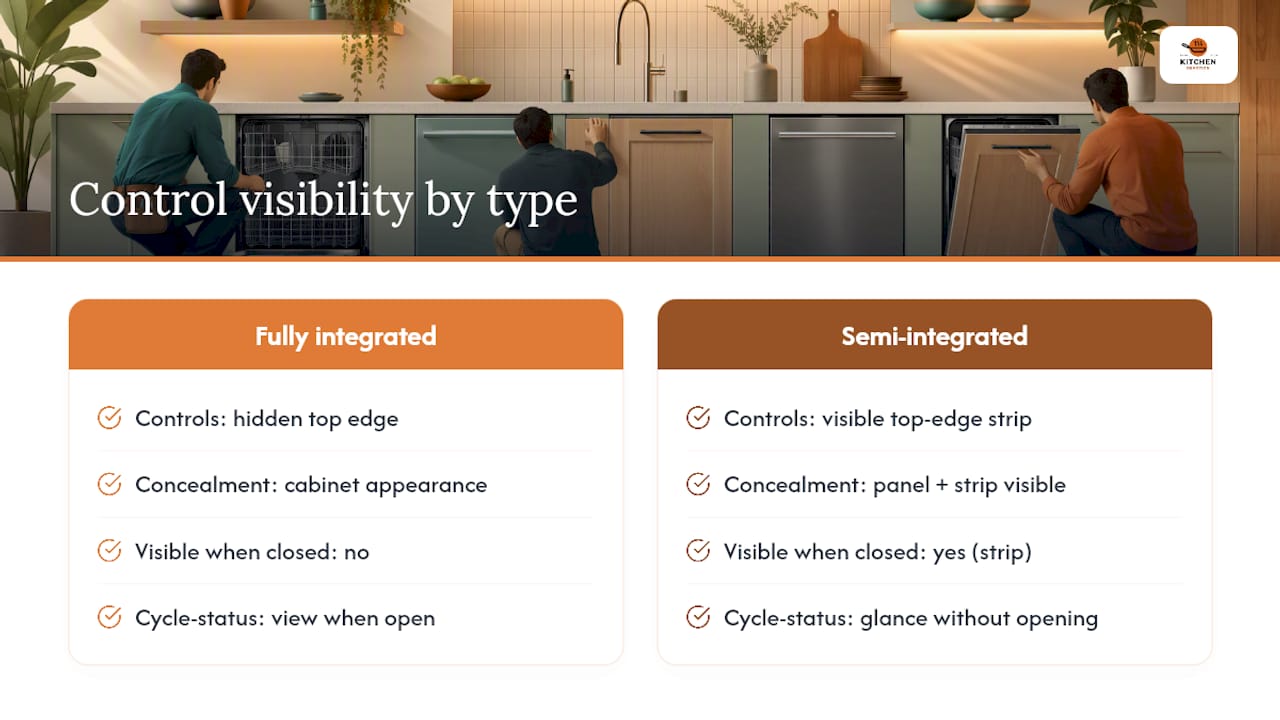
Fully integrated models hide the control panel on the inside top edge of the door, so once it’s closed and the custom panel is mounted, you see nothing but cabinetry. This is the option designers reach for when the goal is maximum concealment, a kitchen where the dishwasher genuinely vanishes between cabinet runs.
Semi-integrated units leave a visible control strip along the top edge of the door face, with the custom panel filling the space below it. Choice’s testing coverage notes that performance is comparable across both types. The difference is purely visual and functional in terms of how you interact with the machine day to day.
For daily use, semi-integrated means you can glance at a cycle countdown without opening the door. Fully integrated means you’ll rely on other cues, which we’ll get to shortly.
How Panel Customization Actually Works
The panel itself is usually built to match your existing cabinet doors, using whatever material your cabinetmaker already works with. Painted MDF is the most common choice because it’s affordable and finishes smoothly. Wood veneer panels match real wood cabinetry but cost more and can be sensitive to heat and humidity near the dishwasher’s vents. Laminate holds up well against moisture but offers fewer custom finish options.
Attachment happens through factory-supplied mounting brackets. Cabinetmakers build the panel to the manufacturer’s spec, then it’s screwed into place using those brackets, matching the same profile and finish as the surrounding cabinet doors.
Handle options come down to two routes: an integrated groove pull machined into the panel’s edge for a minimal look, or a standard cabinet pull that matches your existing hardware. Getting handle height right so it lines up with adjacent cabinet pulls takes real coordination.
- Buyer selects the dishwasher model and confirms panel dimensions with the manufacturer’s spec sheet
- Cabinetmaker fabricates the panel to match door style and finish
- Installer mounts the dishwasher, attaches the panel using factory brackets, and adjusts hardware alignment
Pro Tip: Bring your dishwasher’s spec sheet to your cabinetmaker before final measurements are cut. A pantry door hardware guide or similar cabinetry resource can help you match pull placement across your whole kitchen run, not just the dishwasher.
Weighing The Pros And Cons
Design continuity is the whole reason this style exists. Designers treat appliance panels as cabinet doors to achieve a cohesive run, and the visual payoff is often disproportionate to the added cost, a small investment in panel fabrication buying a much bigger aesthetic result.
- Pro: visual continuity across an entire cabinet run
- Pro: flexibility to match any finish, since the panel is independent of the appliance’s factory options
- Pro: often reads as higher-end than a standard stainless front
- Con: panel fabrication and hardware are an added line item on top of the dishwasher price
- Con: hidden controls on fully integrated models mean an adjustment period
- Con: installation takes more coordination and more time on-site
Full custom kitchens and higher-end remodels are where this shows up most. If you’re doing a quick appliance swap without touching cabinetry, a standard finished-front model is almost always the simpler, cheaper path.
What To Check Before You Buy
Order the wrong specs and you’ll find out during installation, which is the expensive time to find out. Work through this list before you commit to a model.
- Measure the opening and confirm panel allowances. Standard openings run close to 24 inches wide, but panel thickness and height allowances vary by manufacturer, so check the spec sheet against your actual cabinet opening.
- Verify control placement. Decide if you want a fully integrated model with hidden controls or a semi-integrated one with a visible strip, since ordering the wrong type means either an unwanted display panel or unexpected front-panel blindness.
- Confirm hinge weight limits. Heavier panels, especially wood veneer or thick MDF, can push against a door hinge’s rated weight capacity. Ask the manufacturer for their maximum panel weight recommendation.
- Plan handle placement early. Pulls need to align with the cabinetry beside and above the dishwasher, not just look good on their own.
- Ask about warranty terms. Some manufacturers treat panel-related fitment issues differently from mechanical defects, so it’s worth asking what’s actually covered if a panel doesn’t sit flush.
Pro Tip: If you’re mid-remodel and still finalizing appliance placement, Kitchendevotion’s guide to planning a kitchen remodel is worth reading before you lock in dishwasher specs, since layout changes can shift your opening dimensions.
How Installation Actually Goes
Installation starts with verifying the opening matches the appliance’s rough-in specs, then setting the unit level and square in the cabinet bay. Once it’s secured and plumbed, the cabinetmaker’s panel gets attached using the factory brackets, and gaps get adjusted so reveal lines match the rest of the kitchen.
- Verify opening dimensions and confirm the panel has arrived matching spec
- Set the dishwasher level, connect water and drain lines, secure it to the surrounding cabinetry
- Attach the panel using manufacturer brackets, checking that gaps and reveals are even on both sides
- Align the handle with neighboring cabinet pulls and confirm the door swings and latches cleanly
The most common fit issues involve gaps that are slightly uneven or a panel that sits proud of the surrounding doors. Installers typically resolve this with shims or minor trim adjustments rather than remaking the panel. A straightforward appliance tech can usually handle the mechanical install, but you’ll want a cabinetmaker involved for panel fit and trim work, especially on a first-time custom kitchen.
Fixing Alignment Issues And Long-Term Upkeep
Panels drift out of alignment over time, usually from normal door use loosening the mounting screws. Re-leveling is typically a matter of loosening the brackets, resetting the gap evenly on both sides, and retightening, a job most homeowners can do themselves with a screwdriver and a level.
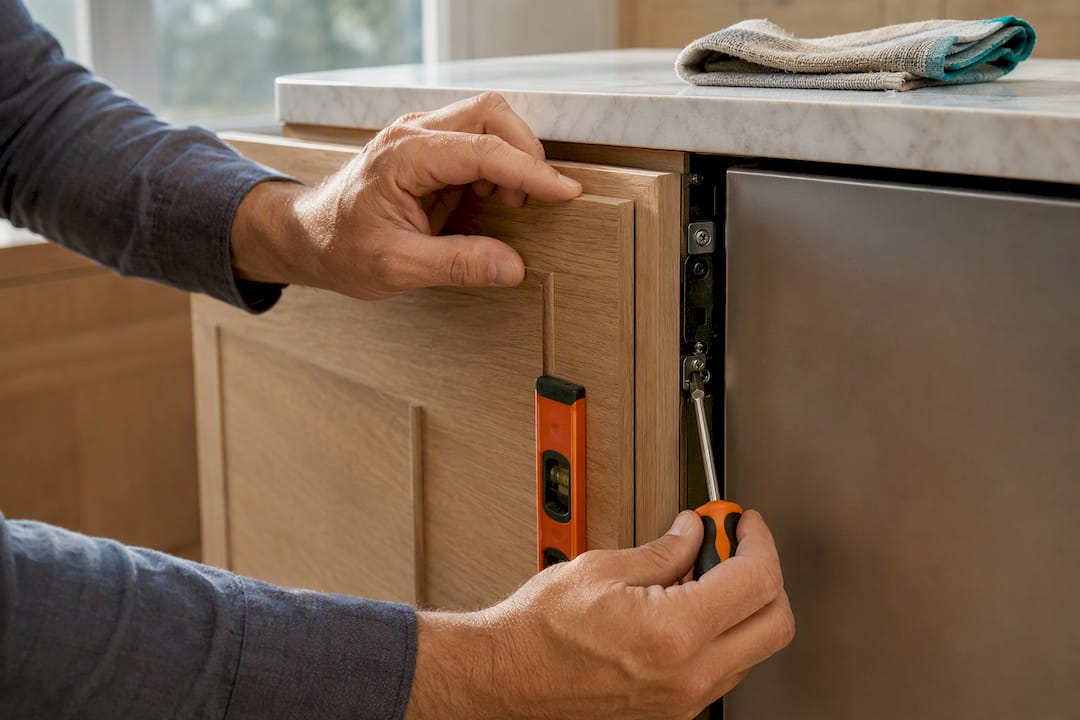
Material choice matters for longevity. Painted MDF holds up fine in most kitchens, but it can swell if it’s repeatedly exposed to steam venting from the dishwasher door. Solid wood veneer is more moisture-resistant but needs periodic refinishing to avoid cracking near the vent area.
For hidden-control models, manufacturers build in workarounds. Status lights that project onto the floor, audible chimes, and app notifications all substitute for a visible display, so you’ll know a cycle finished without seeing the controls directly. If the panel won’t sit flush no matter how you adjust the brackets, or the door won’t latch securely, that’s your signal to call a service tech rather than keep shimming it yourself.
Kitchen Devotion’s Take On Choosing Panel-Ready
We look at panel-ready dishwashers the way we look at every appliance decision: does the trade-off actually serve how you cook and live, or just how the kitchen photographs? For most full remodels, the answer is yes. For a quick swap, a standard front usually serves you better. Browse Kitchendevotion’s dishwasher hub for model comparisons, and pair it with the size guide before you measure anything.
— K. Connors
Where To Go Next For Your Dishwasher Decision
If you’ve read this far, you already know panel-ready involves more coordination than grabbing a stainless model off the shelf. That’s exactly why Kitchendevotion built curated resources instead of leaving you to sort through spec sheets alone.

Our team curates appliance picks with the same design-first thinking this article walks through, weighing fit, finish, and daily usability rather than just brand names. If you’re still narrowing down what goes into your kitchen beyond the dishwasher itself, the kitchen appliance priority list for new homeowners is a practical next stop, and it’s built around the same measure-first, plan-ahead approach. We’re upfront that our product links are affiliate links, curated because they fit the kitchens we recommend them for, not because a brand paid for placement. Start there, then come back to lock in your dishwasher choice once your full appliance lineup is mapped out.
Sources
- Panel-Ready Appliances Explained | Kitchen Integration | CDC
- How to Seamlessly Integrate Dishwashers with Custom | Bradco
- Integrated dishwashers: Pros, cons and need-to-knows
FAQ
Are panel-ready dishwashers worth it?
They’re worth it if you’re doing a full cabinetry remodel and want visual continuity across the kitchen. For a standalone appliance swap without touching cabinets, the added panel cost usually isn’t justified.
What are the common problems with panel-ready dishwashers?
The most frequent issues are gap misalignment from loosened mounting brackets, panels that swell or warp from vent moisture, and buyers not confirming control placement before ordering.
Which dishwasher should I stay away from?
Avoid any panel-ready model where the manufacturer doesn’t clearly publish panel weight limits and mounting specs, since that’s the information your cabinetmaker needs to avoid hinge strain and fitment issues down the line.
Which brand of panel-ready dishwasher is best?
There isn’t one universal answer since performance is largely comparable across integrated and semi-integrated types. The better question is which model’s control placement and panel specs match your kitchen’s layout, which Kitchendevotion’s dishwasher hub can help you narrow down by size and style.





No comment