
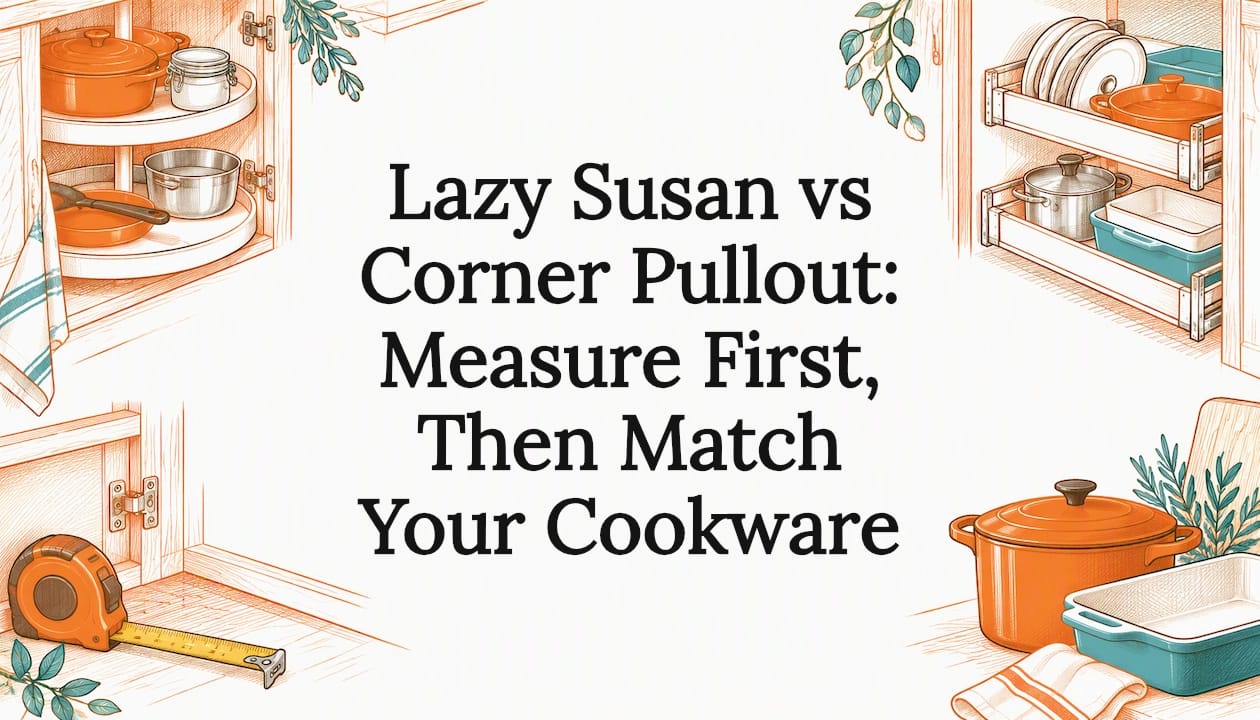
Choose a lazy susan when you want quick reach to jars, cans and small round containers. Choose a corner pull-out when you need the most usable space for pots, pans and bulky cookware. The trade-off is simple: a lazy susan gives you easy visibility and reach, while a pull-out gives you more rectangular volume at the cost of more moving parts.
TL;DR:
- Pullouts suit heavy cookware and rectangular dishes; some models rate near 55 pounds per shelf, but confirm the exact model’s capacity before loading.
- Before buying, measure opening width and height, cabinet depth, door swing, and nearby clearance; confirm the pullout matches the cabinet’s opening side.
- For limited reach or difficulty bending, choose a sliding system because it brings contents into view while a rotating shelf still requires reaching inside.
- Lazy susans usually cost less and have fewer parts; pullouts with multiple tiers cost more, may need adjustment, and can require professional installation.
Table of Contents
- What is the difference between a lazy susan and a corner pull-out at a glance?
- How do lazy susans and corner pull-outs actually work?
- How much can you store, and what fits best in each system?
- Which option is easier to use every day?
- What should you measure before you buy?
- How long do they last, and how much weight can they hold?
- What is the quickest way to choose?
- Who is behind these recommendations?
- How do you keep lazy susans and pull-outs clean and working?
- What do lazy susans and corner pull-outs cost, and which is the better value?
- Our view on corner storage
- Where to go next with Kitchen Devotion
- FAQ
- Sources
What is the difference between a lazy susan and a corner pull-out at a glance?
Both fix the same problem, a deep corner where items disappear. They solve it in opposite ways, and the differences below drive everything else in this guide.
- Usable volume: A lazy susan wastes the corners of its round trays. A pull-out uses more of the rectangular cabinet footprint.
- Access method: A lazy susan rotates to bring items to you. A pull-out slides forward to show everything at once.
- Best items: Lazy susans suit jars, cans and spices. Pull-outs suit heavy pots, pans and rectangular containers.
- Footprint and clearance: A lazy susan needs room for its full diameter to swing. A pull-out needs a minimum opening width and enough depth for its hardware.
- Maintenance: A lazy susan has few parts. A pull-out has sliding hardware that may need tuning over time.
- Weight capacity: Lazy susans generally carry lighter loads. Pull-out specs vary by model, and some list capacities near 25 kg per shelf.
If you want the background on why these corners cause trouble in the first place, our piece on why kitchen corner cabinets become wasted space covers it.
How do lazy susans and corner pull-outs actually work?
A lazy susan is a rotating shelf. It comes as a full circle or a half-moon, and it sits in an L-shaped corner so that deep-set items swing around to the front when you spin it. You never reach into the dark back corner. The back corner comes to you.
A corner pull-out works the opposite way. It is a mechanical system, often called a blind-corner pull-out or a magic corner, with telescoping or linked trays that slide out of the cabinet. Once extended, the whole contents sit in view, so nothing hides behind something else. The University of Nebraska extension material describes this same split: rotating shelves for L-shaped corners, and pull-forward systems that fully expose deep or blind corners.

Variants you will see
Lazy susans come in single-tier and double-tier versions. Two tiers add shelf area, though each tier is still round, so the corner waste remains. Pull-outs come in single-tray models and multi-tier blind-corner units. Many multi-tier units use linked trays, so pulling the front tray also draws the rear tray out into the open.
Handedness matters
Many blind-corner pull-outs are side-specific. They come in left-hand and right-hand versions, and the product listings say plainly that door orientation must be verified because the units are not universally interchangeable. A wrong pick can block an adjacent drawer or appliance. Lazy susans do not have this issue, since a circle has no left or right.
How much can you store, and what fits best in each system?
Round trays leave dead space in the corners of a square cabinet. That is the core reason a lazy susan usually holds fewer large or rectangular items than a pull-out of the same cabinet. A tall stockpot or a rectangular baking dish does not sit neatly on a curved edge, and it can overhang as the shelf spins.
Pull-outs use more of the cabinet footprint. Their trays are rectangular, so they take rectangular containers, stacked cookware and bakeware without wasted gaps. The tradeoff is that the mechanism itself takes up some room, so the gain is real but not unlimited.
Storage experts note that the choice comes down to what you keep. Lazy susans work well for circular items like jars, cans and spices that benefit from rotation, while pull-out trays are more stable and better suited to heavy pots, pans and rectangular containers that might tip or slide on a spinning surface.

Where each item belongs
On a lazy susan:
- Spice jars, grouped by cuisine so one spin finds what you need
- Canned goods, with the newest at the back of each wedge
- Oils, vinegars and bottles in a tight cluster
- Small bowls and everyday dry goods in jars
On a corner pull-out:
- Pots and pans, nested with lids stored flat beside them
- Mixing bowls and rectangular bakeware
- Casserole dishes and heavy appliances you use only now and then
- Bulky storage containers that would roll off a round tray
A simple placement tip: keep the things you grab daily at the front tier, and push seasonal items to the back or the lowest tray. If your heaviest cookware is the problem, our guide to kitchen storage ideas for large pots and pans goes deeper on that. And if the cabinet itself is deep and awkward, simple ways to make deep cabinets easier to use pairs well with either choice.
Which option is easier to use every day?
Think about how you reach for things. A lazy susan brings items to the front with one spin. You still need to scan the tray, but the item arrives where your hand already is. That works best for small things you grab in a hurry, like a spice mid-recipe.
A pull-out shows everything at once. You slide it forward and see every item from above, with no need to move one thing to find another. For heavy or oddly shaped cookware, that full reveal saves a lot of fumbling, because you are not rotating a loaded shelf to find a lid.
Match the solution to where you work
Design professionals recommend planning storage at the point of use, where items are used most often, to reduce effort. The best corner solution fits the workflow of the sink, range or prep area next to it.
In practice, that means:
- Corner near the stove: a pull-out for pots, pans and lids you reach for while cooking.
- Corner near the prep area: a lazy susan for oils, jars and seasonings you use while chopping and mixing.
- Corner near the sink: whichever holds your cleaning supplies and everyday dishes with the least bending.
A note on limited reach
If you have limited reach, mobility concerns or trouble bending, lean toward pull-forward solutions. Extension guidance for accessible kitchens points out that roll-out drawers and pull-outs bring cabinet contents into view and are often recommended for below-counter storage for ease of use. A rotating shelf still asks you to reach into the cabinet, while a pull-out delivers the contents to you.
For a wider look at everyday organization, see our overview of the best kitchen storage solutions for busy homes.
What should you measure before you buy?
Measure before you shop. Corner hardware is sold by size, and a near miss often means returning a heavy box.
Lazy susan sizing
Lazy susans are typically sized by diameter, with common examples at 24, 28 and 32 inches. Your cabinet width and door opening decide which one fits. The tray must clear the door frame and the cabinet walls as it spins, so measure the inside width, the opening width and the depth, then pick a diameter that leaves a little breathing room.
Pull-out sizing
Pull-out corner systems are sized by minimum cabinet opening width and need specific clearance for their hardware. Check the product specifications for the required opening height and clear cabinet depth, then compare those requirements with your cabinet. Check each of those numbers against your own cabinet, not just the width.
Squareness and level
Cabinets that are out of square cause trouble for both options. Design guidance is blunt on this point: installation must be level and square or doors and mechanisms will not operate properly. A rotating shelf can scrape a wall that is slightly crooked. A sliding tray can bind, drift or refuse to close.
Handedness and adjacent clearance
Confirm whether your pull-out is a left-hand or right-hand model before ordering. Then check the door swing and any appliance or drawer next to the corner. A pull-out that opens into a dishwasher door or a neighboring drawer front will frustrate you daily. If you are rethinking a larger area, such as a pantry, choosing the right pantry door is a useful companion decision.
Before you shop, note the opening width and height, inside depth, and the position of the door hinges.
How long do they last, and how much weight can they hold?
Weight is where the two options part ways most clearly. Some pull-out systems list capacities in their specs, with ranges such as 25 kg per shelf, roughly 55 pounds, depending on the manufacturer and series. Always read the rating for your specific model rather than assuming.
Lazy susans generally carry lighter loads. Their bearings and center posts handle jars and cans well, but a stack of cast iron can strain them. They also have fewer mechanical parts, which means fewer things to wear out.
Pull-outs rely on sliding hardware, and sliders can drift out of alignment with years of heavy use. Kitchen designers note that these systems maximize internal space but add mechanical complexity, and they suggest simpler mechanical systems when long-term reliability and low maintenance matter most to you.
Installation quality decides much of the outcome. The same guidance warns that DIY installation can void warranties. If your cabinets are out of square or the unit is heavy, a professional installer reduces the chance of binding, sagging or a voided warranty down the road. If something starts to rub or drag, call for adjustment early rather than forcing it.
What is the quickest way to choose?
Work through these steps in order, at a pace that suits you.
- Measure the opening, depth and clearances. Record the cabinet opening width and height, the inside depth, and how the door swings. Check nearby appliances and drawers.
- List what you actually store. Check categories such as spices, canned goods, small appliances, pots and pans, bakeware, and lids.
- Match items to a solution. As a quick rule, spices and jars point to a lazy susan, and pots, pans and bakeware point to a pull-out. If your list is split, count which group you use more often.
- Confirm handedness and installation. Decide whether the unit is left or right mounted. Ask your installer about cabinet squaring and any warranty effects.
- Budget for hardware and labor. Include installation difficulty in the total. If you value low maintenance, favor the simpler mechanical system.
Who is behind these recommendations?
This guide draws on our related articles about cabinet storage, including our pieces on corner cabinets and deep cabinets linked above. The measurements and installation points come from published sources you can check yourself: the University of Nebraska extension material on rotating versus pull-out systems, the Kansas State extension publication on matching storage to item types, and a manufacturer product listing for sizing and handedness.
How do you keep lazy susans and pull-outs clean and working?
Both options collect crumbs, drips and dust, so plan a quick routine.
Lazy susans are easy to clean. Spin the tray, wipe each wedge with a damp cloth, and dry it. Take everything off every few months and clean the underside and the center post, where grit builds up and slows the spin. If the turn feels stiff or noisy, a little dry lubricant on the bearing often helps. Wipe away spills right away, since sticky residue under a tray can make it drag.
Corner pull-outs need a little more attention because of the sliders. Pull the unit fully out and wipe the trays and the visible rails. Vacuum or brush crumbs from the tracks, since debris in a channel can make a tray stick. Check that the soft-close feature still catches, and tighten any screws that have loosened with use.
Both benefit from a seasonal reset. Empty the unit, wash the surfaces, discard expired items, and put things back where they belong. Cleaning is also a good moment to spot early wear, like a wobble, a squeak or a tray that no longer sits level. Catching it early is far cheaper than replacing a damaged mechanism.
What do lazy susans and corner pull-outs cost, and which is the better value?
We do not list prices for either option here, because cost depends heavily on size, materials, finish and brand, and no single figure would be honest. What holds across the board is the pattern: lazy susans tend to be the simpler, lower-cost route, while multi-tier blind-corner pull-outs tend to cost more because of their hardware.
Installation shifts the math. A basic rotating shelf can be easy to set up. A pull-out with side-specific hardware, tight clearances and a heavy load is more demanding, and many homeowners pay a professional for it. Factor labor into your total from the start.
Value is a different question from price. A cheaper lazy susan that holds the wrong items wastes money, and so does a premium pull-out in a corner that only stores a few jars. Look at long-term use: a simpler system with fewer parts may cost less to keep running, while a pull-out may justify its price if it turns dead space into easy daily storage for heavy cookware. If you are also planning to upgrade the pots that will live in that corner, what to know before upgrading your cookware set can help you budget the whole project.
Our view on corner storage
We favor whatever removes friction from daily cooking. Start with the item list from the checklist above, decide what you reach for most, and only then pick hardware that supports that choice. Fancy mechanisms matter less than whether the thing you need is in your hand when you need it. We also like storage that pairs with cookware that nests and stacks neatly, because good organization starts with what goes inside the cabinet.
— K. Connors
Where to go next with Kitchen Devotion
Once you know which corner solution fits, the next step is making sure your cookware and kitchen organization pieces fit it too. We curate cookware and kitchen items built to be easy to use and easy to store. If you plan to stock a pull-out with heavy pots, browse our cookware sets. Or start at our home page to explore our full range of kitchen appliances, tableware and organization resources.
Ready to match your storage to your cookware? Head to our cookware sets page and find pieces that make your new corner work harder.
FAQ
Are lazy susans outdated?
No. Lazy susans still work well for small, round items like jars, cans and spices, and they remain a simple, low-maintenance choice. They are less suited to heavy cookware, where a pull-out is more stable.
Which pull-out is best for corner cabinets?
It depends on your opening and which side the cabinet opens from. Blind-corner pull-outs are sized by minimum opening width, and many are left-hand or right-hand specific. Check the model’s specifications, measure first, then match them to your cabinet.
What is the most efficient corner cabinet solution?
For raw usable space, a multi-tier blind-corner pull-out usually wins, because its rectangular trays use more of the cabinet. For fast daily access to small items, a lazy susan can feel more efficient. Efficiency depends on what you store.
Can I install a corner pull-out myself?
You can, but be careful. Installation must be level and square, and DIY work can void a warranty. A professional installer is worth considering for heavy or side-specific units.
Sources
- Digitalcommons
- 2-Tier Girasolo Left-Hand Blind Corner Pull-Out with Soft-Closing for 15" Cabinet Opening, Light Brown | Würth Louis & Company
- MF2213 Creating Accessible Homes





No comment