
For most home cooks, a medium-sized air fryer that holds several quarts hits the sweet spot. Go smaller, down to 2 to 3 quarts, only if you’re cooking for one or working with a tiny kitchen counter. Go bigger, into toaster-oven territory, when you regularly roast a whole chicken or want sheet-pan capacity in one shot.
TL;DR:
- An air fryer’s usable capacity often differs significantly from its total volume, depending on basket shape and food arrangement.
- A 2 to 3 quart air fryer suits solo cooks, while 5 to 6 quarts are better for families or batch cooking, with toaster-oven models ideal for large meals.
- Overcrowding the basket compromises cooking safety and efficiency, increasing undercooked food risk and reducing crispness.
- Basket-style units are suitable for quick meals, but toaster-oven formats offer better capacity for whole proteins and sheet-pan meals.
- Choosing the right size depends on household size, cooking habits, and kitchen space, not just marketing or capacity numbers.
Table of Contents
- Air Fryer Size Guide: How Capacity Is Actually Measured
- What Size Air Fryer Do I Need for My Household?
- How Food Type Changes the Capacity You Really Need
- Basket, Dual-Zone, or Toaster-Oven: Which Format Fits?
- Why Overcrowding Your Air Fryer Is a Safety Issue
- How Kitchendevotion Curates Air Fryers by Size
- When Size Matters More Than Speed (and Vice Versa)
- Ready to Shop by the Right Capacity
- Sources
- FAQ
Air Fryer Size Guide: How Capacity Is Actually Measured
Air fryer listings mix quarts and liters almost interchangeably, and the conversion is simple enough to keep in your head: one quart equals roughly 0.95 liters, so a 6 quart basket holds about 5.7 liters. The bigger issue isn’t the unit. It’s what “capacity” actually measures.
Manufacturers quote total basket volume, but that number tells you almost nothing about how much food will actually crisp in a single layer. A tall, narrow basket might hold 6 quarts on paper while giving you less usable surface area than a shorter, square one rated at 5 quarts. Testing at Wirecutter consistently finds that square baskets outperform round ones of the same nominal size, because corners add flat cooking surface that round shapes waste.
That’s why an air fryer capacity chart based on quarts alone can mislead you. Before trusting the number on the box, check:
- Basket shape (square or rectangular baskets generally beat round baskets at equal volume)
- Whether the listing shows “usable capacity” separate from total volume
- Product photos showing real food in the basket, not an empty shell
- Oven-style cavity dimensions if you’re comparing toaster-oven formats instead of a basket
Two air fryers with identical quart ratings can cook completely differently once real food goes in.
What Size Air Fryer Do I Need for My Household?
Household size is the fastest way to narrow the field, but it’s not the whole story. Cooking habits, whether you meal-prep, host often, or mostly reheat leftovers, shift the right number up or down.
- One person: 2 to 3 quarts. A single chicken breast, a personal portion of fries, or four or five wings fit comfortably. Consumer guides commonly point solo cooks toward this range, and it’s genuinely enough for most one-person meals. The catch: leftovers and reheating a second portion get tight, so if you cook in batches for the week ahead, size up.
- Two adults: 3 to 5 quarts, leaning toward 5. This is where testers often add a buffer. Wirecutter’s reviewers recommend adding roughly a quart above what strict “solo” math suggests when a second person enters the picture, because two dinners plus the occasional reheated lunch push past a 3 quart basket fast. A 5 quart unit handles a chicken breast for each of you, a full portion of vegetables, and still has room to breathe.
- Three to four people: 5 to 6 quarts, or a small toaster-oven format. This is the range that most closely matches a family dinner: bone-in chicken pieces, a batch of fries for the table, or a sheet of roasted vegetables. Beyond 6 quarts, basket-style units start to lose efficiency; Wirecutter’s testing notes that oversized pod fryers cook more slowly and can leave food soggy because the concentrated heat that makes a mid-size fryer crisp well gets diluted across too much empty space.
- Five or more people, or regular entertaining: For larger groups, toaster-oven style air fryers with full-size cavities are better suited to whole birds or sheet pans in a single batch. Basket-style fryers can still be used but may require cooking in multiple batches, which takes more time.
A large pod-style basket still earns its place if you host occasionally but cook solo most nights. You get the flexibility of extra capacity for game day without having to live with an oversized appliance every day of the week.
How Food Type Changes the Capacity You Really Need
Capacity needs shift depending on what’s going in the basket, not just how many people are eating. Foods that need to crisp evenly require single-layer spread, which eats up usable space fast regardless of the quart rating on the box.
- Needs spread (single layer only): fries, wings, breaded cutlets, tater tots
- Stacks reasonably well: dense proteins like salmon fillets or chicken thighs, roasted whole vegetables
- Good batching candidates: wings and fries, since a partial batch still cooks evenly
A single small chicken (around 3 to 4 pounds) needs a toaster-oven cavity or a large basket with several inches of clearance on all sides. Two salmon fillets fit a 4 quart basket without crowding. Eight wings usually need two batches in anything under 5 quarts if you want them properly crisp rather than steamed.
Pro Tip: Cooking times in most recipes assume 350°F to 400°F and a 5 to 25-minute window. If your batch is crowded, add a few minutes and shake the basket halfway. That’s a signal your size is running tight, not just a cooking adjustment.
Basket, Dual-Zone, or Toaster-Oven: Which Format Fits?
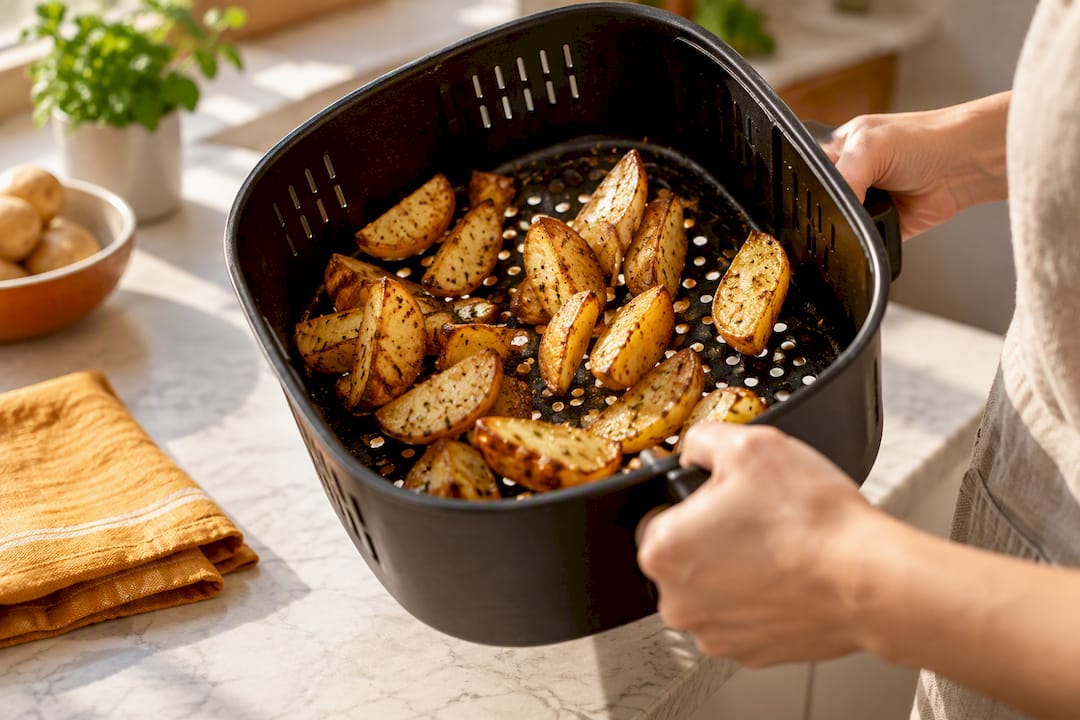
Format matters as much as capacity. A basket-style pod is compact and quick to preheat, but it caps out fast once you need whole-food capacity. A toaster-oven-style air fryer trades some counter footprint for a full cooking cavity that handles a small roast or a sheet pan without batching.
- Basket/pod units: best for quick weekday meals, fastest preheat, smallest footprint
- Dual-basket models: useful for cooking two different foods at once without flavor crossover
- Toaster-oven formats: the right call for whole birds, sheet-pan dinners, or frequent entertaining
Before buying, measure your actual counter space, including the clearance needed behind and above the unit for exhaust. A toaster-oven model can run 18 inches or more deep, which changes what fits under your cabinets. If storage is tight, a smaller basket unit stores in a cabinet more easily than an oven-style appliance ever will. For counter and cabinet fit more broadly, advice on matching appliance dimensions to kitchen space applies just as well to air fryers as it does to other built-in fixtures. Smaller units also tend to draw less power per use, which lines up with the general efficiency edge that compact countertop appliances hold over full-size ovens for small loads.
Why Overcrowding Your Air Fryer Is a Safety Issue
Size isn’t just about convenience. It affects whether your food actually cooks safely. The USDA’s Food Safety and Inspection Service warns that overcrowding an air fryer blocks the hot air circulation the appliance depends on, which can leave parts of a batch undercooked even when the timer says it’s done.
The overcrowding risk: When a basket is packed too tight, air can’t reach every surface evenly. FSIS recommends cooking in batches rather than forcing everything in at once, and always confirming doneness with a food thermometer instead of guessing by time alone.
Use a thermometer and check against these safe internal temperatures: 165°F for poultry, 145°F for fish, and 145°F with a rest period for whole cuts of meat. If hitting those numbers means shrinking your batch, shrink the batch. That’s the real test of whether your air fryer is the right size for how you cook, more than any number printed on the box.
How Kitchendevotion Curates Air Fryers by Size
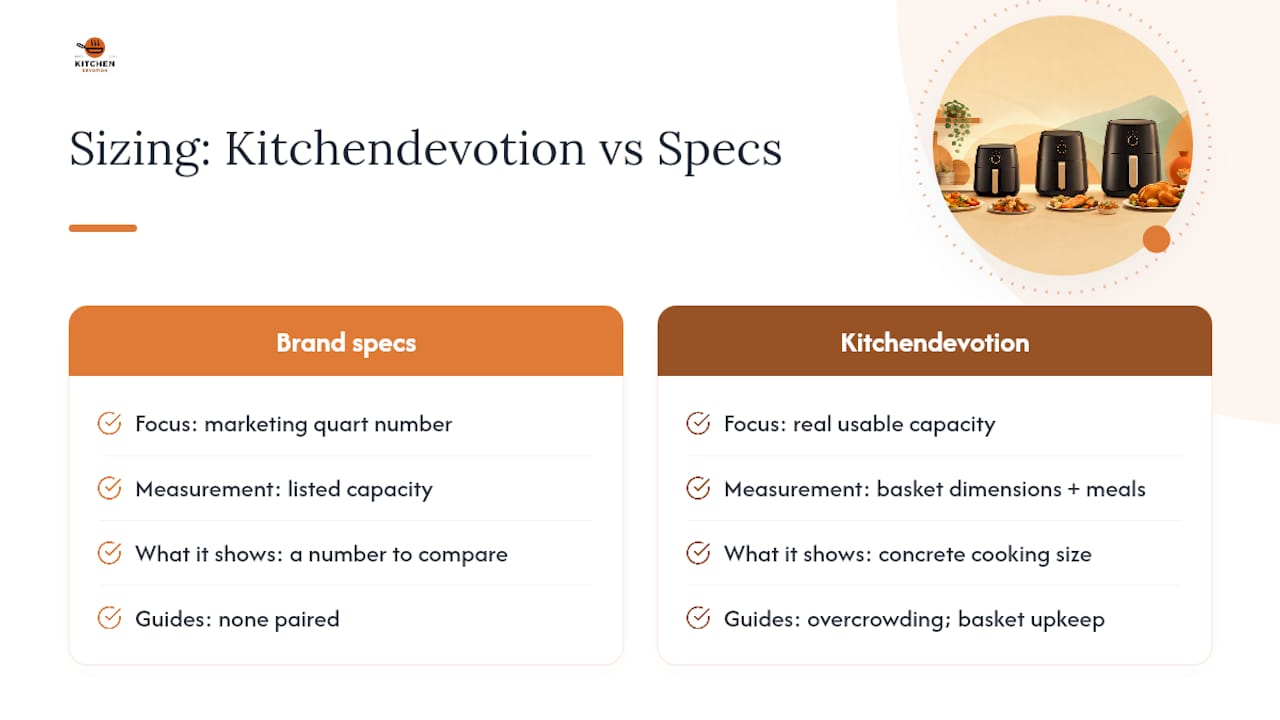
Sizing an air fryer from spec sheets alone is hard, which is why Kitchendevotion builds its air fryer picks around real usable capacity rather than marketing numbers. Our guides pair basket dimensions with the kinds of meals people actually cook, so a 5 quart listing means something concrete instead of a number to compare against a competitor’s.
For readers still narrowing their choice, our breakdown of common air fryer cooking mistakes covers overcrowding in more depth, and our guide to keeping a basket in good shape explains why airflow around the mesh matters as much as the quart rating. Between the two, you get a clearer sense of what a size number actually buys you at the stove.
When Size Matters More Than Speed (and Vice Versa)
Smaller wins when speed, easy reheating, and counter space are your priorities; a 2 to 3 quart unit preheats fast and doesn’t hog storage. Larger wins for regular family dinners or batch cooking, where a 5 to 6 quart basket or toaster-oven format saves you from running three rounds every night.
Before buying, ask yourself three questions: How many people am I actually feeding on a typical night? Do I cook whole proteins or mostly cut-up pieces? How much counter and cabinet space can I realistically give this appliance? Answer those honestly, and the right size becomes obvious fast.
— K. Connors
Ready to Shop by the Right Capacity
This air fryer selection is organized around the same size categories this guide just walked through, so you’re matching a model to your actual household instead of a marketing number.
If you’re cooking solo, look for the compact 2 to 3 quart picks built for speed and small counters. Feeding a family, check the 5 to 6 quart and toaster-oven-style options built for whole chickens and sheet-pan nights. Browse the full curated air fryer lineup and pick the size that matches how you actually cook, not just how much counter space you have to spare.
Sources
- Air fryers and food safety | FSIS (USDA)
- The 3 Best Air Fryers of 2026 | Reviews by Wirecutter
- Everything you’ve always wanted to know about air fryers | CNET
- Find the air fryer size that’s best for you | Taste of Home
FAQ
How Do I Know What Size Air Fryer I Need?
Match capacity to your household size first, then adjust for how you cook. One person usually needs 2 to 3 quarts, a couple does well with 3 to 5 quarts, and a family of three or four typically needs 5 to 6 quarts or a toaster-oven format for whole meals.
What Are the Different Sizes of Air Fryers?
Air fryers generally range from 2 quart personal models up through 6 quart family-size baskets, with toaster-oven-style units going even larger for whole chickens and sheet-pan meals. Consumer guides typically group these into solo, small-family, and entertaining categories.
What Size Air Fryer Is Best for 2 Adults?
Most two-person households do best with a 3 to 5 quart air fryer, leaning toward the 5 quart end for flexibility. Testers often recommend adding roughly an extra quart beyond strict solo-sized math once a second person is cooking regularly.
Should I Get a 4 Quart or 6 Quart Air Fryer?
Choose 4 quarts if you’re cooking mostly for one or two people without much batch cooking or leftovers. Choose 6 quarts if you regularly feed three or more people, cook bone-in chicken pieces or family-size fries, or want fewer batches per meal.
Can an Air Fryer Be Too Big for My Kitchen Needs?
Yes. Oversized pod-style air fryers can cook more slowly and leave food soggy because the heat spreads across too much empty space. If you’re cooking solo or in small batches most nights, a smaller basket will crisp food better than an oversized one running mostly empty.



No comment