

For most homeowners, stainless steel is the right call. It handles daily abuse, costs less than almost every alternative, and installs without structural drama. If you want a quieter, scratch-resistant upgrade, granite composite is the next step up. And if you’re building a farmhouse kitchen around an apron-front sink, fireclay is the ceramic-family material worth the extra weight and cost.
The NKBA’s 2026 trends report tracks sinks as one of 12 core product categories shaping buyer priorities this cycle, and the signal is clear: homeowners are moving toward materials that balance visual impact with long-term practicality. Consumer Reports’ buying guide reinforces that point, advising buyers to match material to mounting style and kitchen use before anything else.
Quick picks before you read further:
- Best value for most kitchens: 16–18 gauge stainless steel
- Best for busy households wanting quiet and durability: granite or quartz composite
- Best for farmhouse/statement look: fireclay apron-front
- Best for a high-end designer kitchen: natural stone or copper (with planned maintenance)
- Best budget option: solid-surface or acrylic
Key Takeaways
Stainless steel is the best all-around sink material for most homeowners, but granite composite, fireclay, and stone each outperform it in specific scenarios when installation costs are factored in.
| Point | Details |
|---|---|
| Match material to use case | Stainless for daily heavy use, composite for quiet kitchens, fireclay for farmhouse style. |
| Gauge determines stainless quality | 16-gauge for heavy use, 18-gauge for standard kitchens; avoid 22-gauge. |
| Budget total installed cost | Heavy sinks (cast iron, stone, concrete) add $150–$600+ in labor and reinforcement beyond the sticker price. |
| Sealing is a long-term commitment | Stone and concrete require annual resealing; skipping it leads to permanent staining. |
| Kitchendevotion simplifies the search | The curated kitchen sinks category covers stainless, composite, and fireclay with reviews and comparisons. |
Table of Contents
- Why stainless steel is still the best all-around sink material
- Are composite sinks durable enough for a busy household?
- Fireclay vs. porcelain sink: which ceramic-family material holds up?
- Enameled cast iron: classic look, serious weight, and chip risk
- Copper sinks: warm patina, antimicrobial surface, and real upkeep
- Natural stone sinks: high-end look, sealing schedule, and structural demands
- Solid-surface and acrylic sinks: affordable, repairable, but heat-sensitive
- Concrete sinks: custom aesthetic, sealing demands, and weight realities
- Sink material comparison at a glance
- How do you choose the right sink material for your kitchen?
- Hidden costs and installation realities you need to budget for
- Best sink material by kitchen type and budget
- What most sink guides get wrong about material choice
- Kitchendevotion’s curated sink picks make the next step easier
- Sources
- FAQ
Why stainless steel is still the best all-around sink material
Stainless steel dominates American kitchens for a reason. It resists corrosion, handles boiling water and frozen pans without complaint, and costs far less than stone or fireclay. The catch is that not all stainless is equal, and the number that matters most is the gauge.
Gauge measures sheet thickness, and the numbering runs backward: lower gauge means thicker steel. The Plumbing Directory’s buying guide puts it plainly: 16-gauge is premium, 18-gauge is the practical standard, and 22-gauge is budget territory that dents and resonates. For most remodels, 18-gauge with sound-deadening pads hits the right balance between noise control and cost. If you cook heavily and drop cast-iron pans near the sink regularly, step up to 16-gauge.
Key specs to check before buying:
- Gauge: 16 for heavy use, 18 for standard kitchens, avoid 22
- Sound-deadening: look for spray-on undercoating or adhesive pads on the basin underside
- Finish: brushed/satin finishes hide water spots and minor scratches better than polished
- Mounting: stainless is the most undermount-compatible material across countertop types
Scratches are the most common complaint. They’re real, but they’re also manageable. Over time, fine scratches blend into a uniform satin patina that most homeowners stop noticing within a year. For cleaning, a damp cloth with a nonabrasive cleaner handles daily grime. Water spots respond to a quick wipe with white vinegar. Avoid steel wool and chlorine bleach, which pit the surface.
Price-wise, stainless sinks run roughly a few hundred dollars for quality options, with undermount models at the higher end. A black stainless drop-in option gives you the same durability with a bolder visual finish for kitchens that need a bit more personality.
Are composite sinks durable enough for a busy household?
That composition gives them a hardness and density that stainless steel simply can’t match. According to BHG’s sink materials guide, some brands cite heat resistance up to around 530°F, and scratch resistance is genuinely excellent under normal kitchen use.
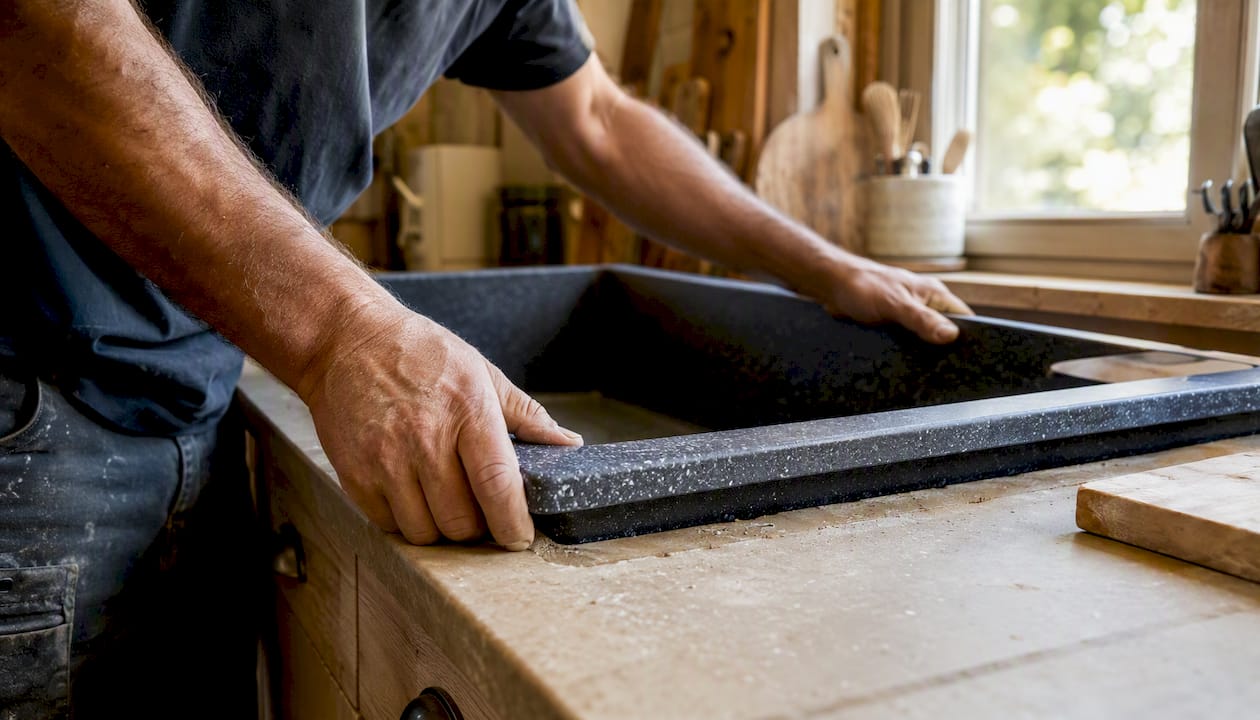
The trade-off is that same hardness. Drop a wine glass into a granite composite sink and it’s more likely to shatter than it would in stainless. The surface is unforgiving. For households with a lot of delicate glassware, that’s worth factoring in.
What composite does well:
- Noise: significantly quieter than stainless, no pads required
- Scratch resistance: holds up well against knives, pots, and general daily contact
- Color options: uniform color throughout the material, so chips (rare) don’t show white
- Stain resistance: nonporous surface resists most food stains with routine cleaning
Cleaning is straightforward: mild dish soap and a soft cloth for daily use. Avoid bleach-based cleaners and abrasive pads, which can dull the finish over time. Manufacturers vary on what they approve, so check the warranty documentation before reaching for anything stronger than dish soap.
Composite sinks typically run in the mid-price range for kitchen sinks. They’re heavier than stainless, so confirm your cabinet can handle the load before ordering. For a real-world look at how granite composite performs in a 33-inch cabinet, the Ruvati vs. Kraus granite sink comparison on Kitchendevotion walks through the practical differences between two leading options.
Fireclay vs. porcelain sink: which ceramic-family material holds up?
The terminology here trips people up. Fireclay, ceramic, and porcelain are related but not interchangeable, and the differences matter for durability.
Fireclay is clay fired at very high temperatures (often above 2,000°F), which vitrifies the material into a dense, nonporous surface. BHG confirms that this higher-temperature kiln process makes fireclay more durable than porcelain-enamel finishes applied over a metal base. Porcelain-enamel is a glass coating fused to cast iron or steel. It looks similar but chips more readily, and a chip that reaches the metal underneath creates a rust risk.

For apron-front farmhouse sinks, fireclay is the right choice. It’s built for that format, holds its white gloss well over time, and resists most stains when wiped promptly. A TUKTUK 33" fireclay farmhouse sink is a good starting point for readers ready to compare specific models.
Fireclay sink care is simple but consistent:
- Use nonabrasive cleaners only (Bar Keepers Friend or a mild dish soap)
- Wipe dry after use to prevent mineral deposits and water staining
- Avoid dropping heavy cast-iron cookware directly into the basin
- Don’t use steel wool or harsh scrubbers
The weight is the main installation challenge. Fireclay sinks are heavy, often requiring cabinet reinforcement and higher labor costs. The sink itself is more expensive than standard options, plus installation labor that can run significantly higher than a standard stainless swap.
Enameled cast iron: classic look, serious weight, and chip risk
Enameled cast iron delivers a thick, glossy finish that looks expensive and holds heat well. It’s the material behind many of the deep, heavy farmhouse sinks that defined American kitchens for decades. But it comes with two problems that remodelers consistently underestimate: weight and chipping.
A standard cast iron sink is very heavy and generally requires reinforcement and professional installation, which can be costly Chowhound’s expert roundup flags this directly: premium materials like cast iron often carry hidden installation costs that buyers don’t see in the sticker price.
The enamel surface is beautiful but brittle. A dropped pot or a sharp impact can chip it, and once the enamel cracks through to the iron beneath, rust becomes a real concern. Chip repair kits exist but rarely produce an invisible fix.
Care essentials:
- Avoid impact: don’t drop heavy cookware directly into the basin
- Use gentle cleaners only; avoid anything abrasive or acid-based
- Dry after use to prevent mineral buildup on the enamel surface
- Address chips immediately with an epoxy repair kit to prevent rust spread
Price range runs in the higher hundreds to over a thousand dollars, with installation labor adding substantially to the total. Longevity is excellent if the enamel stays intact, but that’s a big “if” in a working kitchen.
Copper sinks: warm patina, antimicrobial surface, and real upkeep
Copper is a statement. It ages visibly, develops a living patina that shifts from bright penny-orange to deep brown over months and years, and no two copper sinks look identical after a year of use. If that sounds appealing, copper can be genuinely beautiful. If you want your sink to look the same in five years as it did on install day, copper is the wrong material.
The antimicrobial angle is real but often overstated in marketing. Copper does have natural antimicrobial properties, but a kitchen sink sees constant water, soap, and food contact that limits how much that property matters in practice. It’s a nice-to-have, not a reason to choose copper over other materials.
What copper owners need to know:
- Patina is inevitable: you can slow it with wax coatings, but you can’t stop it
- Acidic foods and cleaners accelerate patina and can cause uneven discoloration
- Denting is possible: copper is softer than stainless or composite, so heavy impacts leave marks
- Cleaning: warm water and mild soap only; avoid vinegar, citrus-based cleaners, and anything abrasive
Angi’s pricing data places copper sinks toward the higher end of typical kitchen sink price ranges, with custom or hammered copper sinks running well above that. Copper makes sense when the kitchen design is built around it, not as an afterthought.
Natural stone sinks: high-end look, sealing schedule, and structural demands
Granite, marble, and soapstone sinks are carved or fabricated from solid stone. The result is genuinely stunning, especially when the sink material matches the countertop. But the maintenance commitment is higher than any other material on this list, and the structural demands are significant.
Stone is porous. Without regular sealing, it absorbs water, food acids, and oils, which leads to staining that can’t be cleaned away. The sealing schedule depends on the stone type and finish, but annual resealing is a minimum for most installations, and some stones need it more frequently. Skip a cycle and you’re looking at professional remediation or permanent discoloration.
Weight is the other constraint. Stone sinks can weigh 200–400 lbs or more, which means countertop support, cabinet reinforcement, and specialized installation. Custom fabrication for a countertop-matched sink adds cost on top of that.
Care requirements:
- Use only stone-approved, pH-neutral cleaners
- Reseal on the manufacturer’s recommended schedule (typically annually)
- Blot spills immediately, especially wine, citrus, and coffee
- Never use vinegar, bleach, or abrasive scrubbers
Natural stone sinks are typically among the most expensive options, with prices starting in the higher hundreds and up for the sink alone, before fabrication and installation. They’re the right choice for a high-end remodel where the design intent justifies the ongoing commitment.
Solid-surface and acrylic sinks: affordable, repairable, but heat-sensitive
Solid-surface sinks (brands like Corian) and acrylic options are the most budget-friendly non-stainless choice. They’re lightweight, easy to customize in color and configuration, and surface scratches can often be sanded out with fine-grit sandpaper, which is a genuine advantage no other material offers.
The limitations are real, though. Angi notes that solid-surface and acrylic are more prone to heat damage and surface scratches compared with metal or stone. Placing a hot pan directly in the basin can cause warping or discoloration that sanding won’t fix.
Best practices:
- Always use a sink grid or mat to protect the basin floor
- Avoid placing hot cookware directly in the sink
- Use nonabrasive cleaners only; abrasive pads accelerate surface wear
- Follow the manufacturer’s repair guidelines for scratch removal
Price range is typically in the lower hundreds, making this a reasonable choice for a budget remodel or a secondary sink. Lifespan is shorter than stone or stainless under heavy use, but the repairability factor extends it meaningfully if you stay on top of maintenance.
Concrete sinks: custom aesthetic, sealing demands, and weight realities
Concrete sinks are a niche choice, but the right niche. They suit industrial, modern farmhouse, and custom-designed kitchens where the sink is a deliberate design feature. The look is genuinely hard to replicate with any other material.
The practical reality is demanding. Concrete is porous and must be sealed before use and resealed regularly. The sealing chemistry matters: penetrating sealers protect from within, while topical sealers create a surface barrier that can wear and peel over time. Finish options range from polished to matte, and the finish affects both appearance and how aggressively the concrete needs protection.
Weight is comparable to stone: 200 lbs or more is common, which means the same structural reinforcement requirements. Cracking is a risk if the concrete wasn’t properly cured or if the cabinet shifts over time.
Care basics:
- Reseal every 1–2 years, or immediately if water stops beading on the surface
- Use pH-neutral cleaners only; acid-based products attack the sealer and the concrete itself
- Avoid heavy impact and dragging metal objects across the surface
Cost ranges widely depending on whether the sink is custom-poured or prefabricated, but premium concrete sinks and installation can be costly. This is a material for homeowners who’ve thought it through, not a spontaneous upgrade.
Sink material comparison at a glance
| Material | Best for | Durability / scratch resistance | Heat resistance | Stain resistance | Maintenance | Typical US price | Weight / install | Noise | Longevity |
|---|---|---|---|---|---|---|---|---|---|
| Stainless steel | Most kitchens, all budgets | Good (scratches patina over time) | Excellent | Good (nonporous) | Low | $150–$600 | Light / easy | Moderate (pads help) | 15 years |
| Granite composite | Busy households, quiet kitchens | Excellent | High (heat resistant) | Excellent | Low-moderate | Moderate price | Moderate weight, check cabinet support | Low noise | Typical lifespan of decades |
| Fireclay | Farmhouse / apron-front | Very good | Good | Very good | Low-moderate | Higher price | Heavy, may need reinforcement | Low noise | Typical lifespan of decades |
| Enameled cast iron | Classic / traditional kitchens | Good (chip risk) | Good | Good (chip risk) | Moderate | Premium price range | Very heavy, reinforcement needed | Low noise | Potentially long lifespan if enamel intact |
| Copper | Statement / warm aesthetic | Moderate (dents possible) | Good | Moderate (develops patina) | High maintenance | Higher price range | Moderate weight | Moderate noise | Long lifespan possible |
| Natural stone | High-end / matched countertops | Excellent | Excellent | Requires sealing | High maintenance | High price range | Very heavy, custom install needed | Low noise | Long lifespan possible |
| Solid-surface / acrylic | Budget / secondary sinks | Moderate (repairable) | Less heat resistant | Moderate | Low to moderate maintenance | Lower price range | Light weight | Moderate noise | Shorter lifespan expected |
| Concrete | Custom / industrial design | Good (when sealed) | Good | Requires sealing | High maintenance | Higher price range | Very heavy, reinforcement needed | Low noise | Medium to long lifespan depending on care |
Price ranges sourced from Angi’s kitchen sink materials guide, showing a broad range for kitchen sink prices, with cast iron, copper, and stone generally toward the higher end.
How do you choose the right sink material for your kitchen?
Start with use case, then check structural constraints. A sink that looks perfect in a showroom but requires $800 in cabinet reinforcement is a different purchase than the sticker price suggests. Consumer Reports advises matching material to mounting style and kitchen use before comparing aesthetics.
Work through this checklist before you buy:
- How often do you cook? Heavy daily cooking favors stainless (16-gauge) or granite composite. Occasional use opens up more options.
- Do you use fragile glassware? If yes, avoid granite composite and stone. Stainless is more forgiving on impact.
- What’s your maintenance tolerance? Stone and concrete require sealing. Copper requires consistent cleaning. Stainless and composite are the lowest-maintenance choices.
- What mounting style does your countertop support? Undermount requires a solid-surface or stone countertop. Drop-in works with almost anything. Apron-front requires cabinet modification.
- What’s your real budget? Include installation labor, not just the sink price. Heavy materials add $200–$600 or more in labor.
- What’s your lifespan expectation? Stainless and composite hold up 20–30 years. Stone and cast iron can last 50 years with proper care. Acrylic is a 10–20 year material.
- Does the finish carry a warranty? Check what the manufacturer covers and for how long. Finish warranties vary significantly by brand.
Questions to ask your installer before signing off:
- What gauge is this stainless, and does it include sound-deadening?
- Does the cabinet need reinforcement for this sink’s weight?
- What sealing or finish maintenance does this material require?
- Is this sink compatible with my countertop material for undermount installation?
Red flags that should stop a purchase:
- No weight specification listed for a heavy-looking sink
- No finish warranty or unclear warranty terms
- A stone or concrete sink with no sealing guidance from the manufacturer
- A supplier who can’t confirm undermount compatibility with your countertop material
Hidden costs and installation realities you need to budget for
The sink price is rarely the full cost. For heavy or premium materials, Chowhound’s expert analysis confirms that installation labor and structural reinforcement can exceed the sink’s purchase price, particularly for cast iron, stone, and concrete.
Cabinet reinforcement for a 200+ lb sink typically adds $150–$400 in labor, depending on your cabinet construction and local labor rates. Undermount installation for any material runs $200–$400 in labor on top of that. For stone sinks requiring custom countertop cutouts, fabrication costs add another layer. And for stone or concrete, plan for professional resealing every 1–2 years at $100–$300 per service.
Pro Tip: Before ordering any sink heavier than 80 lbs, get a written quote from your installer that explicitly covers cabinet reinforcement, countertop modification, and plumbing reconnection. Verbal estimates for heavy sinks routinely miss one of these line items.
Stainless steel avoids most of these complications. An 18-gauge undermount stainless sink installs in a standard cabinet without reinforcement, and a plumber can swap it in a few hours. That simplicity has real dollar value that doesn’t show up in the material comparison.
Best sink material by kitchen type and budget
Match the material to the scenario, not the showroom:
- Busy family kitchen: 16–18 gauge stainless steel. Handles volume, resists corrosion, and costs less than any comparable alternative. A Kraus Dex 33-inch undermount is a strong starting point.
- Quiet, high-use kitchen: Granite composite. The noise reduction alone justifies the upgrade for open-plan kitchens where sink sounds carry.
- Farmhouse or apron-front design: Fireclay. It’s the only ceramic-family material built for that format with the durability to back it up.
- Budget remodel: 18-gauge stainless or solid-surface acrylic. Both install easily and hold up for a decade or more with basic care.
- High-end designer kitchen: Natural stone or copper, with a realistic maintenance plan in place before purchase.
- Industrial or custom modern: Concrete, but only with a contractor experienced in concrete sink installation and sealing.
- Classic traditional kitchen: Enameled cast iron, with cabinet reinforcement budgeted and a commitment to gentle cleaning habits.
For installation complexity, the general rule is: if the sink weighs more than 100 lbs, hire a pro. Drop-in stainless is the one format experienced DIYers can handle confidently. Everything else benefits from professional installation, especially undermount and apron-front configurations.
What most sink guides get wrong about material choice
Most guides lead with aesthetics and treat durability as a secondary consideration. That’s backwards. The sink is the most-used fixture in the kitchen, and a material that looks stunning but chips, stains, or requires monthly maintenance becomes a source of daily frustration within a year.
The other thing guides consistently underweight is installation complexity. A $500 fireclay sink that requires $600 in cabinet work and $400 in professional installation is a $1,500 purchase. That changes the comparison entirely. Stainless steel’s real advantage isn’t just the material cost; it’s the total installed cost, which is often half what premium materials run when you add labor and structural work.
The one place where aesthetics genuinely should drive the decision is when the sink is a design anchor, not just a functional fixture. A copper or stone sink in a kitchen built around it will hold its visual impact for decades. The mistake is choosing those materials for a kitchen where the sink is just a sink.
Kitchendevotion’s curated sink picks make the next step easier
Knowing which material fits your kitchen is half the work. Finding a quality sink in that material, at the right size and price, is where most homeowners lose time.

Kitchendevotion’s kitchen sinks category brings together curated picks across stainless, granite composite, and fireclay, with product reviews and side-by-side comparisons that cut through the noise. Whether you’ve landed on 18-gauge stainless for a practical remodel or a fireclay apron-front for a farmhouse kitchen, the category page gives you specific models to evaluate rather than starting from scratch on a retailer search. For homeowners planning a full kitchen refresh, the kitchen appliance priority list for new homeowners helps you sequence the bigger decisions alongside your sink choice. Browse the sink selection, check the reviews, and order with confidence.
Sources
- Best Sink Buying Guide
- Types of Sink Materials: A Complete Guide
- Best Kitchen Sink Materials
- The Pros And Cons Of 8 Materials For Your New Kitchen Sink
- NKBA KBIS 2026 kitchen trends report
FAQ
What type of sink material is best for most kitchens?
Stainless steel is the best all-around choice for most kitchens. It resists corrosion and heat, installs without structural complications, and costs $150–$600 for quality options.
Which is better: porcelain or fireclay?
Fireclay is the stronger choice. BHG confirms that fireclay’s higher kiln-firing temperature produces a denser, more durable surface than porcelain-enamel, which chips more easily and can expose the metal base to rust.
What type of sink does not scratch easily?
Granite composite sinks offer the best scratch resistance of any common sink material. Their crushed-stone-and-resin composition resists knife marks and daily abrasion better than stainless steel or any ceramic-family option.
What are the kitchen sink trends for 2026?
The NKBA’s 2026 trends report places sinks among 12 core product categories, with signals that point toward materials balancing visual impact and long-term practicality, particularly composite and fireclay for style-forward remodels.
Are composite sinks worth the extra cost over stainless?
For open-plan kitchens or households that prioritize quiet, yes. Granite composite sinks run around $300 but deliver noticeably lower noise levels and better scratch resistance than stainless, without requiring sound-deadening pads.





No comment