

If you need trustworthy sites that review and compare kitchen appliances and cookware, Kitchendevotion is the best single starting point for most home cooks. It offers curated picks, buying guides, and honest affiliate disclosure without burying you in lab jargon. For raw performance benchmarks, Consumer Reports adds depth. For short-term usability at scale, retailer-aggregator platforms surface real purchase patterns. For long-term reliability and repair talk, niche appliance forums and community video channels fill the gap.
Quick TL;DR — where to click first:
- Curated picks and buying guides: Kitchendevotion
- Lab benchmarks and reliability rankings: Consumer Reports (subscription)
- Short-term usability patterns: Retailer aggregators (filter by “verified purchase”)
- Long-term reliability and troubleshooting: Niche appliance forums and YouTube communities
Table of Contents
- What are the best cosmo2050.com alternatives for kitchen reviews?
- Short profiles of the top alternative review sites
- How were these alternatives selected?
- How to use multiple review sites together when buying
- How to spot credibility risks in appliance review sites
- Which site should you use for each buying question?
- What’s the best overall recommendation for home cooks?
- Key Takeaways
- The case for triangulation over single-source trust
- Kitchendevotion makes the shortlist easier to act on
- Useful sources
- FAQ
What are the best cosmo2050.com alternatives for kitchen reviews?
| Best for | Testing style | Depth | Cost/access | Methodology transparency | Affiliate ties | Update frequency | Practical signal |
|---|---|---|---|---|---|---|---|
| Curated home-cook picks | Editorial + affiliate | Appliances and cookware | Free | Clear disclosure, how-we-pick pages | Yes, disclosed | Regular | Curated reliability + usability |
| Lab benchmarks | Lab testing | Appliances and cookware | Subscription/paywall | Detailed how-we-test pages | No | Ongoing | Performance metrics |
| Large-volume usability | User-derived | Appliances (broad) | Free | Varies by platform | Varies | Continuous | Short-term usability patterns |
| Long-term reliability | Community/forum | Appliances (deep) | Free | Peer-sourced, no formal method | None | Continuous | Failure patterns and repair tips |
| Feature walkthroughs | Video/editorial | Appliances | Free | Minimal | Sometimes | Varies | First-impression and unboxing |
Pro Tip: No single source covers everything. Start with editorial or lab results for raw performance, then cross-check retailer reviews filtered by “verified purchase” for usability, and finish with forum threads for failure patterns that only show up after a year of use.

Short profiles of the top alternative review sites
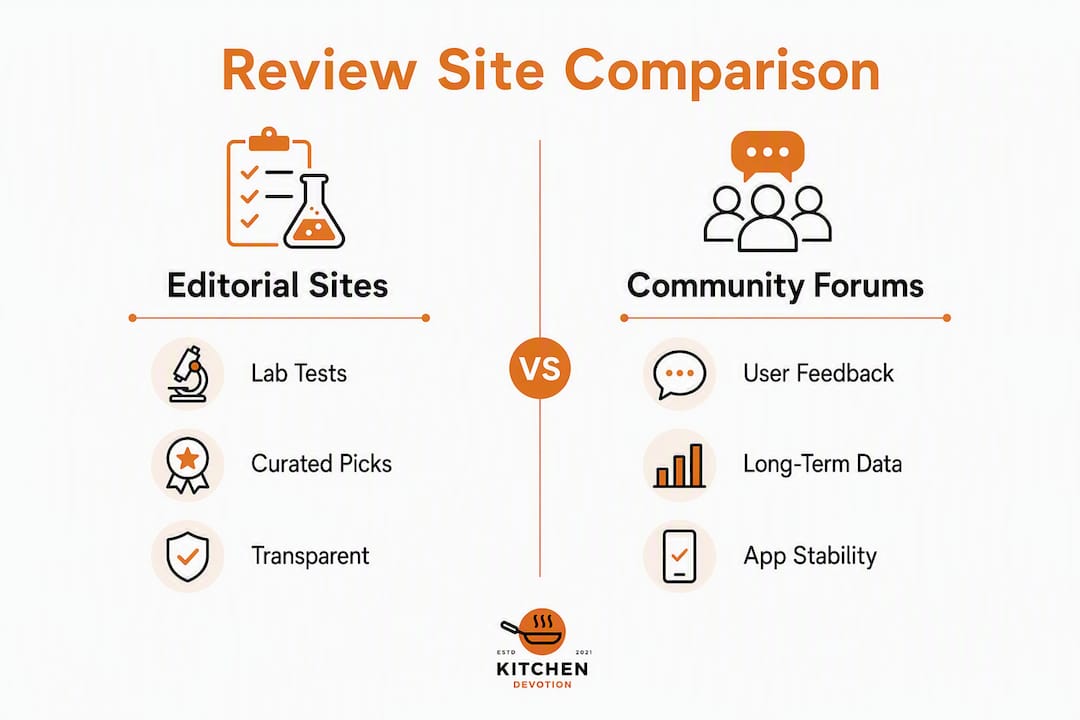
Kitchendevotion
Kitchendevotion covers kitchen appliances, cookware, air fryers, eco-friendly utensils, and organization solutions with a clear focus on home cooks rather than commercial kitchens. Reviews combine editorial testing with affiliate-linked product recommendations. Affiliate relationships are disclosed, and the site’s buying guides (like its cookware materials guide) walk you through decision criteria rather than just ranking products. Navigation is clean, and the visual design makes it easy to filter by category. The main limitation: no in-house lab with certified instruments. The strength: picks are chosen for real-kitchen usability, not just spec-sheet performance.
- Access: Free
- Affiliate disclosure: Yes, clearly stated
- Community features: Guides and how-to content; no open forum
- Best for: Home cooks who want a curated shortlist without wading through raw test data
Lab-tested publishers (e.g., Consumer Reports, Wirecutter, America’s Test Kitchen)
These publishers run structured tests on large appliance samples. Consumer Reports aggregates survey data across hundreds of thousands of appliances to produce predicted reliability rankings, which is genuinely hard to replicate elsewhere. Wirecutter (The New York Times) uses hands-on editorial testing with named testers. America’s Test Kitchen focuses on cookware and kitchen tools through cooking-performance trials. The tradeoff: Consumer Reports sits behind a paywall, and some publishers carry affiliate links that can influence which products get featured.
- Access: Subscription or free with limits
- Affiliate disclosure: Varies by publisher
- Best for: Buyers who need objective performance data or reliability probability before a major purchase
Retailer-aggregator platforms (e.g., Reviewed by USA TODAY, CNET)
Sites like Reviewed and CNET blend editorial testing with large volumes of user-submitted ratings. The value here is scale: thousands of verified-purchase reviews surface usability patterns that a small editorial team cannot replicate. The risk is noise. Delivery complaints, installation frustrations, and retailer-service issues get mixed in with actual product feedback. Filtering aggressively by date, “verified purchase,” and “most critical” cuts through most of that noise.
- Access: Free
- Affiliate disclosure: Present but not always prominent
- Best for: Confirming short-term usability and spotting repeat failure modes
Niche forums and video communities
Reddit communities (r/Appliances, r/Cooking), dedicated appliance forums, and long-form YouTube channels are where long-term reliability data actually lives. A dishwasher that scores well in a 30-day editorial test may show a known pump failure at 18 months. Forum threads surface that. Video reviewers are useful for feature walkthroughs and first impressions, but they rarely follow up on reliability after extended use. Use forums for the follow-up.
- Access: Free
- Best for: Long-term reliability, troubleshooting, and repair cost estimates
How were these alternatives selected?
The shortlist was built on six criteria, applied in this order:
- Transparency of test methods. Does the site explain how it tests? A clear “how we test” page is the minimum bar. Sites with no methodology disclosure were excluded.
- Sample size or aggregated data. A single reviewer’s opinion on one unit is weak evidence. Sites that aggregate across large samples or survey pools earn more weight.
- Update frequency. Appliance lines change. Sites that refresh reviews when new model generations ship are more reliable than those with three-year-old verdicts.
- Coverage breadth. The shortlist prioritizes sources that cover both appliances and cookware, not just one category.
- Editorial independence. Independent, consumer-driven platforms are perceived as more credible for experience goods like kitchen appliances. Sites where editorial decisions are visibly influenced by advertiser relationships were deprioritized.
- Visible conflict-of-interest disclosure. Affiliate links are not disqualifying. Undisclosed affiliate links are.
Sites with opaque methodology, no author credentials, or obvious advertiser-driven rankings were excluded entirely.
How to use multiple review sites together when buying
Triangulating across sources takes about 20 minutes and dramatically reduces the chance of a bad purchase.
- Start with lab or editorial benchmarks. Pull the performance score from a lab-tested publisher or a curated editorial source like Kitchendevotion. This tells you whether the appliance actually does what it claims (energy efficiency, heat distribution, motor power).
- Check retailer “verified purchase” reviews, filtered aggressively. Sort by most recent, then by most critical. Search for the specific component you care about (e.g., “heating element,” “seal,” “control panel”) rather than the brand name. Repeated identical failure descriptions across dozens of posts are the signal worth acting on. One-star rants about shipping are not.
- Search niche forums for the model number plus a failure keyword. If a known issue exists, someone has documented it with dates and part numbers. This step is especially worth doing for appliances you plan to keep for five or more years.
- Separate product issues from installation issues. Most home cooks conflate the two. A complaint about a refrigerator “not cooling” filed the day after delivery is almost always an installation or leveling issue, not a compressor defect.
Pro Tip: When reading retailer reviews, check the FTC’s guidance on spotting suspicious patterns. A cluster of five-star reviews posted in a single week, all using similar phrasing, is a classic manipulation signal.
When evaluating smart kitchen appliances, add a fourth step: search forums specifically for app stability and firmware update history. Performance specs mean less if the companion app breaks after an OS update.
How to spot credibility risks in appliance review sites
Not every review site deserves equal trust. Common problems:
Fake or clustered reviews. The FTC has approved rules prohibiting fake reviews, paid positive reviews, and suppressed negative ones, with civil penalties up to $51,744 per violation. Despite that, manipulation persists. A high density of reviews posted in a short window is a reliable red flag.
Retailer-service noise. Complaints about delivery damage, wrong items, or installation problems are real consumer experiences but tell you nothing about the product itself. Filter them out before drawing conclusions.
Undisclosed affiliate ties. A site that earns a commission on every product it recommends has a structural incentive to rank higher-margin products favorably. Disclosure does not eliminate bias, but its absence is a hard disqualifier.
Small sample sizes presented as definitive. One tester’s experience with one unit is an anecdote. The Better Business Bureau cautions that a notable portion of large-platform reviews can be fake; cross-checking across multiple impartial platforms is the practical fix.
Verification checklist:
- Does the site have a “how we test” or methodology page?
- Are author credentials (tester, chef, engineer) visible?
- Does the site reference third-party certifications or independent lab results? (The Good Housekeeping Institute seal, for example, backs qualifying products with a limited warranty.)
- Are affiliate relationships disclosed clearly?
- Do review timestamps cluster suspiciously?
Which site should you use for each buying question?
- “Will this dishwasher still work well in five years?” Niche forums and Consumer Reports reliability surveys. Predicted reliability data requires large sample sizes.
- “What’s a good air fryer for a small kitchen?” Kitchendevotion’s small-space appliance guide covers this directly, with picks filtered for counter footprint and usability.
- “Should I pay for a Consumer Reports membership?” — Yes, when you are buying a major appliance (refrigerator, range, dishwasher, washer/dryer) and want reliability probability data across hundreds of thousands of units. For cookware and countertop appliances, free editorial sources usually suffice.
What’s the best overall recommendation for home cooks?
Kitchendevotion is the best single starting resource for most home cooks because it combines curated picks, clear buying guides, and honest affiliate disclosure without requiring a subscription or a degree in engineering to interpret.
- Start at Kitchendevotion. Use the buying guides and category pages to build a shortlist of two or three candidates. Check the kitchen appliance priority list if you are outfitting a new kitchen.
- Cross-check with a lab-tested publisher — For any appliance over $300, pull the Consumer Reports or Wirecutter verdict to confirm performance claims.
Paid lab reports are worth the subscription cost when you are buying a major appliance you expect to keep for a decade. For everyday cookware and countertop appliances, the free sources above cover the decision well.
Key Takeaways
Kitchendevotion is the best starting point for most home cooks because it combines curated picks, transparent affiliate disclosure, and practical buying guides without a paywall.
| Point | Details |
|---|---|
| Start with curated editorial | Kitchendevotion offers free, home-cook-focused picks with clear affiliate disclosure and no subscription required. |
| Triangulate across three source types | Combine lab benchmarks, retailer verified-purchase filters, and niche forums for the most complete picture. |
| Watch for clustered review timestamps | A surge of same-week reviews using similar phrasing is a reliable manipulation signal per FTC guidance. |
| Prefer transparent methodology | Only trust sites with a visible “how we test” page, named author credentials, and explicit conflict-of-interest disclosure. |
| Pay for lab data on major appliances | Consumer Reports reliability surveys aggregate hundreds of thousands of units; worth the subscription for refrigerators, ranges, and dishwashers. |
The case for triangulation over single-source trust
Most shoppers pick one review site and stick with it. That habit is understandable, but it leaves real money on the table. Lab tests are excellent at measuring what instruments can measure: energy draw, temperature consistency, motor torque. They are poor at capturing what breaks after 18 months of daily use, or whether the companion app still works after a software update.
Forum communities are the opposite. They are rich in long-term failure data and repair costs, but they skew toward people who had problems. The person whose dishwasher ran quietly for seven years rarely posts about it.
Kitchendevotion sits in a useful middle position: editorial curation with a home-cook lens, honest about affiliate relationships, and focused on products that actually fit a real kitchen rather than a test lab. The Samsung Bespoke refrigerator review is a good example of that approach: style and performance weighed together, not just spec-sheet numbers.
The readers who make the best appliance decisions are the ones who treat review sites as complementary tools, not competing authorities. Use each source for what it does best, and the picture gets clear fast.
Kitchendevotion makes the shortlist easier to act on
The sites above give you the signals. Kitchendevotion turns those signals into decisions. The buying guides cover everything from air fryers to cookware sets, with picks filtered for home-cook priorities: counter space, ease of cleaning, price-to-performance, and healthier cooking options. Affiliate links are used and disclosed; they fund the editorial work without changing which products make the cut.
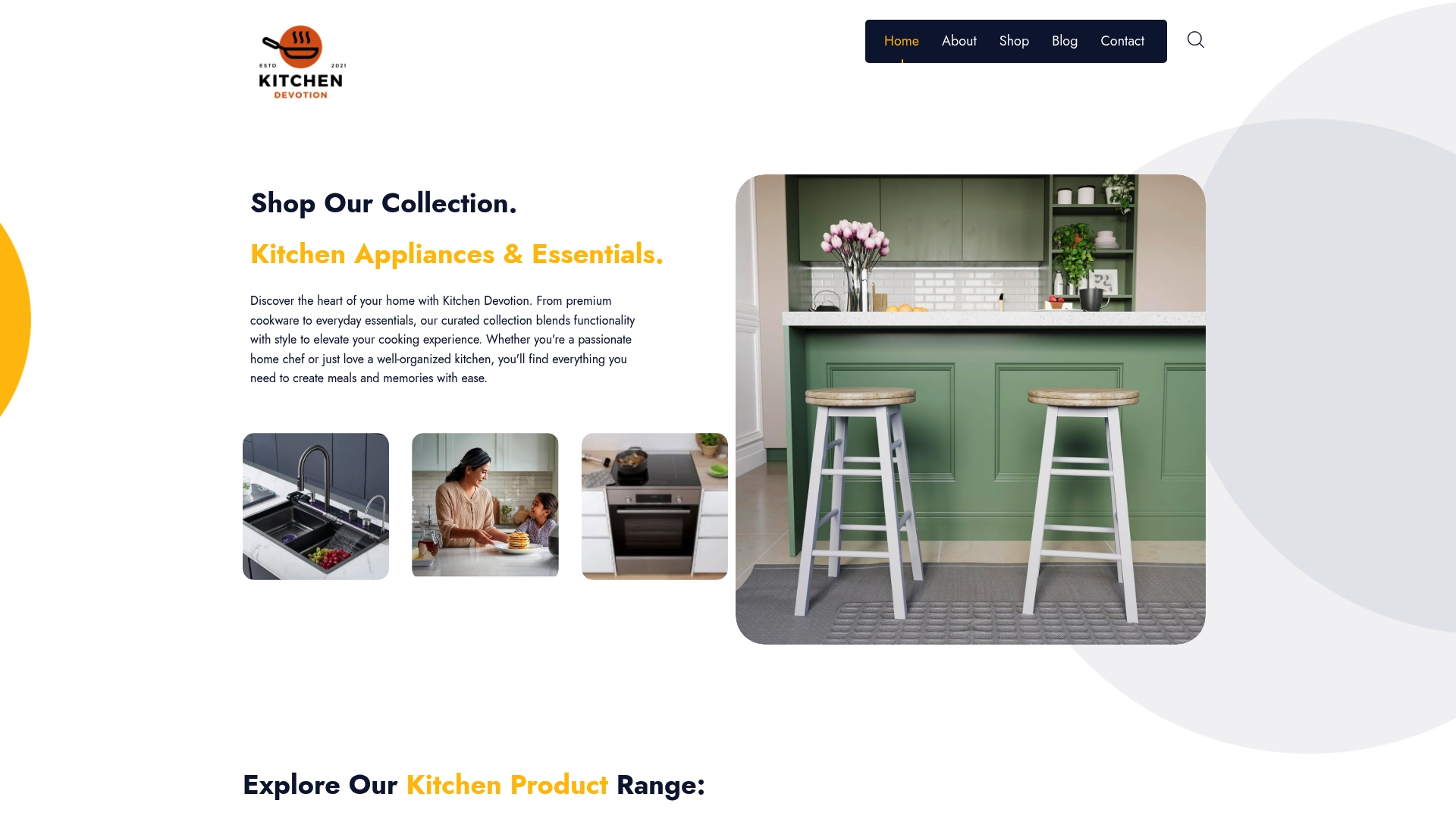
If you are building a kitchen from scratch or replacing a major appliance, the kitchen appliance priority list is the fastest way to sequence your purchases without overspending on day one. Browse the category guides, check the buying criteria, and use the triangulation workflow above to confirm your final pick.
Useful sources
- How to evaluate online reviews (FTC) — Practical guidance on spotting fake and manipulated reviews, including timestamp clustering and verified-purchase filters.
- Most Reliable Kitchen Appliance Brands (Consumer Reports) — Large-sample reliability survey data; the benchmark for predicted long-term performance.
- How to recognize fake online reviews (PIRG) — Covers the FTC’s final rules on fake reviews and the civil penalties for violations.
- Appliance review fatigue (Yale Appliance Blog) — Explains why the same appliance gets called “bulletproof” and “garbage” in the same week, and how to read patterns instead of individual verdicts.
- Tested for real life: What makes a kitchen appliance worth the investment? (Good Housekeeping) — Covers independent testing programs and what third-party seals actually guarantee.
Before trusting any review site’s verdict, check its methodology page first. If it does not have one, treat every recommendation with extra skepticism.
FAQ
What makes a kitchen appliance review site trustworthy?
Look for a visible “how we test” page, named author credentials, disclosed affiliate relationships, and reviews that reference sample sizes or third-party certifications. Sites without a methodology page should be treated as opinion, not evidence.
Is Kitchendevotion free to use?
Yes. Kitchendevotion is free to browse, with no subscription required. Affiliate links are used and clearly disclosed; purchases made through those links support the site’s editorial work.
When is a Consumer Reports subscription worth it?
For major appliances like refrigerators, ranges, and dishwashers, Consumer Reports reliability surveys aggregate data across hundreds of thousands of units, giving you predicted failure rates that no free editorial source can match. For cookware and countertop appliances, free sources usually cover the decision.
How do you spot fake appliance reviews?
The FTC recommends checking review timestamps for clustering (many reviews in a short window), looking for repeated identical phrasing, and filtering by “verified purchase.” A sudden spike of five-star reviews is a reliable red flag.
What’s the best site for long-term appliance reliability data?
Niche appliance forums (Reddit’s r/Appliances, dedicated brand communities) and Consumer Reports reliability surveys are the strongest sources. Forums surface failure patterns with real dates and model numbers; Consumer Reports quantifies them across large sample pools.




No comment