Follow the four steps — Clean, Separate, Cook, Chill — and pair them with appliance features like an accurate fridge thermostat and an instant-read thermometer to cut your foodborne-illness risk at home. The CDC and FoodSafety.gov both anchor their guidance to this same framework, and Kitchendevotion builds its appliance recommendations around it.
- Clean: Wash hands for 20 seconds; run cutting boards through a dishwasher sanitize cycle.
- Separate: Use dedicated boards for raw proteins; never let meat juices touch produce.
- Cook: Hit minimum internal temperatures with a food thermometer, not by guessing color.
- Chill: Keep your fridge at or below a safe cold temperature; refrigerate perishables promptly to reduce risk.
Table of Contents
- ## The four food-safety rules every home kitchen needs
- Safe cooking temperatures and the tools that hit them
- Which appliance features actually reduce your risk
- Workflow habits that keep your kitchen safe during active cooking
- How to clean and sanitize your kitchen tools properly
- How to store and reheat leftovers without getting sick
- Common mistakes that put home cooks at risk
- Key Takeaways
- The appliance angle most food-safety guides ignore
- Kitchendevotion makes it easier to cook safely at home
- Useful sources
- FAQ
## The four food-safety rules every home kitchen needs
An estimated 1 in 6 Americans get sick from foodborne illness each year. That number drops when you apply the four steps consistently.
Clean. Wash hands with warm, soapy water for at least 20 seconds before and after handling food. Wipe down counters after each protein. Run boards and knives through the dishwasher on a sanitize cycle, or hand-wash with hot, soapy water and follow up with a bleach solution.
Separate. Keep raw meat, poultry, seafood, and eggs away from everything else — in your cart, your bags, and your fridge. Use dedicated cutting boards for raw proteins and a separate one for produce. The Minnesota Department of Health puts it plainly: assume anything that touched raw protein is contaminated until washed.
Cook. Color and texture are not reliable doneness indicators. A chicken breast can look fully cooked and still harbor Salmonella. A thermometer is the only honest answer.
Chill. Bacteria multiply fast between 40°F and 140°F — the USDA calls this the “Danger Zone.” Get perishables into the fridge within 2 hours, or within 1 hour when the ambient temperature tops 90°F.
One rule that surprises people: Do not wash raw chicken or any raw poultry. Splashing water spreads bacteria across your sink, counters, and nearby utensils. The CDC and Cleveland Clinic both advise skipping the rinse entirely and cooking to temperature instead.
Pro Tip: Post a short checklist on your fridge: 20-second handwash, dedicated boards, thermometer check, 2-hour rule. Visible reminders close the gap between knowing and doing.
Safe cooking temperatures and the tools that hit them
| Food | Minimum Internal Temp | Rest Time |
|---|---|---|
| Beef, pork, lamb, veal (steaks, chops, roasts) | 145°F | 3 minutes |
| Ground beef, pork, lamb, veal | 160°F | None required |
| Poultry (all) | 165°F | None required |
| Fish and shellfish | 145°F | None required |
| Leftovers and casseroles | 165°F | None required |
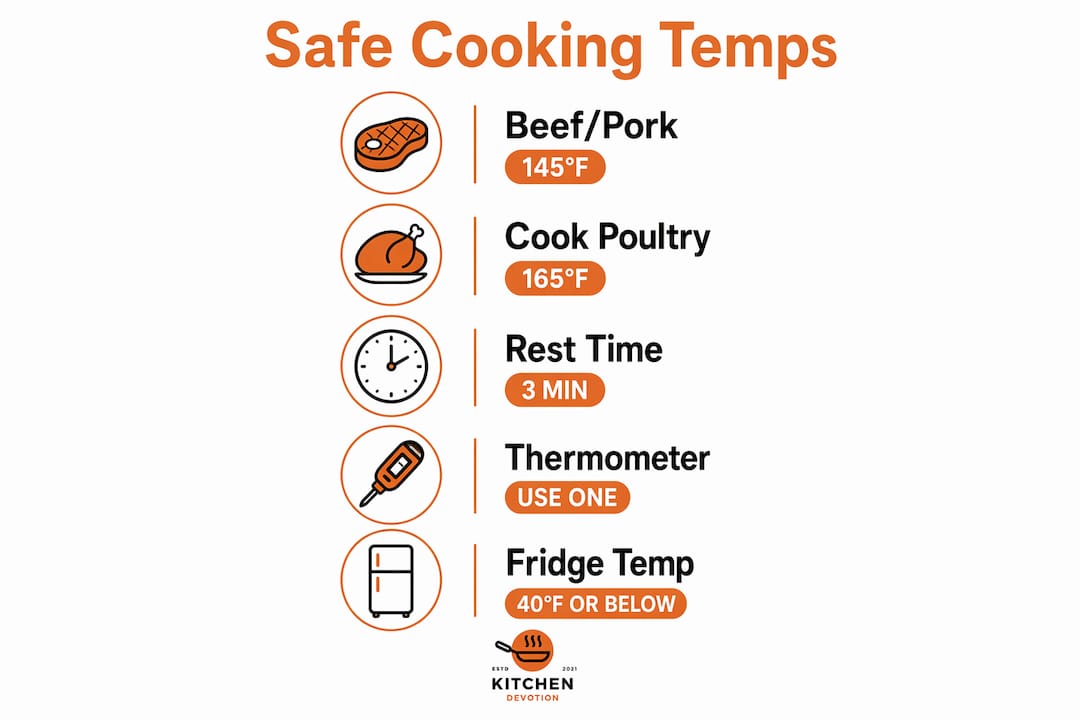
Source: USDA/FSIS Safe Minimum Internal Temperature Chart
Two thermometer types cover most home kitchens. An instant-read thermometer (like a Thermapen or similar probe) gives you a reading in 2–3 seconds and works for steaks, burgers, and chicken breasts. A leave-in probe thermometer sits in a roast or whole bird throughout cooking and alerts you when the target is reached, so you never have to guess or open the oven repeatedly.
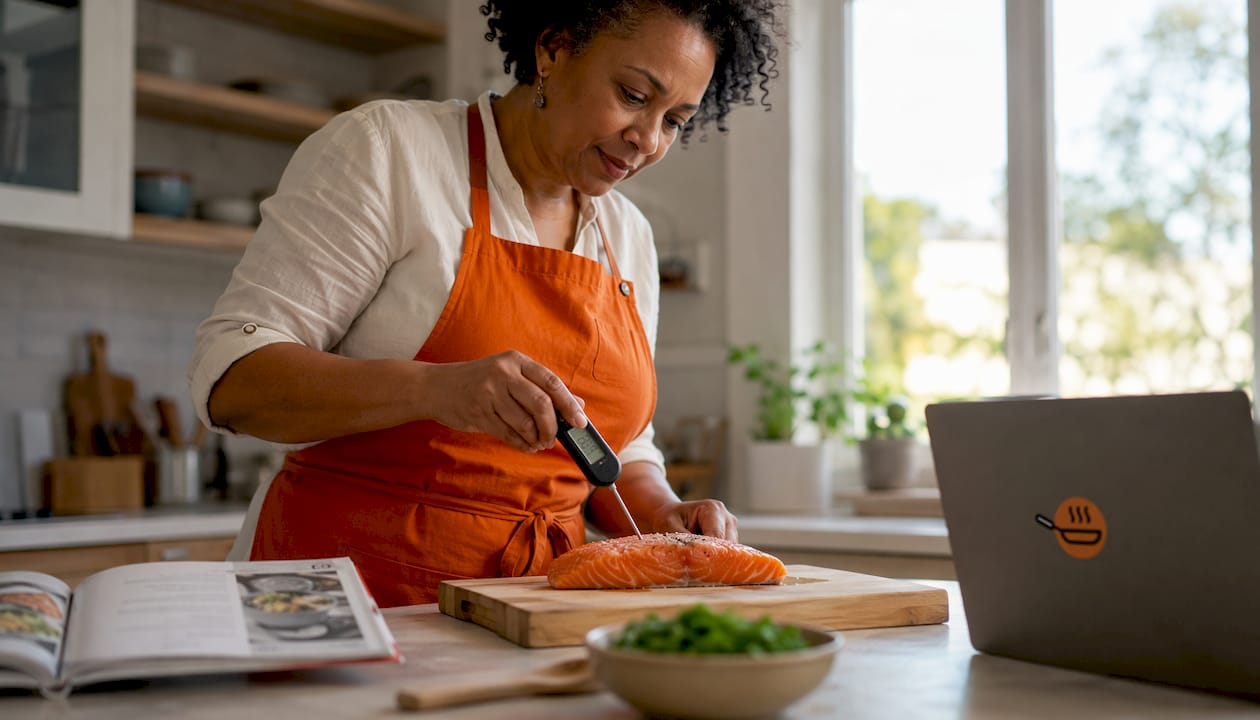
For accurate readings, insert the probe into the thickest part of the meat, away from bone, fat, or gristle. For burgers, go in from the side to reach the center.
Your fridge should sit at or below 40°F; your freezer at 0°F. An inexpensive appliance thermometer — placed on the middle shelf — tells you whether the built-in display is accurate. Many refrigerators run warmer than their dials suggest.
Pro Tip: To calibrate a thermometer, place it in ice water (32°F) and boiling water (212°F at sea level). If it reads off by more than 2°F, adjust or replace it. A $15 thermometer that reads wrong costs more than it saves.
Which appliance features actually reduce your risk
Not every appliance feature matters equally for safe food handling. These are the ones worth prioritizing.
Refrigerators and freezers
- Digital thermostat with a visible readout (not just a dial numbered 1–5)
- Door alarms that alert you when the seal is broken too long
- Separate humidity-controlled drawers to keep produce away from raw proteins
Dishwashers
- A certified sanitize cycle that reaches 150°F or higher — this substitutes for hand sanitizing on boards and utensils
- High-temp wash option for cutting boards and knife handles
Ovens and air fryers
- Precise temperature control (not just “high/medium/low”)
- Built-in probe thermometer port on ovens; for air fryers, look for models with a preheat indicator so food enters a fully hot chamber
- Easy-disassemble baskets and trays that fit in the dishwasher
Countertop and prep tools
- Smooth, non-porous cutting board surfaces (plastic or composite) that go in the dishwasher
- Color-coded board sets (red for meat, green for produce, yellow for poultry) to enforce separation without thinking
Appliance placement matters too. Keep your raw-protein prep zone close to the sink so you can wash hands and tools without crossing the kitchen. A countertop layout that puts the sink between the raw-prep area and the plating area cuts cross-contamination paths significantly.
Pro Tip: You don’t need new appliances to raise your safety level. A $10 appliance thermometer in the fridge, a $15 instant-read probe, and a two-tier sink organizer to drain sponges and brushes off the counter make a measurable difference immediately.
Workflow habits that keep your kitchen safe during active cooking
Good habits during prep prevent most contamination events before they start.
- Set up three zones before you start: a raw-protein area near the sink, a produce/dry-goods area, and a plating area. Never move raw protein across the plating zone.
- Wash hands every time you switch from raw protein to anything else — not just at the start and end.
- After cutting raw meat, wash the board, knife, and counter with hot, soapy water before using them for produce or cooked food.
- Marinate proteins in a covered dish in the fridge, never on the counter.
- Use separate serving utensils for raw and cooked food. The tongs that flipped raw chicken go straight to the sink.
Pro Tip: When seasoning raw proteins, grind pepper into a small bowl first, then sprinkle it on. Grinding directly over the meat turns your pepper mill into a contamination contact point that’s easy to forget about. This tip comes from America’s Test Kitchen, and it’s one of those small shifts that costs nothing.
For families cooking with kids, a kid-friendly kitchen setup keeps high-risk prep zones clearly separated from where children help.
How to clean and sanitize your kitchen tools properly
Cleaning removes dirt. Sanitizing kills germs. You need both, in that order.
For a home sanitizing solution, USDA/FSIS recommends one tablespoon of unscented liquid chlorine bleach per gallon of water, applied after cleaning with hot, soapy water.
Key replacement and cleaning intervals:
- Sponges: Replace every 1–2 weeks, or sooner if they smell or look worn. Cleveland Clinic identifies sponges as major germ hotspots. A countertop paper towel holder within reach makes it easy to grab a fresh sheet instead of reaching for a damp sponge.
- Dish towels: Wash weekly, or immediately after contact with raw protein.
- Cutting boards: Sanitize after every raw-protein session. Replace boards with deep grooves that trap bacteria and can’t be fully cleaned.
- Knives: Wash with hot, soapy water after each protein; never leave them soaking in a sink where someone might reach in blindly.
- Dishwasher sanitize cycle: Use it for boards, utensils, and containers that held raw protein. It reaches temperatures hand-washing rarely does.
Pro Tip: Before pounding meat, wrap your cutting board in plastic wrap. The plastic contains the juices, limits the contamination area, and peels off in seconds. Your board stays clean; your cleanup shrinks. Credit to America’s Test Kitchen for this one.
How to store and reheat leftovers without getting sick
| Item | Fridge (≤40°F) | Freezer (0°F) |
|---|---|---|
| Cooked leftovers and casseroles | 3–4 days | 2–3 months |
| Ground meat (cooked) | 3–4 days | 2–3 months |
| Cooked poultry | 3–4 days | 2–6 months |
| Cooked fish | 3–4 days | 4–6 months |
| Soups and stews | 3–4 days | 2–3 months |
Source: USDA/FSIS Cold Storage Chart
Cool hot food fast by dividing it into shallow containers before refrigerating. A deep pot of soup left on the counter takes hours to cool through; spread across two shallow containers, it chills in a fraction of the time.
Reheating rules:
- Reheat all leftovers to 165°F, verified with a thermometer.
- In the microwave, cover the dish, stir halfway through, and let it stand for at least 2 minutes before checking the temperature. Cold spots are real and common.
- Store raw proteins on the lowest fridge shelf so juices can’t drip onto ready-to-eat food below.
Label containers with the date before they go in the fridge. If you can’t remember when it went in, that’s your answer: throw it out.
Common mistakes that put home cooks at risk
- Washing raw chicken. Splashing spreads bacteria to your sink and surrounding surfaces. Cook to 165°F instead.
- Judging doneness by color. Pink meat can be safe; gray meat can be undercooked. Only a thermometer tells the truth.
- Reusing a stained sponge. A sponge that smells or looks worn is a germ reservoir. Replace it.
- Leaving food out past 2 hours. Bacteria double roughly every 20 minutes in the Danger Zone. Two hours is the hard limit.
- Marinating on the counter. Always marinate in the fridge, covered.
- Using the same board for raw meat and produce. Even a quick wipe between uses isn’t enough. Wash with hot, soapy water or use a dedicated board.
- Skipping the thermometer on “thin” cuts. A thin chicken breast cooks fast but can still miss 165°F at the center.
- Reusing raw-meat marinades as a sauce. Boil the marinade first, or set aside a separate portion before the meat touches it.
For more on tool mistakes new cooks make, including cutting-board errors, Kitchendevotion has a dedicated guide.
Key Takeaways
Safe food handling comes down to four rules, one thermometer, and a fridge you can trust to stay at or below 40°F.
| Point | Details |
|---|---|
| Use a thermometer every time | Cook poultry to a safe internal temperature of 165°F; beef/pork steaks to 145°F, ground meats to 160°F; color alone is not reliable. |
| Keep the fridge at or below 40°F | Use an appliance thermometer to verify; refrigerate perishables within 2 hours. |
| Separate raw proteins from everything else | Use dedicated cutting boards and store raw meat on the lowest fridge shelf. |
| Replace sponges regularly to reduce germ hotspots. | Sponges can harbor germs; switching to brushes or paper towels may reduce risk. |
| Kitchendevotion appliance picks support safe cooking | Prioritize fridges with digital thermostats, dishwashers with sanitize cycles, and air fryers with easy-clean baskets. |
The appliance angle most food-safety guides ignore
Most food-safety content stops at behavior: wash your hands, use a thermometer, don’t leave food out. That’s correct, but it misses half the picture. The appliances you own — and specifically the features you choose — determine how easy those behaviors are to sustain.
A fridge with a dial numbered 1 through 5 is a guessing game. A fridge with a digital readout and a door alarm makes the 40°F rule effortless. A dishwasher without a sanitize cycle means you’re relying entirely on hand-washing technique, which varies. An air fryer with a removable, dishwasher-safe basket removes a friction point that causes people to skip proper cleaning.
The insight worth sitting with: food-safety failures at home are rarely about ignorance. People know they should wash their hands. They skip it because the sink is across the kitchen, or the paper towels ran out, or the cutting board is already in the drying rack. Appliance layout and feature choices reduce those friction points. That’s the real argument for thinking about safety when you buy kitchen equipment, not just when you cook.
Kitchendevotion makes it easier to cook safely at home
Kitchendevotion curates appliances and tools specifically for home cooks who want safe, efficient kitchens without the guesswork. Every category — from fridges with reliable temperature controls to air fryers with dishwasher-safe parts — is selected with both performance and hygiene in mind.

Start with the kitchen appliance priority list to see which appliances deliver the biggest safety and convenience payoff, or browse air fryers filtered for easy-clean features. Both pages include specific model guidance so you know exactly what to look for before you buy.
Useful sources
- 4 Steps to Food Safety — FoodSafety.gov
- Preventing Food Poisoning — CDC
- Safe Minimum Internal Temperature Chart — USDA/FSIS
- Food Safety Basics — USDA/FSIS
- “Danger Zone” 40°F–140°F — USDA/FSIS
- Cross-Contamination: What It Is and How to Avoid It — Cleveland Clinic
- Prevent Cross-Contamination — Minnesota Department of Health
- Food Safety Education Month: Preventing Cross-Contamination — USDA/FSIS
- Preventing Cross-Contamination — America’s Test Kitchen
- Kitchen Safety Tips — Kitchendevotion
- Kitchen Cleaning Tips — Kitchendevotion
This article is general information for home cooks, not professional food-safety or medical advice. For regulatory guidance, recalls, or specific health concerns, consult the USDA, FDA, or CDC directly.
FAQ
What temperature should my fridge be set to?
Keep your refrigerator at or below 40°F and your freezer at 0°F. Use an inexpensive appliance thermometer to verify the actual temperature, since built-in dials are often inaccurate.
Should I wash raw chicken before cooking it?
No. Washing raw poultry spreads bacteria to your sink, counters, and nearby surfaces. The CDC and Cleveland Clinic both advise cooking chicken directly to an internal temperature of 165°F instead.
How long can I keep leftovers in the fridge?
Most cooked leftovers are safe for 3–4 days at or below 40°F, according to USDA/FSIS guidance. Label containers with the date so you’re not guessing.
What’s the safest way to reheat food?
Reheat all leftovers to 165°F, confirmed with a thermometer. In the microwave, cover the dish, stir halfway through, and allow at least 2 minutes of standing time to eliminate cold spots.
How often should I replace kitchen sponges?
Replace sponges at least every 1–2 weeks, or sooner if they smell or look worn. Sponges are among the highest-risk items for cross-contamination in a home kitchen.





No comment