

Clean most removable dishwasher filters at least once a month, and bump that up to every two weeks if you run the dishwasher daily or wash greasy pans often. Low-use households or newer self-cleaning models can often stretch to cleaning every few months. Check your owner’s manual first, since model-specific guidance always overrides a general rule, then head to the step-by-step cleaning process below.
TL;DR:
- Cleaning your dishwasher filter every two weeks is advisable if you run it daily or wash greasy pans frequently, while households with lighter use can stretch to three to six months.
- Visible gunk, foul odors, standing water, or debris on the filter are signs it needs cleaning immediately, regardless of the scheduled timeframe.
- Removable mesh filters require manual removal and gentle scrubbing with a soft brush and mild cleaner, followed by soaking in vinegar or citric acid for mineral buildup.
- Self-cleaning or grinding system filters still benefit from periodic inspection, especially in hard water areas or with greasy loads, even if they don’t require manual removal.
- Neglecting filter maintenance can cause residue on dishes, odors, drainage issues, and reduced cleaning performance over time.
Table of Contents
- How Often to Clean a Dishwasher Filter, According to the Manufacturers
- Signs Your Dishwasher Filter Needs Cleaning Now
- Removable Mesh vs. Self-Cleaning: Which Filter Type Do You Have?
- How to Remove, Clean, and Reinstall Your Dishwasher Filter
- Verifying the Cleaning Worked and Keeping It That Way
- When Filter Cleaning Doesn’t Fix It: Time to Troubleshoot
- Kitchen Devotion’s Take on Filter Upkeep
- What the Conventional Advice Gets Wrong
- Where to Look Next for Easier Appliance Upkeep
- Sources
- FAQ
How Often to Clean a Dishwasher Filter, According to the Manufacturers
The major appliance brands mostly agree on a baseline, and that agreement is worth paying attention to. Maytag recommends rinsing both the upper and lower filter sections under running water at least once a month, and more often if the dishwasher runs daily. Whirlpool’s product guidance says the same thing: monthly maintenance is necessary, and frequent use pushes that timeline up. KitchenAid’s documentation lands in the same range, roughly every 30 days, and some of its newer models flash a “Clean Filter” light so you don’t have to guess.
That monthly figure is a starting point, not a fixed law. A few things push your real-world schedule tighter:
- Daily use or a household of five-plus: clean every two weeks instead of monthly.
- Regular greasy pans or baked-on food: grease clings to fine mesh faster than food residue does, so shorten the interval.
- Hard water: mineral film builds on the mesh even without much food debris, which calls for more frequent checks.
- Light or occasional use, one or two people: you can often push toward the 3 to 6 month range, especially with a self-cleaning system.
The easiest fix for forgetting is pairing the task with something you already do monthly, like changing your air filter or checking smoke detector batteries. BobVila’s guidance suggests pairing filter cleaning with a full tub clean, which turns two small chores into one five-minute habit instead of two things to remember separately.
Signs Your Dishwasher Filter Needs Cleaning Now
Skip the calendar entirely when your dishwasher starts telling you something’s wrong. These are the tells that mean don’t wait for your next scheduled cleaning:
- A musty or rotten smell coming from the dishwasher, even right after a cycle finishes. Trapped food particles decompose in the filter basket and that smell is usually the first clue.
- Dishes coming out with visible food residue or a filmy coating, especially on glasses and flatware, even though the cycle ran a full program.
- Standing water pooling at the bottom of the tub after a cycle ends, a sign the filter or drain path is partially blocked.
- Visible gunk, food chunks, or a slimy film on the filter itself when you pull it out to look.
- A grinding or rattling noise during the wash cycle, which can mean debris is caught where the filter meets the pump.
Before you assume the worst, run a simple flow test: hold the filter under a slow stream of water. If it passes through evenly, the mesh is clear. If the water beads up or runs off the surface instead of soaking through, debris is lodged in the fine mesh holes and it needs scrubbing, not just a rinse. If symptoms stick around after a thorough cleaning, that’s your cue to move to troubleshooting rather than repeating the same steps.
Removable Mesh vs. Self-Cleaning: Which Filter Type Do You Have?
Not every dishwasher filter needs the same attention, and knowing which type sits in your machine changes how often you should think about it.
- Removable mesh filters (coarse and fine, two-part systems): These are the most common design in current residential dishwashers and require manual removal and rinsing on the monthly schedule described above. You’ll usually find a locking ring or twist mechanism at the bottom of the tub, under the lower spray arm.
- Self-cleaning or grinding systems: Older and some higher-end dishwashers use a built-in food disposer that macerates debris and flushes it down the drain automatically, similar to a garbage disposal. The Spruce notes that even these systems benefit from periodic inspection, particularly in hard water areas or households running greasy loads often, since mineral scale and grease can still accumulate on the housing.
- How to tell which one you have: Check your owner’s manual first. If you can’t find it, look at the tub floor. A visible, twist-out cylindrical part usually means removable mesh. No visible part at all, or a manual that mentions “self-cleaning filtration,” points to a grinder system. Some newer models also include a dashboard “Clean Filter” indicator that removes the guesswork entirely.
How to Remove, Clean, and Reinstall Your Dishwasher Filter
If you’ve got a removable mesh filter, the actual cleaning process takes about 10 minutes once you’ve done it a couple of times. Here’s the full sequence.
What you’ll need: a soft nylon brush (an old toothbrush works fine), mild dish soap, warm water, and either white vinegar or a citric acid based cleaner for mineral buildup. Skip wire brushes, steel wool, or abrasive scrubbers. Consumer Reports specifically warns against harsh abrasives on fine mesh, since they can tear the screen or scratch protective coatings.
- Power down first. Unplug the dishwasher or switch off its breaker, and let the interior cool if it just ran a cycle. Hot water and sharp filter edges are a bad combination for bare hands.
- Locate the filter assembly. It sits at the bottom of the tub, usually under the lower spray arm. Most models use a twist lock; check your manual for the exact release mechanism since this varies by brand.
- Remove the coarse filter, then the fine filter beneath it. Twist counterclockwise (most models) and lift straight up. Set both pieces in the sink.
- Rinse under warm running water first to knock loose debris before you scrub anything.
- Scrub the mesh with your soft brush and a few drops of mild dish soap, working in small circles to avoid distorting the screen. Pay close attention to corners and seams where grease collects.
- Soak in a vinegar or citric acid solution for 10 to 15 minutes if you see white mineral film or the mesh still looks dull after scrubbing. This dissolves hard water deposits that soap alone won’t touch.
- Rinse thoroughly and hold the filter up to light to check for any remaining clogged holes.
- Reinstall in reverse order: fine filter first, then coarse filter on top, twisting clockwise until it locks. A filter that isn’t seated correctly can rattle during the cycle or let food particles bypass the screen entirely.
Pro Tip: If baked-on grease won’t budge with soap alone, let the filter soak in hot water with a splash of dish soap for 20 minutes before you scrub. Grease softens dramatically with heat, and you’ll spend a fraction of the elbow grease.
Verifying the Cleaning Worked and Keeping It That Way
Don’t just reassemble the filter and hope. Run the same flow test you used to diagnose the problem: hold the cleaned filter under a slow stream of water and confirm it passes through evenly across the whole mesh surface. Any spot where water still beads up means you missed debris there, and it’s worth another pass with the brush before reinstalling.
Once the filter’s back in, a few habits keep buildup from piling up again between cleanings:
- Run a citric acid or dishwasher cleaner cycle monthly. Pairing this with your filter cleaning schedule cuts down on mineral film and lingering odors, and stretches the time between deep scrubs.
- Scrape plates before loading, rather than relying on the dishwasher to handle large food chunks.
- Avoid overloading with oversized solids like bones or large seeds, which the filter mesh isn’t designed to catch.
- Dose detergent correctly for your water hardness. Too little detergent leaves grease behind; too much can leave residue that clogs the mesh over time.
- Pre-rinse greasy pans and baking dishes rather than letting the dishwasher fight congealed fat, or look into degreasing methods designed specifically for kitchen grease buildup.
If odors or poor cleaning performance persist after all this, the filter probably isn’t the actual problem anymore.
When Filter Cleaning Doesn’t Fix It: Time to Troubleshoot
A clean filter should solve most odor and performance complaints, but not all of them. When symptoms stick around after a thorough cleaning, the cause usually sits deeper in the system, in the drain hose, the P-trap connection, or the circulation pump.
- Standing water that won’t drain even after cleaning often points to a clogged drain hose or a failing drain pump rather than the filter itself.
- Persistent odor with no visible debris anywhere can mean buildup in the drain line or P-trap, which sits outside the filter basket entirely.
- Unusual grinding or a burning smell during cycles suggests a mechanical issue that a filter cleaning won’t touch.
Before calling for repair, check that the drain hose isn’t kinked and that the air gap or garbage disposal connection (if you have one) isn’t blocked. If problems persist, our guide to fixing dishwasher drainage issues walks through the next diagnostic steps. When you do call a professional, have your model number, the specific symptoms, and your recent maintenance history ready. It speeds up the diagnosis considerably.
Kitchen Devotion’s Take on Filter Upkeep
Filter maintenance works best as a habit, not a task you remember only when something smells off. Fold it into whatever monthly chore you already do, like changing an air filter, so it stops competing for your attention.
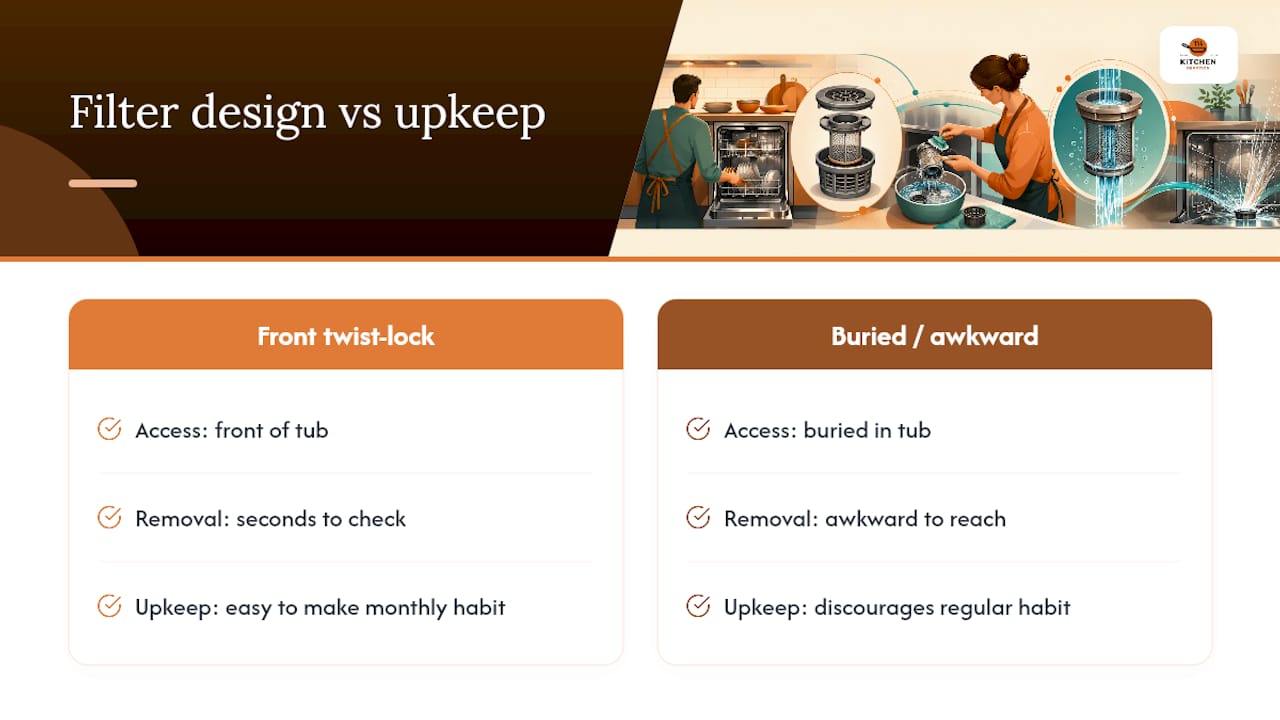
Filter design matters more than most buyers realize when shopping for a new machine. Models with a simple twist-lock filter positioned at the front of the tub take seconds to check, while buried or awkward designs quietly discourage the habit altogether. If you’re comparing new dishwashers, our dishwasher resources cover which designs make this kind of upkeep easier to actually stick with.
What the Conventional Advice Gets Wrong
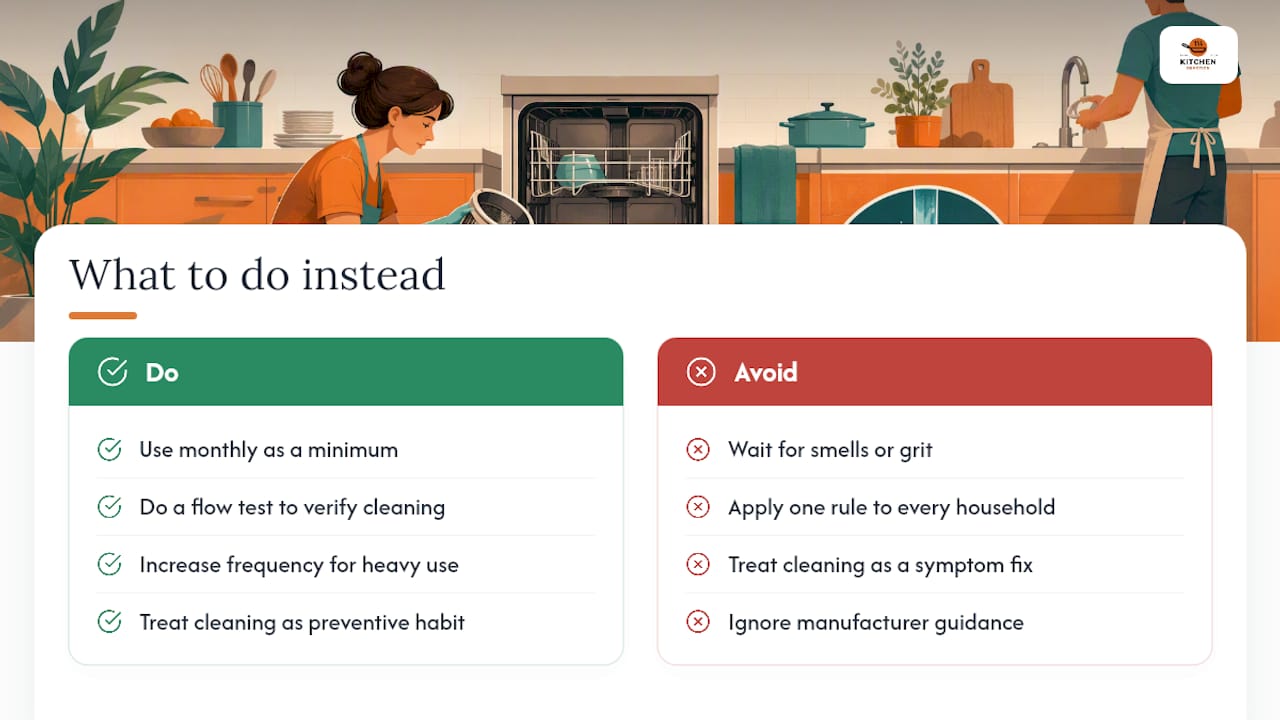
Most articles on this topic hand you the monthly rule and move on, as if every household runs the same three loads a week. That’s not how kitchens actually work. A family running a greasy pan through the dishwasher every night needs a completely different cadence than a retired couple who runs it twice a week, and treating both groups the same is where a lot of filter neglect starts.
The bigger gap I see is that people treat filter cleaning as a fix for symptoms rather than a preventive habit. By the time the dishwasher smells bad or dishes come out gritty, you’re already behind. The flow test matters more than people give it credit for, because it turns a vague “does this feel clean” judgment into something you can actually verify with your own hands. Manufacturer guidance from Maytag, Whirlpool, and KitchenAid all converge on monthly as a floor, not a ceiling. If your household runs hot and heavy, adjust upward without guilt. The appliance will tell you if you’re wrong.
— K. Connors
Where to Look Next for Easier Appliance Upkeep
If filter access on your current dishwasher feels like a hassle every time, that’s usually a design problem, not a you problem. Kitchen Devotion’s kitchen appliance priority list for new homeowners breaks down which features (including front-accessible filters and clean indicators) actually save you time over the life of the appliance, instead of just looking good on a spec sheet.

For households juggling daily cooking and cleanup, our time-saving kitchen appliances list for busy cooks rounds up picks that cut down on maintenance friction across the board, not just dishwashers. And if you’re troubleshooting a broader kitchen setup rather than a single appliance, building a better dishwashing setup at home covers workflow changes that reduce how hard your filter has to work in the first place. Start with the priority list if you’re shopping for a replacement machine soon.
Sources
Manufacturer product-help pages from Maytag, Whirlpool, and KitchenAid informed the frequency guidance above, alongside editorial coverage from Consumer Reports and BobVila on practical maintenance and consequences of neglect.
- Cleaning the Removable Filtration System – Dishwasher – Product Help | Maytag
- How to Clean the Dishwasher Filters – Product Help | Whirlpool
- Cleaning the Removable Filtration System – Dishwasher – Product Help | KitchenAid
- What if you never cleaned your dishwasher filter? | Consumer Reports
- What Happens When You Ignore Your Dishwasher Filter for Too Long? | BobVila
FAQ
What Is the Best Way to Clean a Dishwasher Filter?
Remove the coarse and fine filter sections, rinse under warm water, scrub gently with a soft brush and mild dish soap, and soak in vinegar or citric acid if mineral film is present, then rinse and reinstall.
Do I Need to Wash My Dishwasher Filter After Every Use?
No. Manufacturer guidance from Maytag and Whirlpool points to monthly cleaning for typical use, moving to every two weeks only for daily, heavy loads.
How Do I Know if My Dishwasher Filter Is Clogged?
Watch for lingering odors, dishes that come out with residue, standing water in the tub, or visible gunk on the filter itself, and confirm with a flow test by running water through the mesh.
What Happens if You Never Clean a Dishwasher Filter?
Trapped food particles recirculate onto your dishes, odors build up, and drainage can suffer over time. Consumer Reports notes that neglect can lead to noticeably worse wash performance and lingering smells.





No comment