

Your cookware needs to be ferromagnetic to work on an induction cooktop, and there’s one quick way to check it: grab a fridge magnet and touch it to the base of the pan. If it grips firmly, that pan will heat. Cast iron, enameled cast iron, carbon steel, and many stainless steel pieces pass this test without fuss. Consumer Reports confirms the magnet test as the fastest way to check a pan you already own or one you’re eyeing in a store.
Here’s the short version of what to expect:
- Works reliably: cast iron, enameled cast iron, carbon steel, most magnetic stainless steel
- Usually fails: plain copper, plain aluminum, glass
- Sometimes works: aluminum or copper pans with a bonded magnetic disc welded to the base
That third category is where most kitchen confusion starts, since a pan can look induction-ready and still perform poorly.
Key Takeaways
Induction cookware compatibility comes down to one physical requirement: a ferromagnetic base that a magnet grips firmly, confirmed by lab testing and manufacturer labeling but only guaranteed by checking the pan yourself.
| Point | Details |
|---|---|
| Run the magnet test first | A fridge magnet that sticks firmly to the pan’s base confirms it will activate on induction. |
| Trust cast iron and carbon steel | These materials are magnetic through and through, so they heat evenly without relying on a bonded layer. |
| Check stainless steel individually | Many stainless alloys aren’t magnetic, so test each piece rather than assuming the whole set qualifies. |
| Look past the coil symbol | The induction symbol confirms activation, not even heating, so also check for a full-diameter magnetic base. |
| Choose full-base construction | Kitchendevotion curates induction-ready sets built with full ferromagnetic bases instead of small bonded discs. |
Table of Contents
- What Makes Cookware Induction Cookware Compatible
- How to Test Pots and Pans for Induction Compatibility
- What to Look for When Buying Induction Cookware
- Fixing Buzzing, Warping, and Uneven Heat Over Time
- What the Evidence and the Labels Actually Tell You
- Why the “Induction Symbol” Isn’t the Whole Story
- Find Induction-Ready Cookware Without the Guesswork
- Sources
- FAQ
What Makes Cookware Induction Cookware Compatible
An induction cooktop doesn’t use a heating element at all. It runs current through a coil beneath the glass surface, generating a magnetic field that induces eddy currents directly inside a ferromagnetic pan base. Those currents create resistance, and resistance creates heat, right in the metal itself. No magnetism, no eddy currents, no heat. That’s the whole mechanism, and it’s why the magnet test works so well as a stand-in for a physics lesson.
Cast iron tops most lists for a reason: it’s dense, evenly magnetic across the entire base, and holds heat long after you’ve turned the burner down. The tradeoff is weight. A 12-inch skillet can be quite heavy, which matters if you’re lifting it one-handed to plate a frittata. Enameled cast iron, the kind used in Dutch ovens, keeps that same magnetic core under a glass-like coating, so it’s just as induction-friendly.
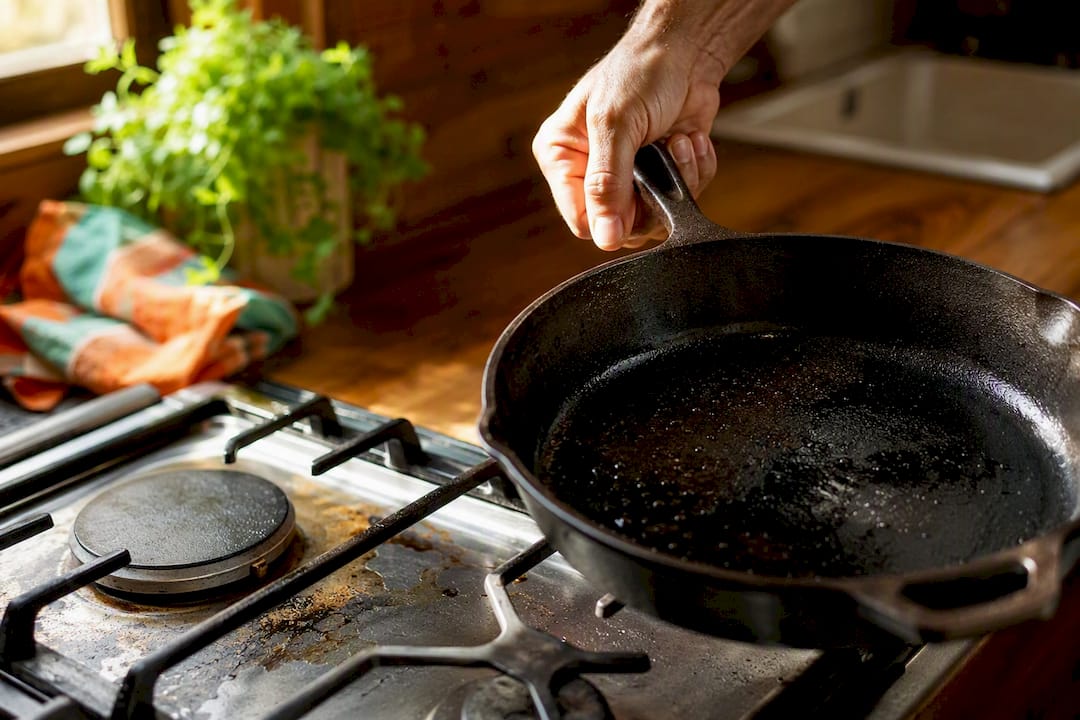
Carbon steel gives you a lighter alternative with a similar magnetic structure. It heats faster than cast iron and cools faster too, which is why professional kitchens favor it for woks and crepe pans where quick temperature control matters more than sustained retention.

Stainless steel is the tricky one. Not all stainless is magnetic. The 18/8 and 18/10 grades common in mid-range cookware often use austenitic stainless, which has a low iron content and won’t grip a magnet. Manufacturers get around this by bonding a magnetic stainless or steel disc into the base during construction, which is why checking cookware material guidance before buying saves you from a pan that looks like stainless but acts like aluminum on your cooktop.
Bonded bases follow the same logic for copper and aluminum cookware. A thin magnetic disc gets fused to the bottom, giving the pan just enough ferromagnetic surface to trigger the coil. The Spruce Eats notes these bonded-layer pans can work fine, but the disc’s size and thickness limit how evenly heat spreads across the rest of the pan.
How to Test Pots and Pans for Induction Compatibility
Testing takes less time than reading this paragraph. Here’s the sequence:
- Grab a standard fridge magnet. Nothing fancy. The small, flat kind from your junk drawer works fine.
- Press it against the outer base of the pan, not the sides or the handle.
- Judge the grip. A strong, immediate stick means the base is fully magnetic. A weak wobble or slow pull-away suggests a thin bonded disc that may underperform. No stick at all means the pan won’t activate.
- Check for the induction symbol on the packaging or stamped into the base. It usually looks like a coil or a zigzag line. Wirecutter points out that this symbol confirms activation but says nothing about how evenly the pan will actually heat.
- Eyeball the base for flatness. Warped or slightly domed bottoms lose contact with the coil and heat unevenly, even if the material passes the magnet test.
- Match the base diameter to your cooktop zone. A small saucepan centered on a large zone may not trigger at all, since most cooktops need a minimum contact diameter to detect the pan.
Pro Tip: Keep a small magnet in your bag when cookware shopping. Store lighting and packaging make it hard to tell real magnetic steel from a thin decorative coating, and a 10-second test on the shelf beats a return trip later.
If you’re testing in a store and staff can’t answer material questions on the spot, ask specifically whether the base is “fully clad” magnetic stainless or has a bonded disc. That single question filters out a lot of guesswork.
What to Look for When Buying Induction Cookware
Passing the magnet test just means a pan will turn on. It doesn’t mean it’ll cook evenly, sit flat after a year of use, or survive your usual scrubbing routine. A few things separate cookware that merely activates from cookware that performs:
- Full-base construction beats a small bonded disc. Lab testing shows full ferromagnetic bases produce more even heating than pans relying on a narrow welded disc at the center.
- Flat, machined bottoms matter more than people expect. Even a slight warp reduces contact with the coil, creating hot spots and slower heating.
- Thickness affects consistency. Thin stamped pans heat fast but unevenly; thicker, disc-bottomed or fully clad pans spread heat more predictably across the surface.
- Buying a matched set in one base material means every pan behaves the same way across every zone, so you’re not relearning heat settings pan by pan.
- Coatings need scrutiny too. Enameled cast iron holds up well long term, while cheaper nonstick coatings on bonded aluminum bases can wear out well before the induction base itself fails.
Budget wisely rather than evenly. A high-quality stainless steel skillet or saucepan earns its price through daily use, while a specialty pan you reach for twice a year doesn’t need the same investment. Put your money into the two or three pieces that touch the stove every day, and let auxiliary pans be more budget-friendly.
Fixing Buzzing, Warping, and Uneven Heat Over Time
That buzzing sound isn’t a malfunction. Consumer Reports attributes the hum to the interaction between the coil’s frequency and the pan’s base, and heavier, flatter cookware tends to vibrate less than thin, bonded-disc pans. If a specific pan buzzes loudly every time, try a slightly smaller zone that matches its base diameter more closely.
- Avoid heating an empty pan on high for long stretches. It stresses thin bonded bases and can cause warping over time.
- Warm cookware gradually rather than jumping straight to max power, especially with carbon steel and cast iron.
- Season carbon steel and cast iron regularly; clean enamel and stainless with non-abrasive pads to protect base flatness.
- Skip metal scouring pads on the base itself. Scratches and dents there are what eventually kill even heating.
Pro Tip: If a pan that used to sit flat and heat evenly starts wobbling or showing scorch rings, check it against a flat surface. A warped base is usually the culprit, not your cooktop.
Once a bonded disc separates slightly from the base metal, no amount of care fixes it. That’s the point to replace the pan rather than keep working around it.
What the Evidence and the Labels Actually Tell You
Independent testing backs up what the magnet test suggests at home. Wirecutter’s lab-tested induction cookware lists show that cast iron, carbon steel, and most fully clad stainless sets perform reliably, while plain copper and plain aluminum consistently fail unless manufacturers add a bonded magnetic layer.
The magnet test and the induction symbol are the two most reliable everyday signals a shopper has. One confirms the physics is right in your hand right now; the other confirms the manufacturer built it that way on purpose. Neither one, on its own, tells you whether the pan will heat evenly for the next five years.
Kitchendevotion curates cookware with that gap in mind, favoring induction-ready cookware sets built with full-base construction rather than pans that pass the magnet test but skimp on the base underneath. Pieces recommended here are chosen specifically because their magnetic bases run edge to edge, not just at the center.
Why the “Induction Symbol” Isn’t the Whole Story
Most shoppers treat the induction symbol like a pass/fail grade. It isn’t. That little coil icon tells you the cooktop will detect the pan and turn on, and that’s genuinely useful information, but it says nothing about whether heat will spread evenly across a 10-inch skillet or stay locked in one hot ring at the center.
The real gap in conventional advice is that it stops at activation. Plenty of guides tell you to check for the symbol or do the magnet test and call it done. That’s necessary, not sufficient. A thin bonded disc will pass both checks and still cook an egg unevenly, browning the middle while the edges stay pale. If there’s one thing worth prioritizing over the symbol itself, it’s base construction: ask whether the magnetic layer runs the full diameter of the pan or just a small welded circle in the center. That single question separates cookware that merely works from cookware that actually performs, and it’s the detail most buying guides skip past on their way to a tidy list.
— K. Connors
Find Induction-Ready Cookware Without the Guesswork
Once you know your current pans pass or fail the magnet test, the next step is filling the gaps without buying pieces that only technically qualify. Kitchendevotion curates cookware sets built specifically around full-base ferromagnetic construction rather than the thin bonded discs that pass activation but heat unevenly.

Every set on the site is selected for home cooks who want consistent behavior across every burner, not a mixed drawer of pans that each need their own workaround. If you’re starting from scratch or replacing a piece that never quite worked right, check the cookware sets collection for options built with full-diameter magnetic bases, or browse the kitchen appliance priority list for new homeowners if you’re outfitting an entire kitchen at once. And if you’re the type who plans meals around new gear, the Dinner Roulette Pro cooking app review is worth a look for pairing new cookware with faster weeknight planning.
Sources
- How to tell if a pot or pan is induction-compatible | Consumer Reports
- What is the best cookware for induction cooktops? | The Spruce Eats
- The 7 Best Induction Cookware of 2026 | Wirecutter
- What happens if you use a non-induction-compatible pan on an induction hob? | Cata Appliances blog
FAQ
How do I know if my pans are induction compatible?
Touch a fridge magnet to the outer base of the pan. If it sticks firmly, the pan has a ferromagnetic base and will work on an induction cooktop.
What type of pans are compatible with induction cooktops?
Cast iron, enameled cast iron, carbon steel, and most fully clad or magnetic stainless steel pans work reliably on induction cooktops.
What cookware cannot be used on induction?
Plain copper, plain aluminum, and glass cookware won’t work on induction unless they have a bonded magnetic disc fused into the base.
What happens if you use a regular pan on an induction stove?
The cooktop performs a brief detection pulse, and if the pan isn’t magnetic, it simply won’t activate — no sustained heating occurs and the cooktop isn’t damaged.
Does a bonded magnetic base perform as well as solid magnetic cookware?
Not always. A full ferromagnetic base tends to heat more evenly than a thin bonded disc, which can leave the outer edges of the pan cooler than the center.



No comment