
Most pans with all-metal construction are oven safe, but the weakest component, whether that’s the handle, lid, or coating, sets the actual temperature ceiling. Before you slide any pan into a hot oven, here’s what you need to know at a glance:
- All-metal handles (stainless, cast iron, carbon steel): No practical ceiling for home ovens; safe well above 500°F.
- Silicone grips or overmolded sleeves: Typically rated to 400–450°F; check the manufacturer’s label.
- PTFE (Teflon) nonstick coatings: Usually limited to around 400°F; degradation begins above that threshold.
- Ceramic nonstick coatings: Often rated to 400–450°F, though solid ceramic bakeware handles higher heat.
- Glass lids and tempered glass: Generally safe to 350–400°F; never use under a broiler.
- Plastic, phenolic, or Bakelite knobs: Typically fail below 350°F; keep these out of the oven entirely.
One critical distinction: oven safe does not mean broiler safe. A broiler fires direct radiant heat at 500–550°F, which is a different challenge than ambient oven heat. Pans with any nonmetal parts or nonstick coatings should stay away from the broiler unless the manufacturer explicitly says otherwise.
Key Takeaways
The single most important rule for oven-safe cookware: the weakest component, whether handle, lid, or coating, sets the maximum safe temperature for the entire pan.
| Point | Details |
|---|---|
| Weakest component rules | Handles, lids, and coatings set the real temperature ceiling, not the pan body alone. |
| PTFE nonstick limit | Most PTFE nonstick pans are rated to around 400°F; never use them under a broiler. |
| Cast iron and carbon steel | Both handle 500°F+ and are broiler safe when fully metal with no nonstick coating. |
| Broiler vs. oven | Broilers reach 500–550°F with direct radiant heat; oven safe does not mean broiler safe. |
| Kitchendevotion recommendation | Shop oven-rated stainless, cast iron, and carbon steel sets with clearly stated temperature limits. |
Table of Contents
- What common pan materials can handle in the oven
- How to know if your pan is oven safe in three steps
- A closer look at each pan material and what it can actually handle
- How handles, lids, and knobs change your oven temperature limit
- Broiler safety: why oven safe doesn’t always mean broiler safe
- Safe use, care, and when to retire a pan
- What experts and safety organizations say about oven-safe cookware
- How an experienced home cook actually picks an oven-safe pan
- Kitchendevotion’s picks for stovetop-to-oven cookware
- Sources
- FAQ
What common pan materials can handle in the oven
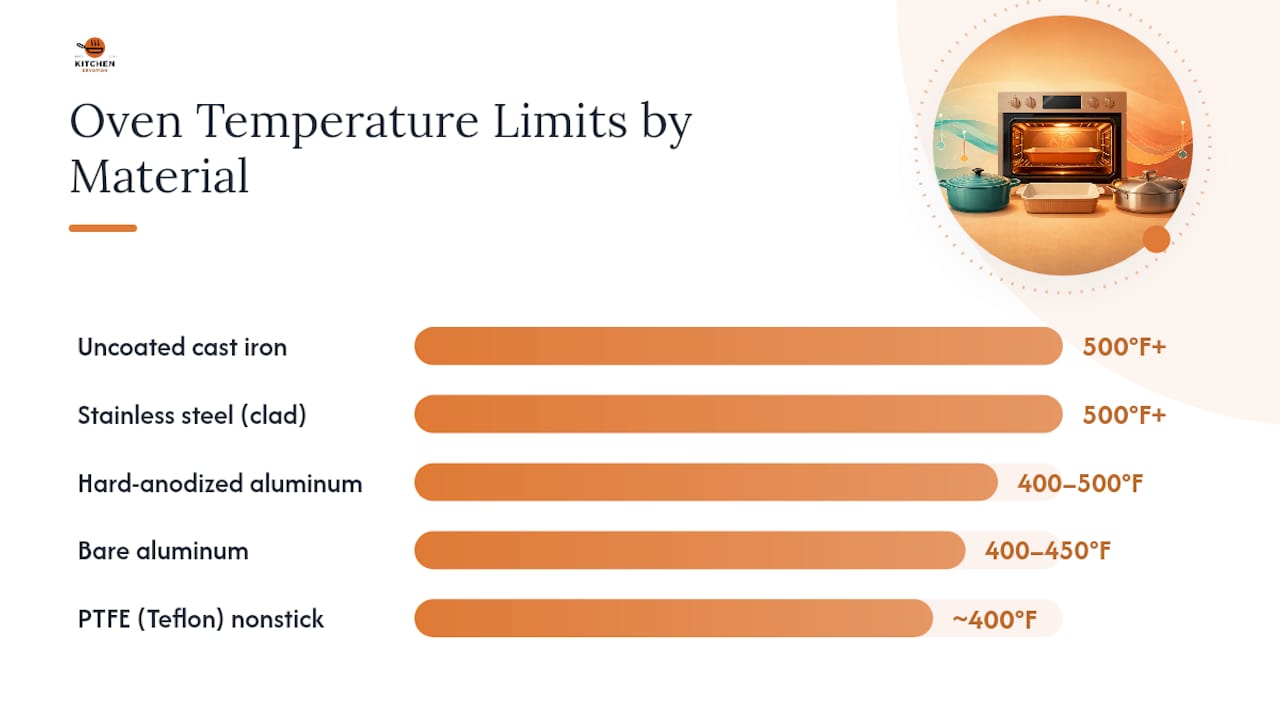
The table below maps the most common cookware materials to their typical oven temperature limits. These are conservative, widely cited ranges. Always verify against your specific manufacturer’s documentation, since construction quality and handle materials can shift the ceiling significantly, as Consumer Reports notes.
| Material | Typical Oven Limit | Broiler Safe? | Limiting Factor |
|---|---|---|---|
| Uncoated cast iron | 500°F+ (no practical ceiling) | Yes | Handle material if not integral |
| Enameled cast iron | ~500°F | Caution | Enamel, knob, or glass lid |
| Carbon steel (seasoned) | 500°F+ | Yes | Seasoning; handle type |
| Stainless steel (clad/multi-ply) | 500°F+ | Usually yes | Handle material |
| Hard-anodized aluminum | 400–500°F | Caution | Handle material; warping risk |
| Bare aluminum bakeware | 400–450°F | No | Thin gauge warps; handle type |
| PTFE (Teflon) nonstick | ~400°F | No | Coating degrades above 500°F |
| Ceramic-coated nonstick | 400–450°F | No | Coating; handle type |
| Glass / tempered glass | 350–400°F | No | Thermal shock risk |
| Stoneware / porcelain | 400–500°F (oven only) | No | Thermal shock; glazing |
| Solid ceramic bakeware | 400–500°F | No | Thermal shock |
When in doubt: treat cast iron and fully stainless steel pans as oven safe; treat any nonstick pan as limited to 350–400°F unless the manufacturer states a higher rating.
How to know if your pan is oven safe in three steps
You don’t need the original box. Run through these checks in under three minutes.
Step 1: Look at the pan base for a stamped symbol or temperature rating.
Flip the pan over. Many manufacturers stamp an oven-safe icon (typically a small oven outline, sometimes with a temperature number) directly into the metal or print it on a label near the base. A number like “Oven Safe to 400°F” is definitive. No symbol doesn’t automatically mean unsafe, but it means you need to keep checking.
Step 2: Inspect every handle, knob, and grip material.
Run your fingers along the handle. Metal riveted or welded handles with no sleeve are the safest bet for high-heat oven use. A silicone sleeve or overmolded grip usually carries a rating of 400–450°F. Anything that feels like hard plastic, rubber, or wood should stay out of the oven. Greasebags emphasizes that the body often survives oven heat just fine; it’s the handle or knob that sets the real safety ceiling.
Step 3: Check the lid separately.
Glass lids, even tempered ones, are typically rated to 350–400°F and are never broiler safe. If the lid has a plastic or phenolic knob, that knob likely fails below 350°F. You can always leave the lid off or transfer to a lidded oven-safe dish.
If no marking exists: Search the brand name plus model number plus “oven safe” on the manufacturer’s website. Look for phrases like “oven safe to X°F,” “stovetop to oven,” or “broiler safe.” If you find nothing, treat the pan as oven safe only to 350°F as a conservative default.
Pro Tip: An unlabeled pan with a plastic or rubber handle should always be treated as not oven safe. The absence of a warning label is not the same as a green light.
A closer look at each pan material and what it can actually handle
Understanding why materials behave differently under oven heat helps you make smarter decisions at the stove and at the store. Better Homes & Gardens test-kitchen guidance confirms that all-metal pans are generally oven safe, with handles, lids, and coatings determining the actual limit.
Uncoated (seasoned) cast iron
Cast iron is the most forgiving material for oven use. A well-seasoned skillet or Dutch oven with an integral metal handle has no practical temperature ceiling for home cooking. It retains heat exceptionally well, which makes it ideal for searing on the stovetop and finishing in the oven. The one caution: avoid moving a cold cast iron pan directly into a screaming-hot oven, since rapid temperature changes can stress the metal over time. If your cast iron shows deep rust that won’t scrub off, or a cracked body, retire it.
Enameled cast iron
The enamel coating adds a ceiling. Most enameled cast iron pieces are rated to around 500°F, but broiler temperatures approach or exceed that limit, so broiler use is risky. A glass lid or a composite knob on the lid typically lowers the safe temperature further. Check whether the knob is metal or phenolic before assuming the whole piece is broiler safe.
Carbon steel
Carbon steel shares cast iron’s heat tolerance but weighs considerably less. Properly seasoned, it handles broiler heat well and transitions from stovetop to oven without complaint. The seasoning itself can degrade if you push temperatures too high repeatedly, so re-season after heavy oven use. Kitchen Clue’s guide highlights carbon steel as a strong stovetop-to-oven choice precisely because of this combination of high heat tolerance and lighter weight.
Stainless steel (clad or multi-ply)
Fully clad stainless steel pans with riveted metal handles are oven safe to 500°F or higher. The main variable is handle construction. A pan with a hollow stainless handle stays cooler in the oven than a solid one, but both are technically safe. Low-quality stainless can leach nickel at high heat, which matters if you have a nickel sensitivity. For oven safe cookware that goes from burner to table, fully clad stainless is one of the most reliable choices.
Hard-anodized aluminum and bare aluminum
Hard-anodized aluminum typically handles 400–500°F, depending on handle material. Bare aluminum bakeware (sheet pans, cake pans) is fine for standard baking temperatures but can warp under direct broiler heat. Thin-gauge aluminum is especially prone to warping. Handle material is the deciding factor for both types.
PTFE (Teflon) nonstick
PTFE coatings are rated for oven use to around 400°F by most manufacturers. Above roughly 500°F, the coating begins to break down and can release fumes. Scratched or aged nonstick fails sooner because the degraded coating has less thermal stability. Never use a PTFE nonstick pan under a broiler. If you’re shopping for a nonstick oven safe pan, confirm the stated oven temperature rating before buying.
Ceramic-coated nonstick
Ceramic-coated pans are often marketed as a safer alternative to PTFE, but the coating still has temperature limits, typically 400–450°F. Solid ceramic bakeware (a ceramic casserole dish, for example) handles higher oven temperatures but is vulnerable to thermal shock. The two are different products with different rules. BCPP cautions that “nontoxic” marketing claims don’t guarantee the absence of PFAS or heat-stable chemicals, so prioritize durable, inert materials for high-heat cooking.
Glass, stoneware, and porcelain
These materials are oven safe for baking but vulnerable to thermal shock. Moving a cold glass dish into a 450°F oven, or setting a hot stoneware dish on a cold surface, can crack it. Tempered glass lids are generally rated to 350–400°F. None of these belong under a broiler.
The weakest-link rule
When the pan body is safe but a coating, adhesive, or handle isn’t, the pan’s effective oven limit is the lowest-rated component. Glued handles, plastic rivets, or rubber gaskets can fail silently before you notice any visible damage. If any part of the pan is not metal, find its specific rating before using it above 350°F.
How handles, lids, and knobs change your oven temperature limit
The pan body rarely fails first. It’s almost always the attachment points.
Metal handles with no sleeve or grip have no practical ceiling for home ovens. They get dangerously hot, so always use oven mitts, but they won’t melt, warp, or off-gas.
Silicone sleeves and overmolded grips are typically rated to 400–450°F. The rating is for the silicone itself, not the underlying metal. If the silicone is glued rather than molded, the adhesive may fail at a lower temperature. Confirm the rating on the manufacturer’s product page.
Plastic, phenolic (Bakelite), and rubber parts are the most common failure points. Phenolic knobs commonly fail below 350°F. Plastic handles can soften, warp, or release fumes. These parts should never go in the oven.
Glass lids rate to around 350–400°F and are never broiler safe. Thermal shock is the bigger risk: don’t move a cold glass lid onto a screaming-hot pan, and don’t set a hot glass lid on a cold counter.
When the body is oven safe but the handle or lid isn’t, you have options. Leave the lid off. Replace a phenolic knob with a stainless steel one (most are threaded and swap easily). Transfer the contents to an oven-safe dish. Or use the pan without the lid and cover with foil instead.
Pro Tip: Many Dutch oven lids have replaceable knobs. A $5 stainless steel replacement knob can turn a lid that’s limited to 350°F into one that handles 500°F. Check the thread size before ordering.
Broiler safety: why oven safe doesn’t always mean broiler safe
A broiler operates differently from a standard oven. Instead of ambient heat surrounding the pan, you get direct radiant heat from an element above, hitting temperatures of 500–550°F at close range. That difference matters enormously for coatings and glass.
Safe under a broiler:
- Bare cast iron (no enamel, no glass lid)
- Seasoned carbon steel
- Fully stainless steel pans with metal handles
- Uncoated metal bakeware (sheet pans, roasting pans)
Keep away from the broiler:
- Any pan with a PTFE or ceramic nonstick coating
- Glass lids, tempered glass bakeware
- Pans with silicone sleeves, plastic handles, or phenolic knobs
- Thin aluminum pans (warping risk under direct heat)
- Enameled cast iron (broiler temps approach the enamel’s ceiling)
The practical rule: unless the manufacturer explicitly states “broiler safe,” assume any pan with nonmetal parts or a nonstick coating is off-limits under the broiler. This aligns with Consumer Reports’ guidance that oven-safe ratings vary widely and manufacturer specs are the only reliable reference.
Safe use, care, and when to retire a pan
Good habits extend the life of oven-safe cookware and prevent the kind of slow damage that turns a safe pan into a hazard.
Avoid thermal shock. Don’t move a pan from a cold refrigerator directly into a hot oven, and don’t set a screaming-hot pan on a cold granite counter. Gradual temperature changes protect both the pan body and any coating.
Clean appropriately for the material. Cast iron and carbon steel should be dried immediately after washing and re-seasoned if the surface looks dull or patchy. Stainless steel handles dishwasher use, but hand washing preserves the finish longer. Nonstick pans should always be hand washed; dishwasher detergent degrades coatings faster than heat does.
Common mistakes that shorten oven-safe life:
- Preheating an empty nonstick pan on a burner before putting it in the oven (the coating overheats rapidly with no food to absorb heat)
- Using nonstick under the broiler even once
- Running seasoned cast iron through the dishwasher (strips the seasoning entirely)
- Stacking heavy pans on top of nonstick without protection
When to retire a pan:
- Nonstick coating is flaking, peeling, or deeply scratched
- Enamel shows cracks or chips (especially on the cooking surface)
- Handle is loose, melted, or shows any deformation
- Pan base is warped and no longer sits flat
- Any adhesive or glued part has softened or separated
A warped pan is a safety issue beyond just uneven cooking. It can tip on a burner and is more likely to stress-crack in a hot oven.
After-oven maintenance checklist:
- Let the pan cool to room temperature before washing
- Inspect handles and knobs for any softening or discoloration
- Re-season cast iron or carbon steel if the surface looks dry
- Store with a cloth or paper towel between stacked pans to protect coatings
What experts and safety organizations say about oven-safe cookware
Manufacturer temperature ratings are the most reliable reference you have. Not the box art, not the retailer description, not a general category claim. The actual stated limit from the brand, found in the manual or on the product page, is what matters.
Consumer Reports makes this point clearly: “oven safe” is relative. Some cookware is safe only to 400°F; higher-end constructions can handle 500–600°F. The difference often comes down to handle construction and coating quality, not just the pan body.
On the nonstick side, the marketing language around “nontoxic” coatings deserves scrutiny. BCPP points out that labels like “PFOA-free” or “non-toxic” don’t guarantee the absence of other PFAS compounds or that coatings will remain stable at high temperatures. For high-heat oven cooking, cast iron, carbon steel, and stainless steel are the safest material choices because they don’t rely on a coating at all.
When shopping for non-toxic cookware, look for these specifics on the product listing:
- A stated oven-safe temperature (not just “oven safe”)
- Separate ratings for the lid and handle if they differ from the body
- An explicit “broiler safe” or “not broiler safe” statement
- Material declarations for coatings, not just marketing terms
Pro Tip: Search the manufacturer’s FAQ or support page for your specific model number. Many brands publish temperature ratings there that don’t appear on the retail listing.
How an experienced home cook actually picks an oven-safe pan
The checklist I run through when buying a pan for stovetop-to-oven cooking comes down to four things: all-metal construction, a clear temperature rating, a replaceable or high-temp knob, and a return policy that doesn’t require a fight.
All-metal construction is non-negotiable for anything going above 400°F. A pan with a silicone sleeve is fine for weeknight sautéing, but the moment a recipe calls for finishing a braise at 450°F or searing a steak under the broiler, that sleeve becomes the limiting factor. A fully stainless or cast iron piece with riveted metal handles removes that variable entirely.
The temperature rating needs to be specific. “Oven safe” printed on the box means almost nothing without a number. A pan rated to 500°F gives you room to roast at 450°F without anxiety. One rated to 350°F is essentially a stovetop-only pan.
For Dutch ovens and covered braisers, the knob matters more than most people realize. A composite or phenolic knob on an otherwise excellent enameled cast iron piece caps the whole thing at 350°F. A metal or high-temp ceramic knob opens it back up to 500°F. That’s often a $5 swap, but it’s worth confirming before you buy.
The practical trade-off: a mid-range stainless clad skillet or an enameled cast iron Dutch oven handles oven tasks more reliably than a delicate nonstick pan, even a well-rated one. Nonstick excels at eggs and fish on the stovetop. For anything that goes from burner to oven and back, the more durable materials earn their keep every time.
Kitchendevotion’s picks for stovetop-to-oven cookware
Knowing the rules is one thing. Finding cookware that actually meets them is where most shoppers lose time.

Kitchendevotion curates cookware specifically for home cooks who want pieces that move from burner to oven without second-guessing the temperature limit. The focus is on all-metal construction, clearly rated collections, and materials that hold up to real cooking, not just light use. Whether you’re building a first set or replacing a pan that’s past its prime, the cookware sets guide covers oven-rated options across stainless, cast iron, and carbon steel categories. For deeper material comparisons before you buy, the cookware materials guide walks through every trade-off in plain language. Start there, pick your material, and shop with a specific temperature rating in mind.
Sources
- Best Cookware Buying Guide – Consumer Reports
- Can You Put a Skillet In the Oven? Everything You Need to Know – BHG
- Safer Cookware Guide – BCPP
- How To Know If A Pan Is Oven Safe? – Greasebags
- Can All Pans Go In The Oven: Safe Use Guide 2026 | Kitchen Clue
FAQ
How do I know if my pan is oven safe?
Flip the pan over and look for a stamped oven-safe icon or temperature rating on the base. If there’s no marking, search the brand name and model number on the manufacturer’s website and look for a stated oven temperature limit.
Which pans cannot go in the oven?
Pans with plastic, rubber, or wood handles should not go in the oven. PTFE nonstick pans are limited to around 400°F and should never go under a broiler. Glass lids and pans with phenolic knobs typically fail below 350°F.
Can you put a nonstick pan in the oven at 400°F?
Most PTFE nonstick pans are rated to around 400°F, so 400°F is at or near the ceiling for most models. Check the manufacturer’s stated limit first, and never use a nonstick pan under a broiler regardless of its oven rating.
Is it safe to put any pan in the oven?
Not all pans are oven safe. All-metal pans with no coatings or nonmetal parts are generally safe for oven use. Pans with plastic handles, nonstick coatings, or glass lids have lower temperature limits and specific restrictions, particularly around broiler use.


No comment