
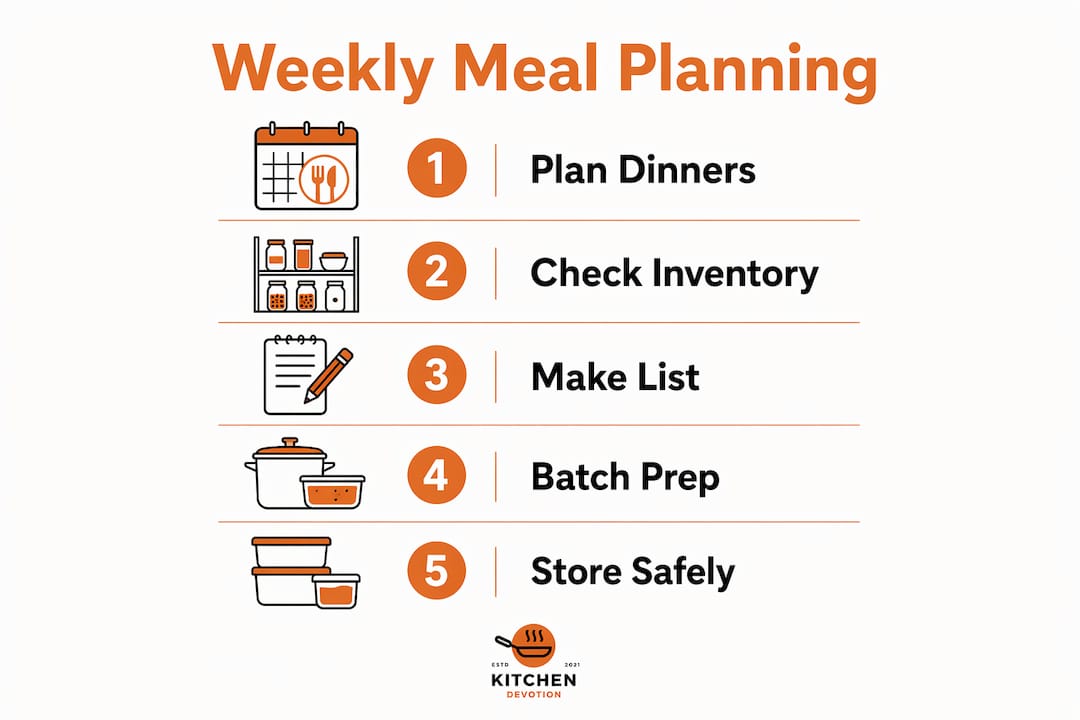
Meal planning is a three-part weekly system: check your inventory, pick several dinners, then build a grocery list. The whole process takes 10–30 minutes once it’s routine. Add a batch-prep window of recommended duration on the weekend and you’ll walk into every weeknight with food already washed, chopped, and ready to cook.
Before your next grocery run, do these three things:
- Open your fridge, freezer, and pantry and note what needs to be used first
- Write down several dinners for the week (not 7 — more on that below)
- Build your shopping list organized by store section: produce, proteins, dairy, dry goods
That’s the whole system. Everything else is refinement.
Table of Contents
- Why does meal planning actually save you money and reduce stress?
- How to run a simple, repeatable weekly meal-planning system
- What kitchen tools should you buy first for meal prep?
- How do you set up a meal-prep station that actually works?
- A concrete 1-week sample plan with a grocery list
- How do you fix the most common meal-planning problems?
- How do you balance nutrition in a weekly meal plan?
- How can you use seasonal and local ingredients in your plan?
- How do you adapt a meal plan for dietary restrictions?
- How do you track pantry inventory to avoid overbuying?
- Kitchendevotion makes the buying decisions easier
- Key Takeaways
- The plan is a tool, not a contract
- Useful sources
- FAQ
Why does meal planning actually save you money and reduce stress?
People make over 221 food-related decisions every single day. By the time 6 PM rolls around, your brain has already spent most of its decision-making energy. That’s when the $40 takeout order happens — not because you’re lazy, but because you’re depleted.
Planning removes that daily friction. When dinner is already decided, you’re not standing in front of the fridge trying to improvise. You’re executing a plan, which takes far less mental effort.
The budget impact is just as real. Building plans from existing inventory prevents duplicate purchases and cuts impulse buys. Fewer unplanned trips to the store means less money spent on things you didn’t need. Reducing food waste is a direct extension of the same habit — you’re shopping for what you’ll actually cook.
Planning several dinners per week — not all seven — reduces burnout, leaves room for leftovers, and keeps the habit sustainable long-term.
Pro Tip: Start with just three dinners your first week. Hitting a small target builds the habit faster than an ambitious plan you abandon by Wednesday.
How to run a simple, repeatable weekly meal-planning system
This three-step workflow takes about 20 minutes of planning plus a 30–45 minute prep session, according to The Whole Fork’s beginner guide.
- Inventory check. Open the fridge and scan for anything approaching its use-by date. Check the freezer for proteins you forgot about. Glance at the pantry for grains, canned goods, and sauces. This takes five minutes and prevents you from buying duplicates.
- Plan several dinners using categories. One-pot meal (Monday), sheet-pan dinner (Tuesday), quick 20-minute meal (Wednesday), planned-over from Tuesday’s leftovers (Thursday), new recipe (Friday). Two flexible nights cover takeout, social plans, or whatever’s left in the fridge.
- Build a grocery list by store section. Produce first, then proteins, dairy, dry goods, and frozen. Sticking to this list is what reduces waste and saves money — not the plan itself.
| Task | Time Required | Safe Hold Time |
|---|---|---|
| Weekly planning session | 10–30 minutes | — |
| Batch-prep window | 30–45 minutes | — |
| Prepped produce (refrigerated at 40°F or below) | — | 3–4 days |
| Cooked proteins (refrigerated at 40°F or below) | — | 3–4 days |
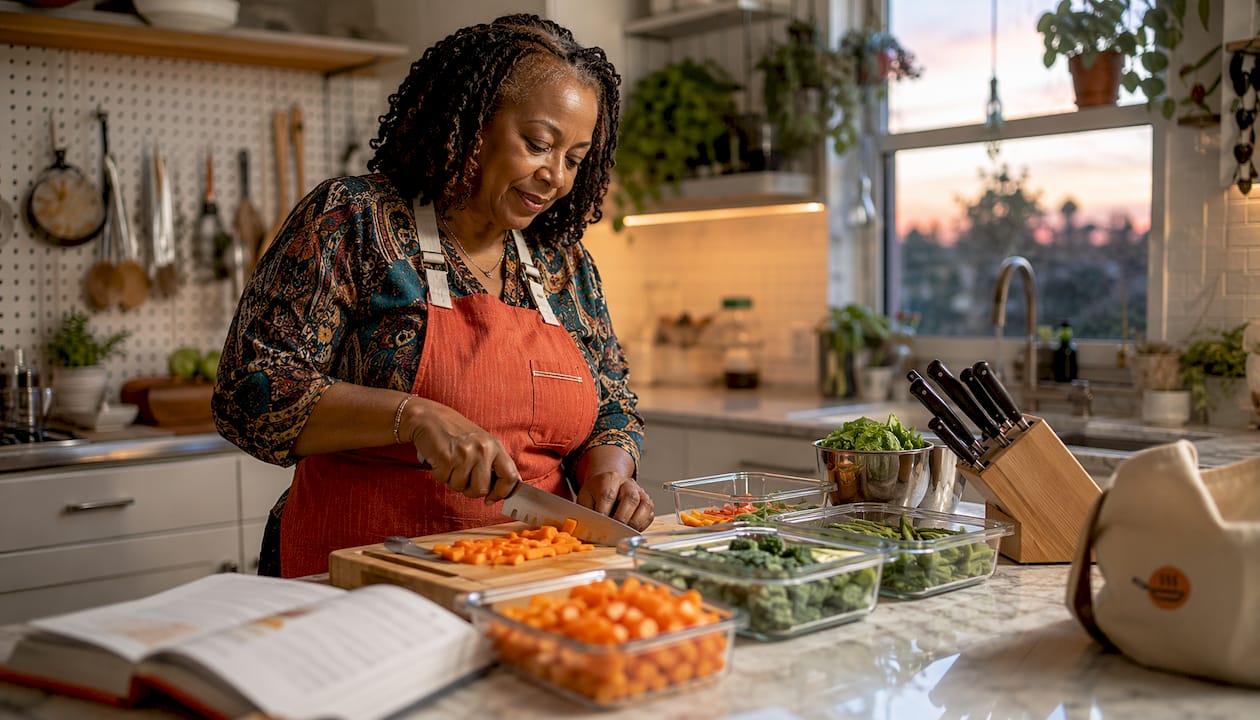
During your batch-prep window, focus on high-impact tasks: wash and chop vegetables, marinate proteins, cook a pot of grains, and hard-boil eggs. Harvard’s Nutrition Source recommends this approach over cooking full meals ahead — it gives you flexibility at dinnertime while still cutting active cooking time in half.
Pro Tip: Limit new recipes to one or two per week. Keep a running “what worked” list so you’re building a reliable rotation, not reinventing dinner every Sunday.
What kitchen tools should you buy first for meal prep?
The answer from professional dietitians and kitchen writers is consistent: buy sharp basics before you buy appliances.
Start with these:
- A quality chef’s knife (8-inch is the most versatile size for most home cooks)
- A large cutting board, at least 18 inches — small boards create mess and slow you down
- Clear glass storage containers so you can see what’s in your fridge at a glance
- Stainless steel measuring cups and spoons that last for years
- A silicone spatula for scraping bowls and stirring sauces without scratching cookware
These tools handle 80% of what weekly prep actually requires. A dull knife and a cramped cutting board will slow you down more than any missing appliance.
Force multipliers to add later:
- A multi-cooker (pressure cooker + slow cooker in one) for soups, stews, and shredded proteins with minimal cleanup
- A food processor for shredding, chopping, and pureeing in seconds instead of minutes
- An air fryer for fast, high-heat cooking that doesn’t require preheating a full oven
Specific small tools that reliably save minutes at prep time include vegetable choppers, kitchen shears, and silicone scrapers. They’re inexpensive and genuinely useful.
| Category | Buy First | Add Later |
|---|---|---|
| Cutting | Chef’s knife, large cutting board | Food processor |
| Storage | Clear glass containers, mixing bowls with lids | Vacuum sealer |
| Cooking | Quality saucepan, sheet pan | Multi-cooker, air fryer |
| Small tools | Measuring cups, silicone spatula, kitchen shears | Vegetable chopper |
For a full prioritized list, Kitchendevotion’s kitchen appliance priority guide walks through exactly what to buy first if you’re starting from scratch.
Pro Tip: Before buying a single-use gadget, ask whether a multi-cooker or food processor already does that job. One appliance that replaces two saves both money and counter space. Kitchendevotion’s guide on multi-purpose appliances makes this comparison straightforward.
How do you set up a meal-prep station that actually works?
A dedicated prep station removes the friction of hunting for tools mid-cook. Here’s how to set one up in any kitchen size:
- Designate a prep zone. Pick the largest clear counter space near your sink. This is where cutting, measuring, and assembling happen.
- Create a supply zone. Keep your most-used tools within arm’s reach: knife block or magnetic strip, cutting board, measuring tools, and a small bowl for scraps.
- Set a cooking zone. The stovetop and oven area stays separate from prep. Move food from prep zone to cooking zone in one step.
- Build a storage zone. A dedicated shelf or drawer for your glass containers, lids, and labels means you’re never hunting for a lid when your hands are full.
Must-haves at your prep station:
- Chef’s knife and honing rod
- Large cutting board (keep it stationary with a damp towel underneath)
- Clear glass containers in two or three sizes
- Masking tape and a marker for date-labeling
- A trash bowl or compost bin within reach to keep the surface clear
For small kitchens, vertical storage is your best friend. A cabinet layout planner can help you find dead space above cabinets or inside doors that most people ignore. Kitchendevotion also covers small-kitchen organization in detail here.
A concrete 1-week sample plan with a grocery list
The week at a glance:
- Monday: Sheet-pan chicken thighs with roasted broccoli and sweet potato
- Tuesday: One-pot lentil soup (make double)
- Wednesday: Flexible night (leftovers, takeout, or eggs)
- Thursday: Lentil soup planned-over with crusty bread
- Friday: Quick shrimp stir-fry over rice
- Saturday/Sunday: Flexible
Grocery list by section:
- Produce: broccoli, sweet potatoes, onion, garlic, carrots, celery, frozen spinach
- Proteins: bone-in chicken thighs, shrimp (frozen), green or brown lentils
- Dairy/Refrigerated: eggs, plain yogurt
- Dry goods: brown rice, canned diced tomatoes, vegetable broth, olive oil
- Frozen: frozen spinach, frozen mixed vegetables (backup)
Frozen vegetables are picked and flash-frozen at peak ripeness, making them a cost-effective, low-waste option that counts toward your daily produce goals.
Batch-prep timeline (30–45 minutes Sunday):
- Roast sweet potatoes and broccoli for Monday (20 minutes, hands-off)
- Chop onion, carrots, and celery for Tuesday’s soup (5 minutes)
- Cook a pot of brown rice (hands-off while you do step 2)
- Portion shrimp into a container for Friday; refrigerate
How do you fix the most common meal-planning problems?
Most plans fail for predictable reasons. Here’s the short list and the fix for each:
- Time mismatch: A recipe that takes 45 minutes on a Tuesday is a problem. Assign your quickest meals to your busiest nights.
- Boredom: Rotate one or two new recipes per week, but keep three or four reliable favorites in the rotation.
- Food spoilage: Prepped produce and cooked proteins stay safe for 3–4 days refrigerated at 40°F or below. Anything beyond that goes in the freezer.
- Schedule changes: “Swap nights” freely. The plan is a guide, not a contract.
- Picky eaters: Build one flexible component into each meal (a grain, a sauce, a protein) that family members can customize.
Pro Tip: Label every container with the date it was prepped using masking tape and a marker. Clear glass containers plus date labels mean you see what’s there and know what to eat first — the two biggest drivers of reducing spoilage.
How do you balance nutrition in a weekly meal plan?
A practical approach: aim for a protein, a vegetable, and a whole grain at each dinner. You don’t need to count macros. If your five planned dinners include two different proteins, two different vegetables, and at least one legume or whole grain, you’re covering the nutritional bases most households need.
Frozen vegetables make this easier. They’re nutritionally comparable to fresh and cost less, so keeping a bag of frozen spinach, peas, or mixed vegetables in the freezer gives you a low-effort nutritional backup on any night. Vary your protein sources across the week — chicken one night, fish another, a plant-based option like lentils or beans on a third — and you’ll naturally hit a broad nutrient range without tracking anything.
How can you use seasonal and local ingredients in your plan?
The simplest method: check what’s on sale at your grocery store before you plan. Seasonal produce is almost always cheaper and better-tasting than out-of-season imports. In summer, that means zucchini, tomatoes, and corn. In winter, it’s root vegetables, squash, and hearty greens.
Farmers markets are worth a weekly visit if one is accessible. Buy what looks good, then build two or three dinners around it rather than shopping for a predetermined recipe. This approach reduces waste because you’re using what’s fresh and abundant, not hunting for a specific ingredient that may be out of season and expensive.
How do you adapt a meal plan for dietary restrictions?
Start by identifying the constraint: gluten-free, dairy-free, vegetarian, low-sodium, or an allergy. Then build your five-dinner template around proteins and vegetables that naturally fit, rather than trying to modify recipes after the fact.
For families with mixed dietary needs, the “component” approach works well. Cook a neutral base (rice, roasted vegetables, a grain) that everyone eats, then prepare proteins separately so each person can assemble their own plate. One base, multiple outcomes, one cooking session.
How do you track pantry inventory to avoid overbuying?
A running list on your phone or a whiteboard on the fridge is more reliable than memory. The habit is simple: when you open the last of something, write it down immediately. When you finish your weekly inventory check, cross off anything you already have before writing your grocery list.
Clear containers in the pantry work the same way they do in the fridge. When you can see that you have half a bag of lentils and two cans of tomatoes, you don’t buy more. Grouping similar items together (all grains in one spot, all canned goods in another) makes the visual check faster and prevents the “I thought we had rice” problem.
Kitchendevotion makes the buying decisions easier
Getting the right tools in the right order is where most home cooks lose time and money. Kitchendevotion curates appliances and cookware specifically for home cooks who want to prep faster without filling their kitchen with gadgets they’ll use twice.
The site’s priority appliance guide for new homeowners follows the same “basics first” logic this article covers. If you’re ready to add a force-multiplier, the time-saving appliances list shows exactly which appliances deliver the biggest prep-time reduction for weekly cooking. For budget-conscious cooks, Kitchendevotion’s tools under $50 page covers the small tools that make a real difference without a big investment. Browse the full collection at Kitchendevotion and find the right starting point for your kitchen.
Key Takeaways
A consistent weekly meal plan built around several dinners, a quick inventory check, and a 30–45 minute batch-prep session cuts food waste, lowers grocery spending, and eliminates nightly decision fatigue.
| Point | Details |
|---|---|
| Plan several dinners per week, not all seven | Fewer planned meals reduce burnout and leave room for leftovers and flexible nights. |
| Inventory before shopping | Check fridge, freezer, and pantry first to avoid duplicate purchases and reduce waste. |
| 15–20 minute planning session | The weekly planning workflow takes 15–20 minutes once the habit is established. |
| 30–45 minute batch-prep window | Focus on washing, chopping, and marinating — not cooking full meals — for the best time-to-value ratio. |
| Kitchendevotion for buying order | Use Kitchendevotion’s appliance priority guide to buy basics first and add force-multipliers when ready. |
The plan is a tool, not a contract
The biggest mistake people make with weekly meal planning is treating it like a rigid schedule. Miss a night, swap a dinner, order pizza on Thursday — none of that means the system failed. It means you used it the way it’s meant to be used: as a framework that reduces friction, not a commitment that creates it.
Starting small is genuinely the right move. Three planned dinners beat seven planned-and-abandoned ones every time. The goal isn’t a perfect week. It’s a slightly easier one, repeated until it becomes automatic.
Useful sources
- Planning Meals for a Family, Clemson HGIC — Behavioral guidance on the 4–5 dinner rule and starting small for long-term consistency
- Meal Prep, Harvard T.H. Chan School of Public Health — Batch-prep timing, food-safety hold times, and high-impact prep tasks
- Why Meal Planning Is a Health Game-Changer, Men’s Health UK — Decision fatigue research and the 221 daily food decisions statistic
- Meal Planning Start to Finish, Canada.ca — Four-step planning framework from a government nutrition authority
- Best Meal Prep Kitchen Tools, National Post — Dietitian-backed tool recommendations and buying-order guidance
- The Complete Beginner’s Guide to Weekly Meal Planning, The Whole Fork — Workflow timing, clear container guidance, and new-recipe rotation advice
- Benefits of Meal Planning for Home Cooking, PlanBite — Waste reduction and budget impact of inventory-first planning
- 10 Best Kitchen Tools for Meal Prep, The Kitchn — Specific small tools (choppers, shears, scrapers) that save prep time
For food-safety specifics on refrigerator and freezer storage temperatures and hold times, consult the USDA’s FoodSafety.gov directly — rules vary by food type and container.
FAQ
How long does meal planning take each week?
The planning session itself takes about 15–20 minutes once the habit is established. Add a batch-prep window of 30–45 minutes on the weekend for washing, chopping, and marinating.
How many dinners should I plan per week?
Plan several dinners, not all seven. This leaves room for leftovers, flexible nights, and social plans without creating burnout or wasted food.
What kitchen tools do I need to start meal prepping?
A sharp chef’s knife, a large cutting board, and clear glass storage containers are the three most important purchases before any appliance. Kitchendevotion’s prep tools guide for beginners covers the full starter list.
How do I keep prepped food safe in the fridge?
Store prepped produce and cooked proteins in airtight containers at 40°F or below and use them within 3–4 days. Label each container with the prep date so you always know what to eat first.
What’s the best way to avoid food waste when meal planning?
Check your fridge, freezer, and pantry before writing your grocery list, and build at least one dinner around ingredients that need to be used up. Clear containers and date labels make it obvious what’s there and what’s next.





No comment