

Multi-purpose kitchen appliances are defined as single units that perform three or more distinct cooking or food preparation functions, replacing several standalone gadgets with one compact machine. The right choice cuts prep time, frees up counter space, and makes weeknight cooking manageable for families of any size. Steam-based multi-cookers, for example, can cook full family meals in as little as 15 minutes for up to 8 people. That kind of efficiency is the core reason home cooks are moving away from single-use tools. When you select multi-purpose kitchen appliances with clear criteria in mind, you stop buying gadgets that collect dust and start building a kitchen that actually works.
What features should you look for in multi-purpose kitchen appliances?
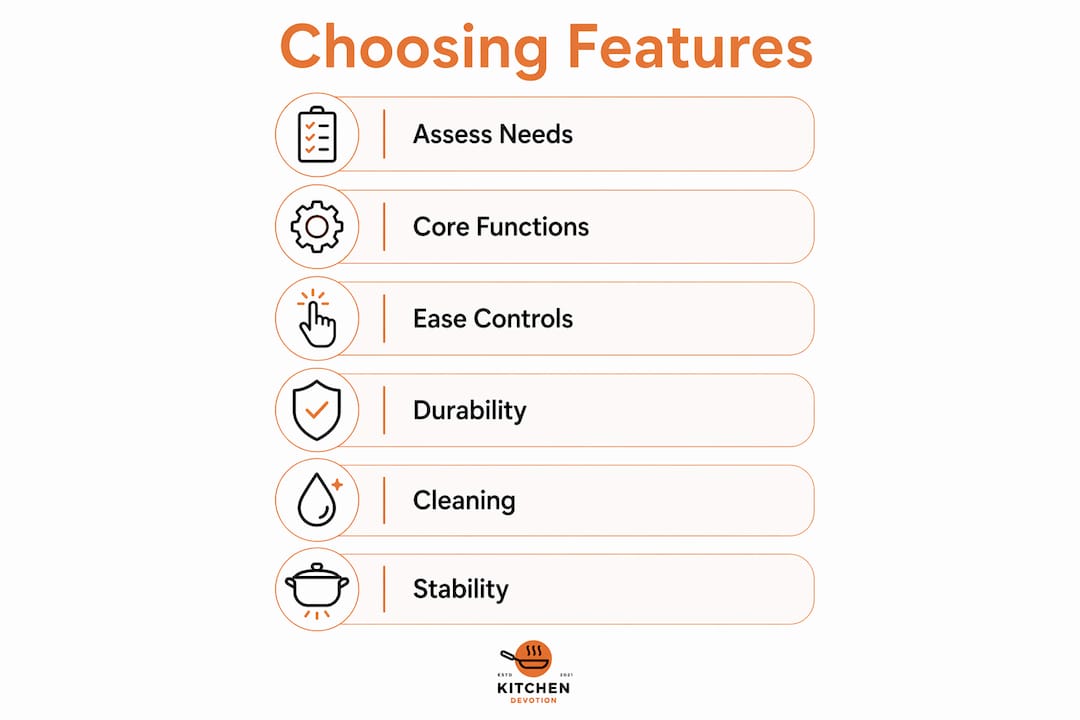
The most useful multi-function kitchen tools share a short list of non-negotiable qualities: genuine cooking versatility, intuitive controls, and easy cleanup. An appliance that handles five cooking methods but takes 45 minutes to scrub is not saving you time. Start with function, then filter by usability.
Core cooking functions worth prioritizing
The broadest multi-use kitchen gadgets cover at least four of these cooking methods in one unit:
- Steam cooking. Preserves nutrients and speeds up meal prep significantly.
- Air frying. Circulates hot air for crispy results with less oil. Kitchendevotion’s air fryer category covers a wide range of capacity options.
- Slow cooking. Ideal for soups, stews, and braised proteins that need low, steady heat.
- Baking and roasting. Replaces a second oven for casseroles, bread, and sheet-pan meals.
- Food processing. Chopping, blending, and pureeing handled without a separate machine.
- Dough kneading. Requires a motor strong enough to handle dense mixtures without overheating.
Not every household needs all six. A family that batch-cooks soups will prioritize steam and slow-cook functions. A household focused on quick weeknight dinners will lean toward air fry and bake.
Controls, durability, and cleaning
User-friendly controls matter more than most buyers expect. Touchscreen panels with preset programs reduce guesswork, but physical dials are more reliable over years of daily use. Durability shows up in the quality of the housing, the thickness of the cooking bowl, and the motor rating. Best-in-class kitchen tools score at least 4.4 out of 5 stars with 10,000 or more customer reviews. That benchmark is a useful filter when you are comparing options online.
Cleaning ease is the feature most buyers underestimate before purchase. Removable, dishwasher-safe parts cut cleanup time dramatically. Avoid units where the blade assembly or heating element is fixed inside the bowl, since those require hand-scrubbing after every use.
Stability during heavy-duty tasks
Vibration reduction technology in all-in-one kitchen machines provides quieter, more stable performance during demanding tasks like dough kneading or high-speed blending. Without it, a machine can walk across the counter at full speed, which is both annoying and a safety concern. Check whether the base has non-slip feet and whether the manufacturer lists a vibration reduction system in the specs.
Pro Tip: Never judge a multi-function appliance by its longest feature list. An appliance that does eight things adequately often does fewer things well. Pick the unit that excels at the two or three tasks you perform most often, and treat the extra functions as a bonus.
How to assess your cooking needs and kitchen space
Matching an appliance to your actual cooking habits is the step most home cooks skip. They buy based on features and discover later that the machine is too large, too limited, or too complicated for daily use. A structured self-assessment prevents that mistake.
-
Count your household size and typical meal volume. A family of four cooking dinner five nights a week needs a different capacity than a couple who meal-preps on Sundays. Most multi-cookers list capacity in quarts or liters. A 6-quart unit handles four to six servings comfortably. An 8-quart or larger unit suits families of six or more.
-
List the meals you cook most often. Write down your ten most frequent dinners. If seven of them involve soups, grains, or steamed proteins, a multi-cooker with a large bowl is the right anchor appliance. If most meals involve roasted vegetables and proteins, an air fryer-oven combo fits better.
-
Measure your available counter and storage space. Kitchen organization in small spaces depends on knowing exact dimensions before you buy. Measure the height clearance under your cabinets, the depth of your counter, and the shelf space in your pantry. A machine that does not fit under the cabinet will not stay on the counter long.
-
Set a realistic budget with a floor, not just a ceiling. Affordable multi-purpose kitchen equipment starts around $80 for entry-level food processors and reaches $500 or more for full all-in-one cooking systems. Spending below your actual needs usually means buying twice. Decide the minimum feature set you require, then find the lowest price that meets it.
-
Audit what you already own. Before adding a new appliance, identify which single-use tools it would replace. Reducing single-use tools in favor of versatile appliances is the clearest path to a less cluttered, more functional kitchen. If a new multi-cooker replaces your rice cooker, slow cooker, and steamer, the trade is worth it. If it duplicates tools you already use daily, reconsider.
Avoiding feature bloat is the discipline that separates a good purchase from a regrettable one. Appliances with too many functions often compromise durability, cleaning ease, or task precision. A 12-in-1 machine that performs each function at 70% quality is less useful than a 5-in-1 that performs each at 95%.
What are the most common types of multi-purpose kitchen appliances?
Understanding the main appliance categories helps you match the right tool to your kitchen. Each type has a distinct strength, a typical footprint, and a set of tasks it handles better than the others.
| Appliance type | Primary functions | Typical capacity | Counter footprint |
|---|---|---|---|
| Multi-cooker | Pressure cook, slow cook, steam, sauté | 6–8 quarts | Medium |
| Food processor-cooker | Chop, blend, cook, steam, knead | 3–5 quarts | Medium to large |
| Air fryer-oven combo | Air fry, bake, roast, toast, dehydrate | 10–26 quarts | Large |
| Immersion blender set | Blend, whisk, chop (with attachments) | Variable | Small |
Multi-cookers
Multi-cookers are the most popular entry point for families moving away from single-use gadgets. They combine pressure cooking, slow cooking, steaming, and sautéing in one pot. The batch cooking advantages for busy families are significant: one session on a Sunday can produce proteins, grains, and soups for the entire week. Most units in this category are round, fit under standard cabinets, and store easily in a lower cabinet when not in use.
Food processor-cookers
All-in-one food processor-cookers go further by adding chopping, blending, and kneading to the cooking functions. These machines handle everything from pastry dough to risotto without switching bowls. The tradeoff is size. Most units in this category have a larger footprint than a standard multi-cooker and require dedicated counter or shelf space. They suit home cooks who bake regularly or prepare complex sauces and dips alongside cooked meals.
Air fryer-oven combos
Air fryer-oven combos replace the countertop toaster oven and the standalone air fryer in one unit. They handle roasting, baking, dehydrating, and toasting alongside air frying. The capacity is larger than a basket-style air fryer, which makes them practical for families. Kitchendevotion covers air fryer techniques in detail for cooks who want to get the most from this category.
Immersion blender sets
Immersion blenders with accessory attachments are the most space-efficient option. A single motor unit accepts whisk, chopper, and blending attachments, covering four to five tasks in a package that stores in a drawer. They do not cook, so they work best as a complement to a multi-cooker rather than a standalone solution.
How to maintain your appliances for longevity and best performance
A well-maintained multi-function appliance lasts years longer than one that is cleaned carelessly or stored incorrectly. Maintenance is not complicated, but it requires consistency.
- Clean after every use. Food residue left in a heating element or blade assembly degrades performance and creates odors. Rinse removable parts immediately after cooking while they are still warm.
- Avoid abrasive scrubbers on non-stick surfaces. Non-stick coatings on cooking bowls scratch easily. Use soft sponges and mild dish soap. A scratched non-stick surface releases particles into food and loses its release properties within months.
- Store with lids off or ajar. Sealing a damp appliance traps moisture and promotes mold growth inside the bowl or around the gasket. Store the lid separately or leave it slightly open.
- Check and replace gaskets annually. The rubber sealing ring on pressure cookers and multi-cookers absorbs odors and degrades over time. Most manufacturers sell replacement gaskets for under $15. A worn gasket causes pressure loss and uneven cooking.
- Use the right accessories. Substituting non-approved attachments can damage the motor coupling or void the warranty. Stick to accessories listed in the manufacturer’s compatibility guide.
Portioning and freezing cooked batches with silicone molds like Souper Cubes preserves freshness and reduces food waste. This practice pairs naturally with multi-cooker batch cooking: make a large pot of soup, portion it into molds, freeze, and pull out single servings as needed. The result is less waste and faster weeknight meals.
Pro Tip: Label every frozen portion with the date and contents using masking tape and a marker. Unlabeled containers are the main reason frozen food goes to waste. A simple labeling habit turns your freezer into a reliable meal resource.
Key takeaways
Choosing versatile kitchen appliances that genuinely improve meal prep requires matching appliance functions to your cooking habits, household size, and available space before comparing prices or feature counts.
| Point | Details |
|---|---|
| Define your core functions first | Identify the two or three cooking tasks you perform most often before evaluating any appliance. |
| Use consumer rating benchmarks | Prioritize appliances with at least 4.4 stars and 10,000 or more reviews as a quality baseline. |
| Avoid feature bloat | Fewer functions performed well outperform many functions performed poorly in daily use. |
| Measure space before buying | Confirm counter height clearance and storage dimensions before committing to any unit. |
| Maintain consistently | Clean after every use and replace gaskets annually to extend appliance life significantly. |
Why I stopped buying appliances by feature count
By K. Connors
The turning point for me came after I bought a 10-in-1 machine that I was convinced would replace half my cabinet. It did, technically. But I stopped using it within three months because the bowl was awkward to clean, the controls required a manual every time, and the results on the tasks I actually cared about were mediocre. I went back to two simpler machines that each did fewer things but did them reliably.
The lesson I took from that experience is that versatility is only valuable when usability keeps up. A machine you avoid using because it is frustrating is not saving you anything. The best multi-function kitchen tools I have used are the ones where the most common task takes under two minutes to set up and the cleanup takes under five.
Home cooks often underestimate how much capacity matters. A 4-quart multi-cooker sounds reasonable until you are feeding four people and trying to fit a whole chicken with vegetables. Buying slightly more capacity than you think you need is almost always the right call. You can cook a small batch in a large pot. You cannot cook a large batch in a small one.
The other mistake I see regularly is buying for aspirational cooking rather than actual cooking. If you make pasta twice a year, you do not need a machine with a pasta attachment. Buy for the meals you cook every week, and let the occasional special dish be handled by a simpler method. That discipline keeps your kitchen functional instead of cluttered.
— K. Connors
Kitchendevotion’s picks for time-saving versatile appliances
Home cooks who want a shorter path to the right appliance can skip the hours of research. Kitchendevotion has done the curation work, pulling together appliances that balance real cooking performance with practical kitchen footprints.
The time-saving appliances list at Kitchendevotion covers options across budgets and household sizes, from compact immersion blender sets to full multi-cooker systems. Each pick is selected for usability, cleaning ease, and genuine multi-function value. For cooks who also want guidance on simplifying daily cooking, Kitchendevotion’s resource library covers practical techniques alongside product recommendations. The goal is a kitchen that works harder so you spend less time in it.
FAQ
What does “multi-purpose kitchen appliance” mean?
A multi-purpose kitchen appliance is a single unit that performs three or more distinct cooking or food preparation functions. Common examples include multi-cookers that pressure cook, slow cook, and steam, and air fryer-oven combos that bake, roast, and dehydrate.
How many functions should a good multi-use appliance have?
The ideal number is four to six core functions that the appliance performs well, rather than ten or more functions performed at reduced quality. Appliances with too many functions often compromise durability and cleaning ease.
What capacity do I need for a family of four?
A 6-quart multi-cooker handles four to six servings comfortably for most family meals. Families of six or more benefit from an 8-quart unit, particularly for batch cooking soups, grains, and proteins.
How do I know if an appliance is high quality before buying?
Use the consumer benchmark of at least 4.4 out of 5 stars with 10,000 or more verified reviews as a starting filter. Then check for dishwasher-safe parts, a clear warranty, and available replacement accessories.
Are multi-purpose appliances worth it for small kitchens?
Multi-purpose appliances are especially well-suited to small kitchens because one unit replaces several single-use gadgets. Replacing a rice cooker, slow cooker, and steamer with a single multi-cooker frees up meaningful cabinet and counter space.




No comment