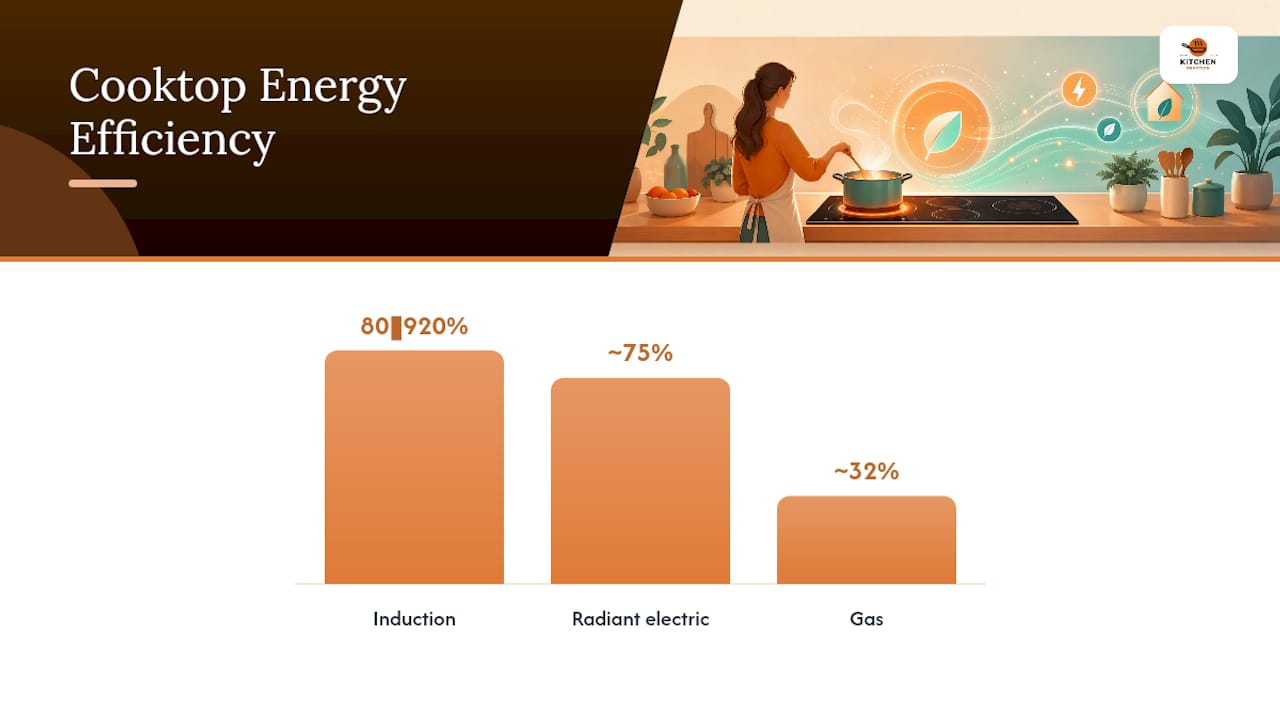
Induction cooking delivers faster heat, tighter temperature control, and higher energy efficiency than gas or conventional electric for most home kitchens. The math backs this up directly: induction cooktops run at roughly 80% to 90% energy efficiency, compared with about 75% for radiant electric and just 32% for gas. Lab and consumer testing also finds induction boils water 20% to 40% faster than gas or standard electric burners, with noticeably better simmer control on top.
The trade-off is upfront. You’ll likely pay more for the cooktop itself, and if your current cookware isn’t magnetic, you’ll need to replace some of it before the burner does anything at all.
Quick fact: Induction hits 80–90% energy efficiency versus 32% for gas, according to the Department of Energy, which is the single biggest reason induction owners see lower cooking-related energy costs over time.
For most home cooks, that combination of speed, control, and lower running costs outweighs the initial hassle of buying new pots. The exceptions are narrower than people assume, and we’ll get to those.
Key Takeaways
Induction cooking beats gas and standard electric on energy efficiency, cook speed, and everyday safety, with cookware compatibility as the main upfront hurdle.
| Point | Details |
|---|---|
| Efficiency edge is real | Induction runs 80–90% efficient versus 75% for radiant electric and 32% for gas. |
| Speed advantage is measurable | Consumer testing shows induction boils water 20–40% faster than gas or electric. |
| Cookware must be magnetic | Run the magnet test on existing pans before buying anything new. |
| Pacemaker guidance is specific | Keep 12–24 inches of distance and consult your cardiologist if you have an implanted device. |
| Start small to test fit | Kitchendevotion’s portable burner and single-pan starter kit lets you try induction at low cost. |
Table of Contents
- What Are the Benefits of Induction Cooking, Technically Speaking?
- What Makes Induction Cooking Better Than Gas or Electric?
- Is Induction Cooking Safe for Your Kitchen?
- Which Cookware Works on an Induction Cooktop?
- How Much Does Induction Cooking Actually Save on Energy?
- What Are the Downsides of Induction Cooking?
- What Can You Actually Cook Well on Induction?
- How Do You Choose the Right Induction Cooktop?
- What Do Experienced Home Cooks Wish They’d Known Before Switching?
- Who Actually Benefits Most From Switching to Induction?
- Start Small: How to Try Induction Without a Full Kitchen Overhaul
- Sources
- FAQ
What Are the Benefits of Induction Cooking, Technically Speaking?
Induction cooktops heat the pan directly through a magnetic field instead of heating the cooktop surface itself. A coil sits beneath the glass ceramic top, and when you set a magnetic pan on it, an electric current runs through the coil and generates a fluctuating magnetic field. That field induces eddy currents directly inside the metal of the pan, and those currents generate heat right in the cookware.
Picture it this way: the coil under the glass never gets hot on its own. Set an empty induction burner to high and touch the surface, and it stays cool because there’s nothing there to react to the field. Put a cast iron skillet on it, and that skillet becomes the heating element itself, going from room temperature to sizzling in seconds. Engineering estimates put the direct energy conversion in this process around 84% in some tested configurations, which explains why so little heat gets wasted along the way.
This is also why cookware matters so much with induction, more than with any other cooktop type. If the metal isn’t magnetic, the field has nothing to grab onto, and the burner won’t heat at all. We’ll walk through exactly how to test your existing pots in a later section.
What Makes Induction Cooking Better Than Gas or Electric?
Induction wins on five fronts that matter to actual cooking: speed, control, efficiency, safety, and cleanup. Each one solves a specific frustration that gas and traditional electric cooks live with every day.
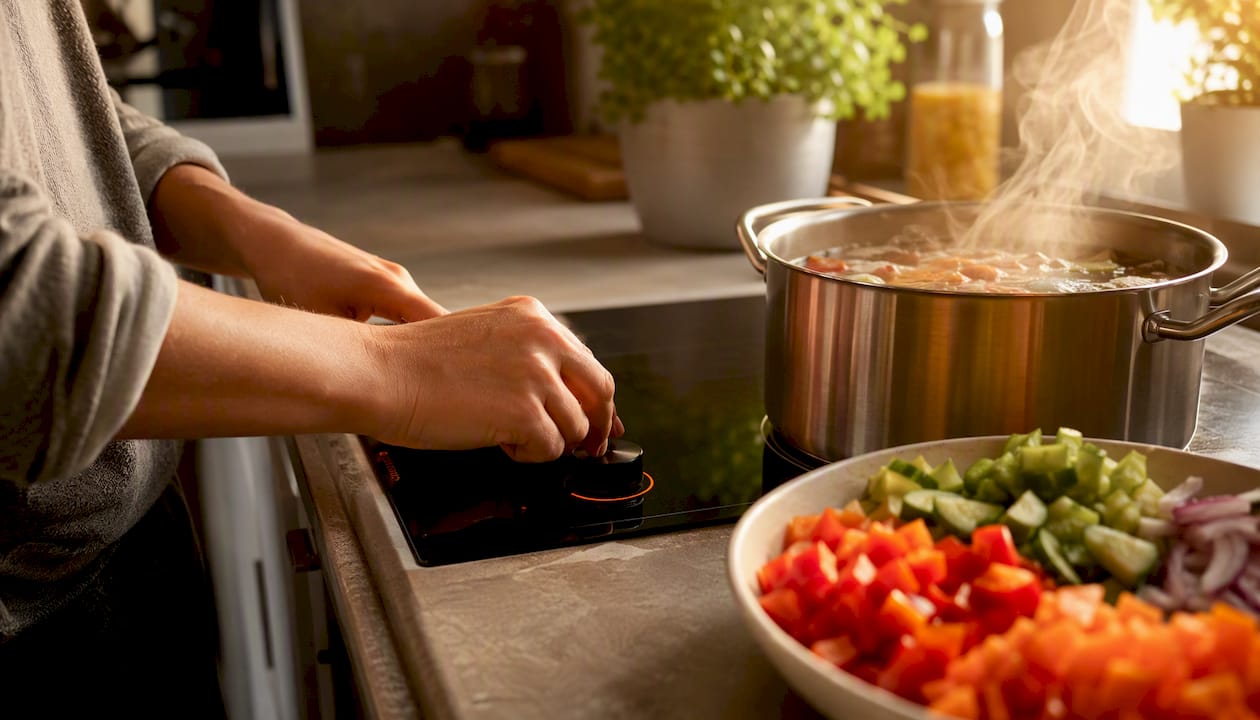
Speed is the most immediately noticeable difference. Because the pan itself is the heating element, there’s no lag time waiting for a burner coil or flame to transfer heat through the cookware. Consumer Reports testing found induction models boil water 20% to 40% faster than gas or radiant electric, and that gap shows up every time you’re waiting on pasta water or trying to get a sear started before dinner guests arrive.
Temperature control is where induction actually surprises people who assume gas is unbeatable for precision. Turn the dial down and the heat output changes instantly, the same way it does on gas, but with none of the low-flame flicker-out problems gas burners have at their lowest settings. That instant responsiveness makes a real difference for anything that needs a rock-steady simmer, like a hollandaise, a delicate risotto, or a chocolate ganache that scorches the second it gets too hot.
Energy efficiency is the number that shows up on your utility bill. The Department of Energy puts induction at 80% to 90% efficient, against 75% for radiant electric and 32% for gas. That efficiency gap means less wasted energy heating your kitchen air instead of your food, which also means your air conditioning works less hard in summer.
Safety comes from the fact that the cooktop surface itself never gets directly heated by a flame or a glowing coil. Most induction units include automatic pan detection, meaning the burner won’t activate unless it senses compatible cookware, and it shuts off the moment you lift the pan.
Cleanup benefits from a flat glass surface with no grates, no burner caps, and no boiled-over spills baking onto an open flame. A damp cloth wipes off most spills in seconds, once the surface has cooled.
Here’s the shorthand version of what you’re getting:
- Faster heat: 20% to 40% quicker boil times than gas or standard electric
- Instant, precise temperature adjustment with no flame flicker at low settings
- 80% to 90% energy efficiency versus 32% for gas
- No open flame and automatic shutoff when cookware is removed
- Flat glass surface that wipes clean without scrubbing around grates
Pro Tip: Once you switch, drop your instinct to preheat pans on high. Induction responds so fast that a medium setting reaches searing temperature almost as quickly as high does on gas, and you’ll burn a lot less oil and garlic learning that the hard way.
Is Induction Cooking Safe for Your Kitchen?
Yes, induction reduces two of the biggest kitchen hazards: open flame and constantly hot surfaces. It does carry one specific consideration worth understanding if you or someone in your household has an implanted cardiac device.
Because there’s no flame and no glowing coil, induction eliminates the most common way stovetop fires start, unattended flammable material catching a flame. The glass surface itself stays relatively cool during cooking since the heat generates in the pan rather than the cooktop, though it will warm somewhat through simple conduction once a hot pan sits on it a while. Most units also include pan-detection sensors that prevent the burner from firing without compatible cookware in place, and many shut off automatically if a pan is removed or boils dry.
The EMF question deserves a straight answer instead of vague reassurance. Health guidance recommends people with pacemakers or ICDs keep 12 to 24 inches of distance from an active induction cooktop and follow their device manufacturer’s specific guidance. Peer-reviewed testing on 11 cooktop models found that under worst-case conditions, such as an off-center pot placed very close to the coil, induced voltages reached up to 800 millivolts, enough to theoretically affect certain older unipolar pacemaker systems. At a distance of roughly 35 centimeters, about 14 inches, that induced voltage dropped to around 60 millivolts, well below the threshold likely to interfere with most modern devices. Anyone with an implanted cardiac device should talk with their cardiologist before relying on induction as their primary cooktop.
Safety-conscious households should also know:
- Kids can’t accidentally leave a burner “on” with visible danger the way a gas flame signals; check your model’s control lock feature if that’s a concern.
- The glass surface can still cause burns from a hot pan sitting on it, so treat it with the same respect as any hot cooktop.
- High-power boost settings on some models draw enough current to require dedicated wiring, which we cover more in the buying section below.
Pro Tip: If a household member uses a pacemaker or ICD, position the cooktop so the primary cooking zone sits at least arm’s length from where that person would normally stand at the stove, and confirm the specific model’s field strength with the manufacturer if there’s any doubt.
For broader appliance safety habits worth building into your kitchen routine, Kitchendevotion’s food safety guide for home cooks covers practical tips that apply across appliance types.
Which Cookware Works on an Induction Cooktop?
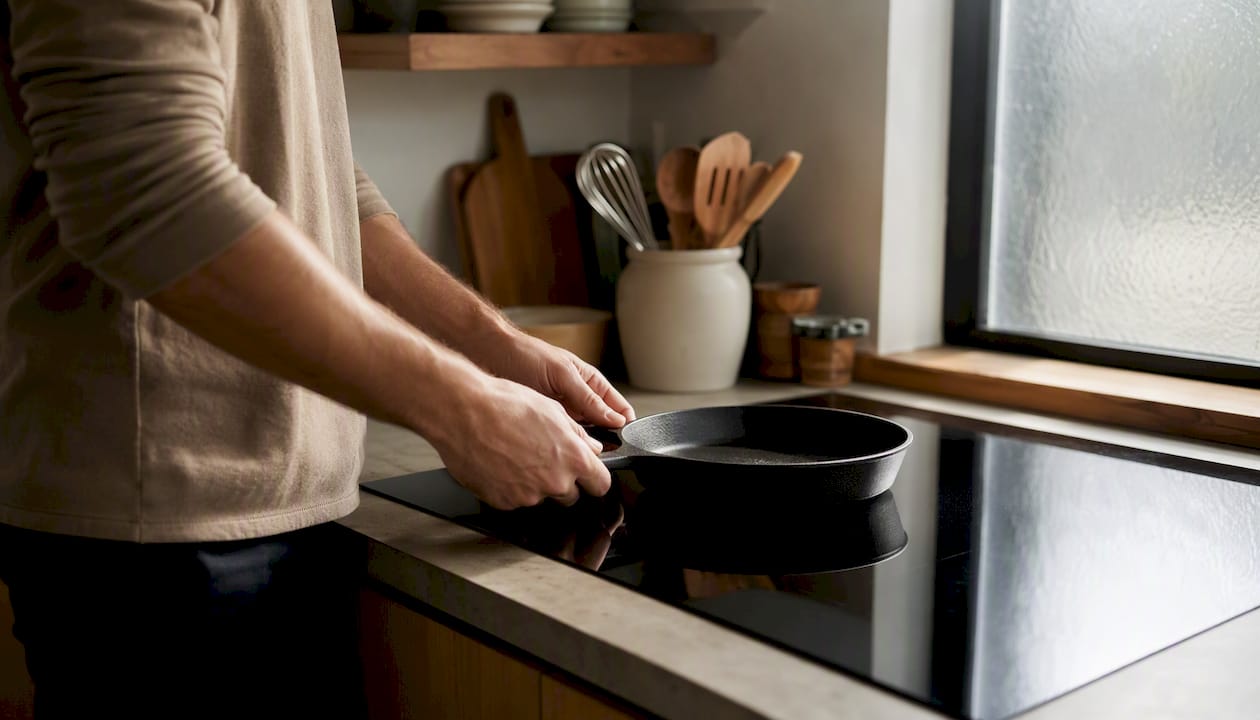
Only cookware with a magnetic (ferromagnetic) base works on induction, and the fastest way to check is the magnet test. Grab any refrigerator magnet, hold it to the bottom of your pot or pan, and if it grips firmly, that piece will work. If the magnet doesn’t stick, or only sticks weakly, the pan won’t heat.
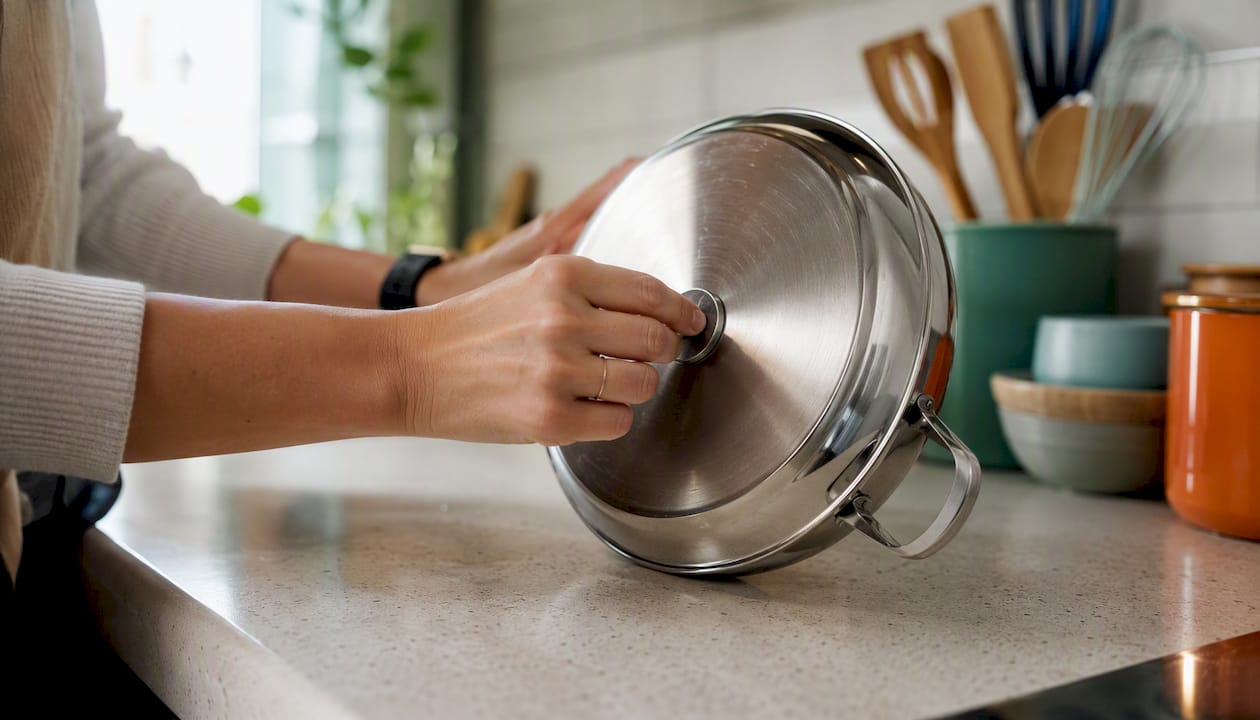
Run this test on every piece in your current cookware collection before you assume you need an entirely new set. Plenty of home cooks discover half their existing cookware already works.
For pieces that fail the magnet test, you have three options: replace them with induction-compatible cookware, buy pans labeled specifically as induction-compatible, or use an interface disk, a flat metal plate that sits between the burner and a non-magnetic pan to make the connection work. Interface disks are a reasonable short-term fix, though they add a heat-transfer step that slows down some of induction’s speed advantage.
Cookware types that generally pass the magnet test:
- Cast iron and enameled cast iron, which almost always work
- Most stainless steel, especially anything labeled “induction-ready” or “18/0”
- Multi-ply stainless with a magnetic steel base layer bonded into the construction
- Carbon steel pans, common in woks and crepe pans
Materials that typically fail unless specifically engineered for induction:
- Pure copper cookware, which is non-magnetic on its own
- Pure aluminum, unless it has a magnetic stainless disk bonded to the base
- Glass or ceramic cookware without a metal induction plate
When buying new pieces, prioritize flat bottoms over warped or slightly domed ones, since even a small gap between pan and cooktop reduces heating efficiency and responsiveness. Match pan diameter reasonably close to the burner zone size rather than using a tiny pan on a large zone. If you’re starting fresh, a single versatile stainless or cast iron pan you use constantly is a smarter first purchase than a full set you might not need. Kitchendevotion’s ceramic cookware options include induction-compatible pieces worth checking against your kitchen’s needs, and the broader cookware sets guide breaks down materials in more depth.
How Much Does Induction Cooking Actually Save on Energy?
Induction runs at 80% to 90% energy efficiency, against about 75% for radiant electric and roughly 32% for gas, and that gap compounds every time you turn on a burner. Efficiency research from ACEEE similarly finds induction among the most efficient common cooking methods available for full-size ranges, with far less energy lost as ambient heat.
In practical terms, gas loses roughly two-thirds of its energy heating the surrounding air instead of your food, which is part of why a gas kitchen runs hotter in summer and why your range hood works overtime. Radiant electric coils lose less than gas but still radiate a fair amount of heat outward before it reaches the pan. Induction sends that energy almost directly into the cookware, so your kitchen stays cooler and your air conditioning doesn’t have to fight the stove during a July dinner prep.
| Cooktop Type | Energy Efficiency | What It Means in Practice |
|---|---|---|
| Induction | 80–90% | Least wasted energy, cooler kitchen, faster response |
| Radiant electric | ~75% | Moderate waste heat, slower response than induction |
| Gas | ~32% | Most energy lost as ambient heat and combustion loss |
A simple way to think about payback: if an induction cooktop costs several hundred dollars more upfront than a comparable gas or electric range, plus a possible electrician visit if your kitchen needs a dedicated circuit, that gap gets offset gradually through lower per-meal energy use and, in many cases, utility rebates for electric appliance upgrades. Exact rebate amounts and eligibility vary by utility provider and state program, so it’s worth checking your local utility’s website before budgeting a specific number. The efficiency gain itself, though, isn’t in question. It’s consistent across Department of Energy findings and the ACEEE research on comparative cooking efficiency.
What Are the Downsides of Induction Cooking?
The most common downsides are higher upfront cost, the need to replace incompatible cookware, some fan noise, and a glass surface that scratches more easily than you’d expect. None of these are dealbreakers for most households, but each deserves an honest look before you buy.
Upfront cost is the first hurdle. Induction ranges and cooktops generally cost more than comparable gas or standard electric models, and if your kitchen currently runs on gas, you may also need an electrician to install a dedicated 240-volt circuit, since induction units, especially those with a high-power boost function, often draw more continuous current than older appliances were wired for. If a full range feels like too big a jump, a portable single-burner induction unit runs on a standard outlet and costs a fraction of the price, letting you test the technology before committing.
Cookware replacement adds cost on top of the appliance itself, though it doesn’t have to happen all at once. Run the magnet test on what you already own, replace only the pieces that fail, and start with one versatile pan you use daily rather than an entire matching set.
Noise and surface care are smaller but real annoyances. Higher-power induction units often run a cooling fan that’s audible during high-heat cooking, similar to a laptop fan under load. The glass ceramic surface also scratches more easily than some cooks expect, particularly from sliding cast iron or gritty pan bottoms, so lifting rather than dragging pans matters more here than on other cooktop types.
Gas still wins in a few specific cases. Cooks who rely on visual flame height for judging heat, or who work in commercial kitchens built around gas-specific equipment, may find the adjustment period frustrating enough that gas remains the better fit. That’s a smaller group than most articles suggest, but it’s a real one.
What Can You Actually Cook Well on Induction?
Induction handles everything from a hard sear to a barely-there simmer, and the responsiveness that makes it fast also makes it forgiving for techniques that punish slower cooktops. A cast iron pan reaches searing temperature almost as fast as it would over a gas flame, and the instant heat drop when you lower the dial means you’re far less likely to overshoot and scorch a pan sauce.
Here’s where induction shines in daily cooking:
- Boiling: Water and stock come to a boil noticeably faster, which matters most on busy weeknights when pasta or rice is on a clock.
- Searing: Cast iron and heavy stainless reach high heat quickly enough to develop a solid crust on steak or chicken thighs.
- Simmering sauces: The steady low-end heat keeps delicate sauces like beurre blanc or custard from breaking or scorching.
- Melting chocolate: Low, even heat with instant adjustment makes tempering chocolate directly in a pan far more forgiving than on gas.
- Precision tasks: Candy making, risotto, and anything requiring a held temperature benefit from induction’s tight control band.
Pro Tip: Because induction responds instantly, you can rely on residual pan heat more than you would on gas. Turn the burner off a minute or two before food is fully done and let the pan’s retained heat finish the job, since induction pans cool faster once the field stops, but they still hold enough heat to carry a dish the last stretch. For more technique adjustments worth learning during the switch, Kitchendevotion’s guide to essential cooking techniques is a useful companion.
How Do You Choose the Right Induction Cooktop?
Buy based on your household’s cooking style first, then match wattage, zone size, and controls to that style rather than chasing the highest-end model available. Here’s the checklist, in priority order:
- Power and wattage. Higher-wattage units and boost functions heat faster but may require a dedicated circuit; match power to how often you actually sear or boil at high heat.
- Burner zone sizes. Make sure at least one or two zones match the diameter of your most-used pans; mismatched sizing wastes efficiency.
- Control type. Touch controls look sleek but can be harder to adjust mid-cook with wet or greasy hands; physical dials offer faster, more intuitive changes for some cooks.
- Boost function. A rapid-boil boost setting is worth having if you regularly cook pasta, blanch vegetables, or need to bring large pots to temperature quickly.
- Simmer stability. Look for models with a genuine low-end simmer setting rather than one that cycles on and off, which matters for sauces and delicate dishes.
- Safety features. Confirm automatic pan detection, child lock, and auto shutoff are included, especially in households with kids.
- Warranty and service. Induction electronics are more complex than a gas burner, so check warranty length and local service availability before buying.
Installation note: Many induction ranges require a dedicated 240-volt circuit, and high-power models can draw more continuous current than your existing kitchen wiring supports. Have a licensed electrician assess your panel and circuit capacity before you buy, not after delivery day. Whether you need a full range or just a cooktop also affects installation complexity, so factor that into your kitchen layout planning; Kitchendevotion’s kitchen layout guide is a useful reference if you’re renovating around the switch.
Your next move: run the magnet test on your current cookware, measure your available counter or range space, and call an electrician for a quick wiring assessment before you finalize a purchase.
What Do Experienced Home Cooks Wish They’d Known Before Switching?
Start smaller than you think you need to. A portable single-burner induction unit, the kind that plugs into a standard outlet, lets you test both your cookware compatibility and your own preference before spending on a full range. It’s the lowest-risk way to find out whether induction fits how you actually cook.
For your first week on induction, keep this rough checklist in mind:
- Magnet-test every pan you own before your first meal, so you’re not discovering incompatibility mid-recipe.
- Practice a simmer on low heat early on, since the steadiness feels different from both gas and electric coil.
- Learn your unit’s power steps; most induction cooktops use numbered levels rather than a dial, and the jump between levels can be bigger than expected.
- Place your most-used pans on the zone size that matches them best, rather than defaulting to whichever burner is closest.
Pro Tip: Lift pans instead of sliding them, especially cast iron, to avoid scratching the glass surface over time. If fan noise during high-heat cooking bothers you, most units have a visual power indicator you can rely on, so you don’t need to listen for cues the way you would with a gas flame.
Once the basics click, pairing induction with the right tools speeds things up further. Kitchendevotion’s guide to cutting cooking time with the right appliances and its smart cooking tools roundup both cover accessories that complement an induction setup well.
Who Actually Benefits Most From Switching to Induction?
Time-pressed home cooks, precision-focused cooks, and households with young kids get the most out of induction, while cooks who genuinely rely on visual flame cues or run commercial gas-specific equipment have legitimate reasons to stay put. That’s not a hedge, it’s just where the evidence actually points. The speed and control benefits are real and measurable, but they matter most to people who cook daily under time pressure or who chase precision in things like sauces and candy work.
What gets underestimated in most coverage of this topic is how much the safety angle matters for households with kids, more than the efficiency numbers do. A cooktop that only heats the pan, shuts off automatically, and never has an open flame changes the calculus for a parent watching a toddler in the kitchen. That’s a bigger deal in daily life than the efficiency spread between induction and gas, even though the efficiency numbers get more attention in most reviews.
The honest caveat: if you cook professionally in a kitchen built entirely around gas-specific technique, or you simply love watching a flame while you cook, induction will feel like a compromise no efficiency statistic will talk you out of. That’s a smaller group of people than most kitchen debates assume, but pretending it’s zero people isn’t honest either.
Start Small: How to Try Induction Without a Full Kitchen Overhaul
You don’t need to gut your kitchen to find out if induction fits your cooking style. Kitchendevotion’s curated appliance picks are built for exactly this kind of low-risk test drive, pairing one versatile induction-compatible pan with a portable single-burner unit so you can run the magnet test, cook a few real meals, and decide before committing to a full range.

If you’re weighing where induction fits against everything else on your kitchen wish list, the kitchen appliance priority list for new homeowners helps you sequence purchases sensibly instead of buying everything at once. Cooks who already know speed is the priority should look at the time-saving appliances list, which lines up closely with what induction delivers in daily use. And if your existing pots failed the magnet test, the guide to choosing cookware materials will save you from buying the wrong replacement twice.
A simple starter kit, one solid induction-compatible skillet plus a portable burner, costs far less than a full range and tells you almost everything you need to know about whether induction fits your kitchen. Check the cookware sets available now and pick one piece to start.
Sources
- Making the Switch to Induction Stoves or Cooktops | Department of Energy
- Pros and Cons of Induction Cooktops and Ranges – Consumer Reports
- Pacemaker precautions in the age of electrification | Harvard Health
- Study on induction cooktops and pacemaker interference (Europace, 2006)
- ACEEE proceedings paper on cooking efficiency (2014)
FAQ
What Is the Disadvantage of Induction Cooking?
The main disadvantages are higher upfront cost, the need for magnetic cookware, occasional fan noise on high-power settings, and a glass surface that scratches more easily than gas grates or electric coils.
Is Induction Cooking Good for Your Health?
Induction produces no combustion byproducts like nitrogen dioxide or carbon monoxide, which reduces indoor air pollutants compared with gas cooking, and it also lowers burn risk since the surface itself doesn’t stay superheated.
Is Induction Cooking Really Better Than Gas?
For most home cooks, yes: induction is 80–90% energy efficient versus about 32% for gas, and it boils water 20–40% faster, though cooks who rely on visual flame cues may still prefer gas.
What Are the Downsides of Induction Cooktops for Everyday Use?
Beyond cookware replacement costs, some households notice audible fan noise during high-heat cooking and find the glass surface requires more careful handling to avoid scratches from cast iron or gritty pan bottoms.
Is Induction Cooking Safe if I Have a Pacemaker?
Guidance recommends keeping 12 to 24 inches of distance from an active induction cooktop if you have an implanted cardiac device, and you should confirm specifics with your cardiologist and the device manufacturer before relying on induction daily.



No comment