
An inverter compressor refrigerator runs on a variable-speed compressor that ramps up or down instead of switching fully on and off, and for most households it’s worth the extra upfront cost. That single design change is why these units carry stronger ENERGY STAR ratings than conventional models and why manufacturers use a variable-frequency drive (VFD) to control motor speed in real time.
Buy one if:
- You run your fridge constantly (every household does, but heavy users benefit most)
- You want quieter kitchen noise, especially in an open-plan layout
- You plan to keep the appliance 8+ years and can absorb a higher purchase price now for lower bills later
Skip it if:
- You need a backup or rarely-used fridge where energy use barely matters
- Your budget is tight and repair-network access in your area is thin
- You have unstable power at home, which can stress inverter electronics
Kitchendevotion’s take: for anyone shopping refrigerators seriously in 2026, this is the technology that should top your checklist.
Key Takeaways
Inverter compressor refrigerators cost more upfront but run quieter, hold steadier temperatures, and typically cut electricity use by 20% to 40% for most households.
| Point | Details |
|---|---|
| Variable speed is the core difference | An inverter board modulates compressor RPM instead of forcing full on/off cycling. |
| Savings depend on habits | Frequent door openings and warm food reduce the efficiency advantage regardless of compressor type. |
| Electronics are the repair risk | Inverter boards fail more often than compressor motors and cost more to replace. |
| Check warranty by model number | Compressor and inverter board coverage often differ even within the same brand lineup. |
| Kitchendevotion’s recommendation | Best suited to energy-conscious, frequent-use households; use the buying checklist above before comparing specific models. |
Table of Contents
- How an Inverter Compressor Refrigerator Actually Works
- The Real Benefits: Energy, Noise, and Food That Lasts Longer
- What You Give Up: Cost, Complexity, and When to Skip It
- How to Choose the Right Inverter Refrigerator
- Troubleshooting an Inverter Refrigerator Before You Call for Service
- Sources
- FAQ
How an Inverter Compressor Refrigerator Actually Works
Every refrigerator needs a compressor to push refrigerant through the cooling loop. A conventional compressor only has two states: full power or off. It kicks on, blasts cold air until the thermostat is satisfied, then shuts down completely, and the cycle repeats dozens of times a day. An inverter compressor never fully stops during normal operation. Instead, it modulates speed to match cooling demand.

The part making that possible is the inverter board, a small electronic control unit that acts as a VFD. It takes incoming AC power, converts it to DC, then re-generates AC at a frequency and voltage it chooses. That variable frequency is what lets the compressor motor spin at 1,200 RPM at 2 a.m. when nobody’s opened the door in hours and jump to 4,500 RPM the moment you load in a week of groceries.
Two motor designs dominate this space. Most inverter compressors use a 3-phase brushless DC motor, prized for durability and smooth speed control. A smaller number of manufacturers, most notably LG, use a linear motor design where the piston moves in a straight line without a crankshaft, cutting a mechanical linkage out of the system entirely. Both designs eliminate the same problem: repeated hard starts.
The industry’s shift toward inverter systems means diagnostic priorities have flipped. Where a technician once assumed a dead compressor motor, service guides now direct techs to check the inverter board and error codes first, because the electronics fail more often than the motor itself.
That diagnostic shift matters for you as a buyer, not just for repair techs. A refrigerator’s most stressful moment isn’t running. It’s starting. A conventional compressor pulls a spike of inrush current every time it kicks on, straining the motor and the home’s electrical circuit alike. An inverter model largely sidesteps that because it rarely fully stops.
Picture a simple diagram: a compressor connected to an inverter board, with a line graph beside it showing RPM over 24 hours. The conventional model’s line looks like a square wave, flat at zero, then a vertical spike to maximum, then back to zero. The inverter model’s line looks more like a gentle rolling hill, dipping and rising with the household’s actual cooling demand.
Three quick contrasts sum up the difference:
- Operation pattern: on/off cycling versus continuous, modulated running
- Inrush current: repeated spikes versus a single soft start and minimal ongoing surges
- Temperature swings: several degrees of drift between cycles versus a narrow, steady band
The Real Benefits: Energy, Noise, and Food That Lasts Longer
Energy efficiency is the headline reason people upgrade, and the numbers back it up. Many consumer-facing buying guides estimate inverter refrigerators use 20% to 40% less electricity than comparable non-inverter models, though your actual savings depend heavily on household size, local climate, and how often the door gets opened.

A quick math check on savings: if your electricity rate and usage put you at the lower end of that range, you might save $50 a year. At the higher end, some buyer guides estimate savings closer to $125 annually. That’s real money, but it’s not automatic. Frequent door openings, adding warm leftovers straight from the stove, or living somewhere with hot summers all reduce potential energy savings, because the compressor has to work harder regardless of its type.
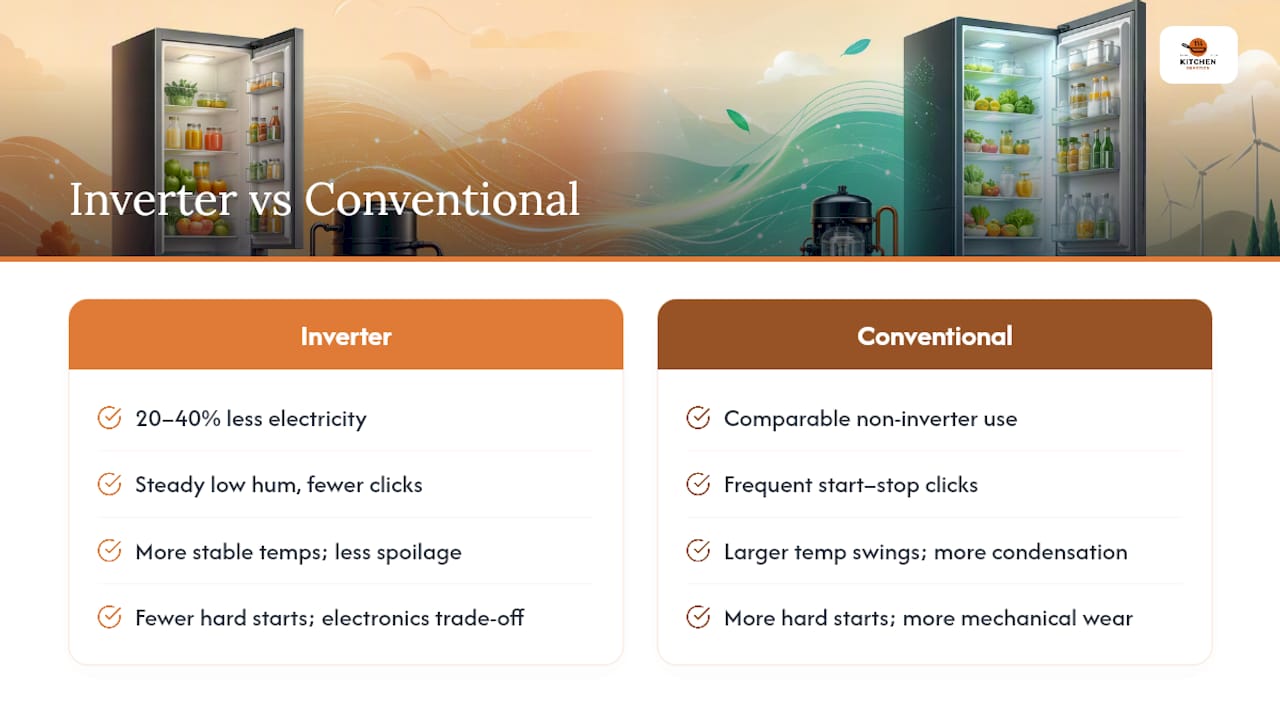
Noise is the benefit people notice fastest, often within the first week. A conventional compressor’s start-up hum and shutoff click happen dozens of times daily. An inverter compressor’s low, steady RPM produces a quieter baseline hum with far fewer jarring transitions, which matters a lot if your kitchen opens into a living room or your fridge sits near a home office.
Food preservation is the benefit fewer shoppers ask about but end up appreciating most. Because the compressor holds a steady, low-speed pace rather than cycling hard and stopping, internal temperatures stay markedly more stable, which cuts down on the temperature swings and condensation that speed up spoilage. Produce drawers stay drier, dairy lasts closer to its printed date, and you’ll notice less frost buildup in the freezer.
On longevity, the mechanical case is straightforward: fewer hard starts means less wear on bearings and seals over the appliance’s life. The catch is that you’re trading mechanical wear for electronic dependency, a trade-off worth understanding before you buy, which the next section covers in full.
What You Give Up: Cost, Complexity, and When to Skip It
Inverter models cost more upfront. Consumer comparisons commonly put the premium at $200 to $500 more than an equivalent non-inverter fridge. If your household saves toward the higher end of the efficiency range, that gap pays for itself in a few years. If you use the fridge lightly, payback stretches out considerably, so run the math on your own electricity rate before assuming the savings are automatic.
Repairs are the bigger trade-off, and it’s one a lot of shoppers don’t hear about until something breaks. Inverter systems depend on specialized electronics, and when something fails, it’s often the inverter board rather than the compressor motor, which requires a technician who understands the diagnostics and a replacement part that costs more than a simple relay or start capacitor.
A few situations chip away at the case for inverter tech specifically:
- Frequent door traffic in a large household keeps the compressor working hard regardless of type
- Regularly adding large batches of warm food forces the compressor into high-speed mode often
- Unstable home power (frequent brownouts or voltage spikes) can stress inverter electronics more than a simpler mechanical system
A conventional compressor still makes sense for a garage backup fridge, a dorm room mini fridge, or any situation where the appliance sees light, infrequent use. In those cases, the efficiency gap barely matters and the simpler mechanical design is cheaper to fix if it ever breaks.
Pro Tip: If you’re torn between the two, check your local electricity rate per kWh first. At rates above 15 cents/kWh, the inverter’s efficiency edge tends to pay back faster; at lower rates, the math gets closer and other factors, like noise, should carry more weight in your decision.
How to Choose the Right Inverter Refrigerator
Start with the ENERGY STAR label and the estimated annual kWh figure printed on the yellow EnergyGuide sticker. That single number lets you compare models on equal footing, and our guide on how much energy a refrigerator uses walks through translating that figure into an actual dollar estimate for your electric bill.
Beyond the energy label, work through this checklist before you buy:
- Compressor and inverter board warranty length. Many manufacturers, including LG, Samsung, and GE, offer extended warranties (often 10 years) specifically on the compressor, but confirm whether the inverter board carries the same coverage. It often doesn’t, and that’s the part most likely to need service.
- Noise rating in decibels. Look for a listed dB rating if the retailer provides one. Anything in the mid-30s to low-40s range counts as quiet for a full-size refrigerator.
- Usable capacity versus footprint. Two models with the same cubic-foot rating can feel very different once shelves, bins, and door storage eat into usable space.
- Surge or voltage protection. If your area sees frequent power fluctuations, ask whether the model includes built-in surge protection for the inverter board, since that electronic component is the one most exposed to power quality issues.
When you’re comparing listings or talking to a retailer, ask specifically about the inverter warranty terms by model number, not just the brand’s general policy, since coverage can vary between product lines even within the same manufacturer, whether that’s Samsung, Bosch, Whirlpool, or another major name. Ask about parts availability and whether an authorized service network exists near you. A great warranty means little if nobody local can act on it.
Your own habits factor into the payback math more than any spec sheet. A household of five that opens the fridge constantly won’t see the same savings as a couple who cooks in batches. If you want to squeeze more out of whatever model you choose, our guide on making your refrigerator more energy efficient covers habit changes that compound with inverter technology rather than replace it.
Troubleshooting an Inverter Refrigerator Before You Call for Service
Not every warning sign means a costly repair. Work through these checks in order before you schedule a technician:
- Pull any error codes first. Most inverter models display a code on the control panel when something’s off. Check your owner’s manual or the manufacturer’s service pages for what that code means before assuming the worst.
- Check the condenser coils and fan. Dust buildup on the coils or a fan blocked by debris forces the compressor to work harder and can trigger false alarms about cooling performance.
- Confirm the power supply is stable. Inverter electronics are more sensitive to voltage irregularities than a simple mechanical compressor, so a flickering outlet or an overloaded circuit is worth ruling out.
- Verify the door seals. A worn gasket lets warm air in constantly, which can make an inverter compressor run at high speed nonstop, mimicking a compressor problem that’s really just a seal issue.
If those checks don’t resolve it, the electronics are usually the correct first suspect, not the compressor motor itself. Industry service guidance consistently points techs toward testing inverter board outputs before condemning the compressor, because board failures are common and compressor motors built for inverter duty tend to be durable.
That diagnostic order affects your wallet, too. A board replacement typically costs less than a full compressor swap, but neither is cheap, and Danfoss’s technical overview of variable-speed systems notes that inverter repairs generally demand more specialized skill and pricier parts than fixing a conventional mechanical failure.
Pro Tip: Before you call for service, have your model number, any displayed error code, and the age of the unit ready. A quick check with a refrigerator thermometer to confirm actual internal temps also helps the technician skip a diagnostic step and can shave real money off the visit.
When We’d Tell You to Buy an Inverter Fridge
Kitchendevotion leans toward recommending inverter refrigerators for energy-conscious households, families who use the fridge constantly, and anyone in an open-plan kitchen where compressor noise carries into living space. The honest caveat: weigh the $200 to $500 upfront premium against your actual electricity rate and usage before assuming the payback is quick for everyone.
Where to Go From Here With Kitchen Devotion
Choosing a refrigerator is rarely a one-appliance decision. It usually comes attached to a bigger kitchen upgrade, whether that’s a new home, a renovation, or just replacing a unit that finally gave out. Kitchendevotion built its kitchen appliance priority list for new homeowners specifically for that moment, ranking which appliances deserve your budget first and which can wait.

If you’re weighing a full-size fridge against something smaller for a secondary space, our breakdown of compressor types in compact units is worth a look before you commit either way. And once you’ve run the checklist above against a few models on your shortlist, the priority list gives you a clear next step for figuring out what else in your kitchen deserves attention alongside the fridge.
Sources
- Danfoss — Variable speed (inverter) compressor overview
- Purdue engineering paper — inverter technology and performance insights
- ServiceMag — Inverter compressor technology guide
- Kitchen Asking — Which compressor is best in a fridge? Inverter vs non-inverter (2025 guide)
FAQ
What Is an Inverter Compressor Refrigerator?
It’s a refrigerator whose compressor speed is controlled by an inverter board, letting it modulate power output continuously instead of cycling fully on and off like a conventional compressor.
Is an Inverter Compressor Refrigerator Good?
For most households, yes. It typically runs quieter, holds steadier temperatures that help preserve food, and uses 20% to 40% less electricity than a comparable conventional model, though light users may not recoup the higher purchase price as quickly.
What Are the Disadvantages of an Inverter Compressor Refrigerator?
The main downsides are a higher upfront cost, commonly $200 to $500 more, and pricier, more complex repairs when the inverter board fails, since that component requires specialized diagnostic skills rather than a simple mechanical fix.
Which Is Better, an Inverter Compressor or a Normal Compressor?
An inverter compressor is the better choice for most everyday households due to lower running costs, quieter operation, and steadier temperatures. A conventional compressor can still make sense for light, infrequent use, such as a backup fridge, where the price premium doesn’t pay off.





No comment