

Most full-size refrigerators fall between 32 and 36 inches wide, 29 to 35 inches deep, and 68 to 70 inches tall, with a median cabinet size around 33.13 inches wide by 30.38 inches deep by 69.9 inches tall. Before you shop, run one checklist: measure the width of your opening at three heights, the depth from the wall to the front of any cabinets, the height to the lowest obstruction, and the narrowest point along the path the delivery crew will use to get the fridge inside.
That single pass will save you from the most common and most expensive fridge mistake: buying a model that fits the kitchen alcove but never makes it through the front door.
Do these four things before you leave home or place an order:
- Measure your space at its width, height, and depth, and write the numbers down (not the old fridge’s size).
- Measure every doorway, hallway turn, and stairwell along the delivery path.
- Check which side the door needs to swing open and how far the handle sticks out.
- Add roughly 1 inch of clearance for ventilation and about 2 inches on the hinge side for the door swing.
Key Takeaways
Matching a refrigerator to your kitchen comes down to measuring the space and the delivery path before you fall in love with a model’s features or capacity rating.
| Point | Details |
|---|---|
| Measure width at three heights | Baseboards and trim narrow openings unevenly, so use the smallest measurement recorded. |
| Check the full delivery path | Doorways, stairwells, and turns matter as much as the installation space itself. |
| Record hinge side and handle projection | A door that swings clear can still slam a handle into cabinetry or an island. |
| Leave clearance for ventilation and swing | Plan roughly 1 inch behind for airflow and 2 inches on the hinge side for the door. |
| Compare usable capacity, not just rated cu ft | Ice makers and bin shapes reduce real storage below the number on the spec sheet. |
| Use curated guides to narrow model choices | Kitchendevotion’s refrigerator reviews compare exterior dimensions against tested usable space. |
Table of Contents
- Standard Refrigerator Exterior Dimensions and What They Mean
- Sizes By Refrigerator Type: What Each Style Actually Requires
- How to Measure Your Space Step by Step
- Door Swing, Handle Projection, and Clearance You Can’t Skip
- Matching Cubic Feet to Your Household, and the Usable-Space Catch
- Counter-Depth vs. Standard-Depth: Which One Fits Your Kitchen
- Your Printable Measuring Checklist and Diagram
- Planning for Outlets and Water Lines Before Delivery Day
- Ventilation Requirements by Model and Location
- A Delivery Failure That Taught Me to Measure the Path First
- Where Kitchendevotion Fits Into Your Fridge Search
- Sources
- FAQ
Standard Refrigerator Exterior Dimensions and What They Mean
A “standard” refrigerator isn’t one size. It’s a cluster of common bands that most manufacturers build around, and knowing which band you’re in tells you a lot about what will fit in your kitchen without a remodel.
Width matters most because it’s the dimension most likely to force a compromise. Compact and apartment-style units run 24 to 32 inches wide. Full-size refrigerators cluster tightly between 32 and 36 inches, and according to Fridge.com’s dimensions data, nearly half of all full-size models fall within the 32 to 36 inch range. That’s the practical “standard” width if you need one number to plan around, though plenty of good models sit just outside it.
Depth spreads more widely, from around 29 inches for counter-depth-leaning designs to 35 inches or more for deep-body standard-depth units, not counting the extra few inches a door and handle add once open. Height typically runs 68 to 70 inches for full-size units, though ice makers and top vents can push that closer to 71 or 72 inches on some French-door and side-by-side models.
Here’s how those width bands typically translate into storage capacity, based on catalog data from Fridge.com and household capacity guidance from Consumer Reports:
| Width Band | Typical Cubic-Foot Capacity | Best Fit |
|---|---|---|
| 24–29 in | 12 to 16 cubic feet | Studios, dorms, secondary fridges |
| 30–32 in | 15–19 cu ft | Small kitchens, couples |
| 32–36 in | 18–25 cu ft | Families of 3–5 |
| 36+ in | 25–30+ cu ft | Large households, entertainers |
Notice the overlap between the 30 to 32 inch and 32 to 36 inch bands. Two fridges with a 2 or 3 inch difference in width can carry a similar cubic-foot rating because depth and height, not just width, drive total volume.
Sizes By Refrigerator Type: What Each Style Actually Requires
The style you want dictates the footprint you need to plan for, and the differences between types are bigger than most first-time buyers expect.
Top-freezer models are the narrowest and shallowest of the full-size categories, typically 28 to 32 inches wide, 28 to 34 inches deep, and 61 to 66 inches tall. They fit tight galley kitchens and rental units well, and they’re usually the easiest type to get through a standard 30-inch doorway.
Bottom-freezer models run close to top-freezers in width (29 to 33 inches) but stand taller, often 67 to 70 inches, since the fresh-food compartment sits at eye level. They suit small households that want easier access to everyday items without bending down.
French-door refrigerators are the current standard for family kitchens, typically 32 to 36 inches wide, 29 to 35 inches deep, and 68 to 70 inches tall. The double-door front means each door only needs half the swing clearance of a single-door model, which is a real advantage in a kitchen with an island close by.
Side-by-side models run narrower in profile but taller and deeper overall, generally 32 to 36 inches wide, 29 to 31 inches deep, and 68 to 71 inches tall. The narrow-but-tall doors need less swing radius, which makes side-by-sides a common pick for kitchens with limited floor clearance in front of the fridge.
Compact and mini fridges stay under 24 inches wide in most cases and rarely exceed 34 inches tall, a category Kitchendevotion covers in detail in its guide to compact refrigerators for dorms and small apartments.
Counter-depth and built-in units are the outliers. Counter-depth models shave 5 to 8 inches off standard depth (typically landing around 24 to 29 inches, not including the door) so the front sits flush with your countertop edge. Built-in refrigerators go further, often requiring custom cabinetry panels and specific width tolerances down to the quarter inch. Kitchendevotion’s review of a counter-depth Samsung Bespoke model walks through exactly how that flush fit changes both the look and the usable capacity of a kitchen.
| Type | Width | Depth | Height | Best For |
|---|---|---|---|---|
| Top-freezer | 28–32 in | 28–34 in | 61–66 in | Small kitchens, rentals |
| Bottom-freezer | 29–33 in | 29–34 in | 67–70 in | Singles, couples |
| French door | 32–36 in | 29–35 in | 68–70 in | Families of 3–5 |
| Side-by-side | 32–36 in | 29–31 in | 68–71 in | Tight-clearance kitchens |
| Compact | 18–24 in | 20–24 in | 32–34 in | Dorms, apartments |
| Counter-depth | 29–36 in | 24–29 in | 68–70 in | Open-concept kitchens |
Kitchendevotion’s broader breakdown of refrigerator and mini-fridge types goes deeper on which style suits which layout if you’re still weighing options.
How to Measure Your Space Step by Step
This is the part that actually prevents the fridge from getting stuck in your doorway on delivery day, and it takes about fifteen minutes with a tape measure and a notepad.
- Measure the width of your fridge opening at three heights, top, middle, and bottom, since baseboards, trim, or slightly out-of-square cabinets can make the opening narrower at one point than another. Use the smallest number you record.
- Measure the depth from the back wall to the front edge of any cabinets or countertop overhang. Note whether outlets or waterlines protrude into that space, since they’ll eat into usable depth.
- Measure the height from the finished floor to the lowest obstruction above, whether that’s a cabinet, a soffit, or a light fixture. Leave room for the fridge’s own height plus hinge clearance at the top.
- Measure the delivery path separately from the installation space. Walk the entire route the fridge will travel: front door, hallway turns, stairwells, and elevator interior if you’re in a building with one. Measure the narrowest point on that entire path, not just the front door.
- Test both orientations at tight turns. A fridge that won’t fit through a doorway going in width-first sometimes clears when tilted or angled depth-first. Home Depot’s measuring guide recommends checking both approaches at any turn narrower than the fridge’s widest dimension.
- Record hinge side and door swing clearance. Note which side the door opens from and measure how far it swings open, plus how far the handle projects when the door is closed.
This is exactly the doorway-clearance problem that trips up more buyers than any other measurement error. Fridge.com’s catalog data found that only about 33% of full-size models can clear a 30-inch opening on either side as measured, which means two out of three full-size fridges need either a wider doorway or door removal to get through a standard 30-inch frame.
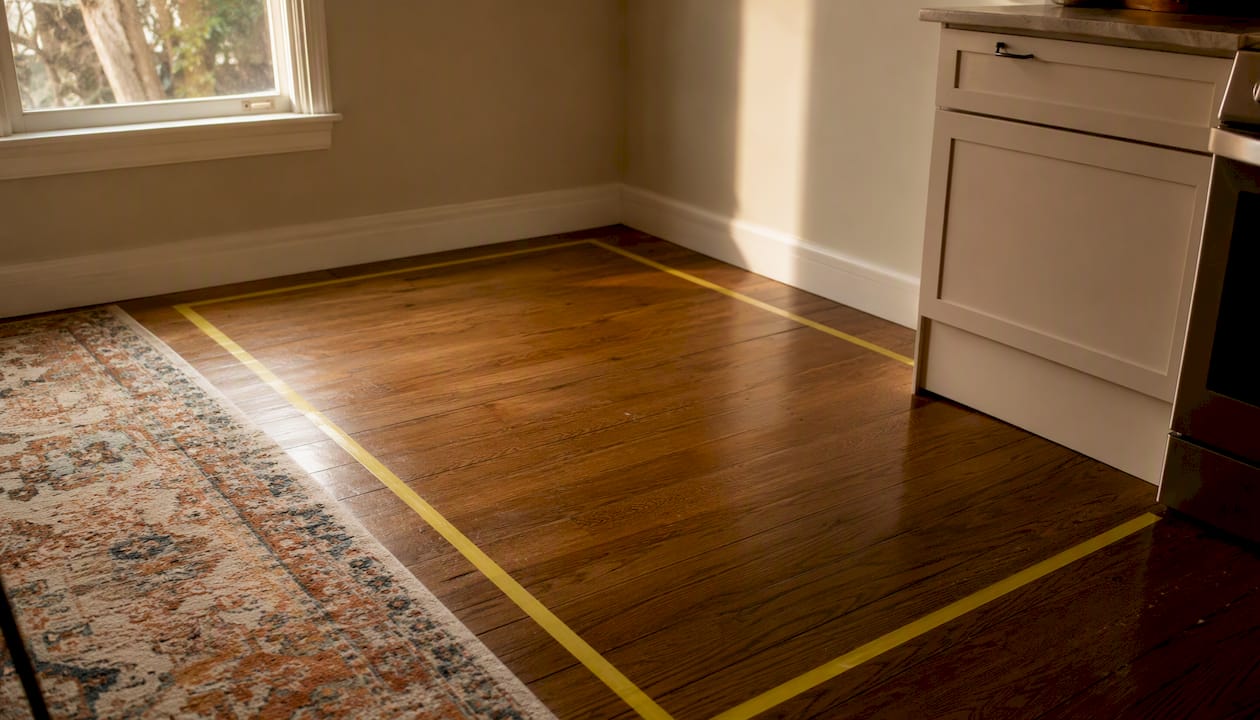
Pro Tip: Measure your floor in at least three spots across the footprint, not just one corner. Older homes especially tend to have floors that slope or dip slightly, and a fridge that looks level on paper can end up rocking on an uneven spot. Lay painter’s tape on the floor in the exact footprint dimensions of the model you’re considering, then walk around it for a day before you commit. It’s a five-minute step that catches problems a tape measure alone won’t show.
Door Swing, Handle Projection, and Clearance You Can’t Skip
Clearance numbers are where a lot of otherwise careful measuring falls apart, mostly because buyers measure the box and forget the door needs somewhere to go.
Leave at least 1 inch behind and above the unit for ventilation unless the manufacturer’s spec sheet says otherwise, per guidance from both Consumer Reports and GE Appliances. On the hinge side, plan for roughly 2 inches of clearance so the door can swing fully open, though the exact figure depends on the handle projection of your specific model.
Handle projection is the dimension that catches people off guard. A door might swing clear of the wall but still slam its handle into an island edge or an adjacent cabinet pull. Before you buy, measure how far the handle sticks out from the closed door face, then check that distance against the nearest obstacle in the swing path. If a handle repeatedly hits cabinetry, look for a model with reversible hinges, which lets you flip the door swing direction without buying a different unit.

Only about a third of full-size refrigerator models will clear a standard 30-inch doorway based on their as-recorded dimensions in Fridge.com’s data set, which means most buyers need to plan for door removal, a wider entry point, or a model specifically chosen for its narrow profile.
Pro Tip: Most refrigerator doors and shelves come off with a screwdriver in under ten minutes, and removing them before delivery can shave 2 to 4 inches off the total width you need to clear. If your delivery path is close but not quite wide enough, ask the retailer whether their crew offers door removal as part of installation, many do at no extra charge, rather than assuming the fridge won’t fit.
Matching Cubic Feet to Your Household, and the Usable-Space Catch
Bigger numbers on a spec sheet don’t always mean more usable room, and that gap between rated and real capacity trips up more buyers than exterior dimensions do.
Consumer Reports recommends roughly 19 to 22 cubic feet for a family of four as a starting point. Scaling from there by household size, using capacity bands from Fridge.com’s household guide:
- Singles or couples: 12 to 16 cubic feet typically covers regular grocery habits without excess empty space.
- Families of 3 to 4: 18 to 22 cubic feet is the range most manufacturers and reviewers point to as the sweet spot.
- Large households or frequent entertainers: 25 cubic feet or more gives room for bulk shopping and overflow during holidays.
The catch is that rated capacity and usable capacity aren’t the same number. Ice makers, water filtration modules, and oddly shaped door bins all eat into the cubic feet printed on the spec sheet, so a 22 cubic foot model with a bulky in-door ice maker can hold noticeably less than a 20 cubic foot model with a simpler layout. That’s the exact caveat Consumer Reports flags when it warns that manufacturer capacity claims often overstate what you’ll actually be able to load into the fridge.
For a sense of scale, the jump from 18 to 20 cubic feet is smaller than it sounds in practice: one comparison of the two sizes found the difference usually amounts to a few extra grocery bags of storage and only 1 to 3 inches of added exterior width, not a dramatically bigger fridge.
Pro Tip: Don’t shop by rated cubic feet alone. Look for third-party or model-specific reviews that test actual usable capacity, and pay attention to shelf and bin layout in photos. Kitchendevotion’s review of an LG French-door model shows how much exterior size and real usable space can diverge on paper versus in the kitchen.
Counter-Depth vs. Standard-Depth: Which One Fits Your Kitchen
Counter-depth refrigerators sit flush, or nearly flush, with your countertop edge instead of jutting several inches into the room the way standard-depth models do. There’s no single industry standard defining exactly where “counter-depth” starts, which is why you’ll see cabinet depths anywhere from 24 to 29 inches marketed under that label, not counting the door.
Standard-depth units typically run 29 to 35 inches for the cabinet alone, and once you add the door and handle, the total protrusion into the room can reach 3 to 4 inches beyond that. That extra depth buys you more interior capacity per square foot of floor space, which is why standard-depth models tend to pack more cubic feet into a similar width than counter-depth versions do.
| Factor | Counter-Depth | Standard-Depth |
|---|---|---|
| Typical cabinet depth | 24–29 in | 29–35 in |
| Fit with surrounding cabinetry | Flush or near-flush | Protrudes 3–5 in past counters |
| Ventilation needs | Similar, but rear clearance is tighter to plan | Standard 1 in rear clearance |
| Best for | Open-concept kitchens, islands nearby | Kitchens prioritizing capacity over profile |
If your kitchen has an island or a walkway close to the fridge, the flush profile of counter-depth can be the difference between a comfortable path and one where every trip to the fridge means squeezing past a jutting door. If floor space isn’t tight, standard-depth usually gives you more storage for a similar price point. Kitchendevotion’s full look at a counter-depth Samsung Bespoke unit breaks down exactly how that tradeoff plays out with real dimensions and real capacity numbers.
Your Printable Measuring Checklist and Diagram
Bring a physical checklist with you to the store or hand it to the delivery team, because a written record beats trying to recall measurements from memory while standing in a showroom.
A complete printable checklist should capture:
- Width measured at three heights (top, middle, bottom of the opening)
- Depth measured at two points (at the wall and at any cabinet or counter overhang)
- Height from the finished floor to the lowest obstruction above
- Door swing radius and which side the hinge sits on
- Delivery path narrowest point, including doorways, hallway turns, and stairwells
- Outlet and waterline locations relative to the installation space
- Floor level notes from checking multiple spots for unevenness
For a diagram to go with it, sketch three simple views: a front view of the opening with width measurements marked at each height, a side view showing depth plus the outlet location, and a simple path map tracing the delivery route with the narrowest clearance point labeled in inches.
If you’re ordering online rather than measuring in person with a salesperson, take photos of each doorway along the delivery path, straight on and from an angle, and photograph the installation space itself. Retailers and delivery services increasingly ask for these photos anyway to flag potential delivery issues before the truck shows up.
Planning for Outlets and Water Lines Before Delivery Day
Ice makers and water dispensers need more than floor space. They need a working electrical outlet and, in most cases, a dedicated waterline within reach of the fridge’s back panel.
Check that a grounded outlet sits within a few feet of where the fridge will stand, ideally behind it or along the adjacent wall, not on a shared circuit already loaded with other major appliances. If you’re installing a model with a water dispenser or ice maker for the first time, you’ll likely need a plumber to run a waterline to that location, so plan that step well before delivery day rather than discovering the gap once the fridge arrives.
Measure the exact spot where the waterline connector needs to reach the back of the unit, and account for it in your depth measurement. A waterline valve that protrudes from the wall can eat into your clearance the same way a baseboard or trim piece does, a reminder worth keeping in mind since minor wall fixtures are exactly the kind of detail general appliance-space guidance flags as easy to overlook until installation day.
Ventilation Requirements by Model and Location
Every refrigerator needs airflow around its compressor and condenser coils to run efficiently, and how much space that requires depends on where the unit sits.
For a standard freestanding installation, GE Appliances and Consumer Reports both point to roughly 1 inch of clearance behind and above the unit as a baseline, though you should always check the specific model’s spec sheet since some compact or high-efficiency units need more. Side clearance matters less for airflow and more for the door swing itself.
Built-in installations are a different story entirely. Because a built-in refrigerator sits flush within cabinetry on all sides, it needs a dedicated ventilation path, usually a vent kick panel at the bottom or a top vent grille, engineered specifically for that model. You can’t treat a built-in cutout the way you’d treat a freestanding alcove; the manufacturer’s installation manual will specify exact vent dimensions that a general contractor needs to build into the cabinetry, not just leave as open air space.
If your fridge sits in an enclosed pantry nook or a tight corner, check the manufacturer’s spec sheet for that model’s specific ventilation minimums rather than assuming the standard 1-inch rule applies. Poor airflow in these tighter spots is one of the more common reasons a fridge runs hotter and less efficiently than expected, even when every exterior dimension technically fit the space.
A Delivery Failure That Taught Me to Measure the Path First
Measure the delivery path before you fall in love with a model, not after. That’s the single habit that prevents more headaches than any spec sheet comparison ever will.
I’ve seen a French-door refrigerator, purchased because it fit a kitchen alcove perfectly on paper, get stuck at a stairwell landing because nobody measured the turn radius on the way up. The fix ended up being door removal on-site, which the delivery crew handled, but it cost an extra hour and a fair amount of stress that a five-minute tape-measure check at the stairwell would have avoided entirely.
My honest recommendation: if you’re choosing between two models that are close in capacity, and one is an inch or two narrower, take the narrower one. It’s a lot cheaper to give up a small amount of interior storage than to discover on delivery day that your dream fridge needs a doorframe modification to get inside. Measuring the path isn’t the exciting part of buying a refrigerator, but it’s the part that actually determines whether the appliance you ordered ends up in your kitchen or back on a truck.
Where Kitchendevotion Fits Into Your Fridge Search
Once you know your size band and capacity target, the next challenge is narrowing thousands of listings down to models that actually match your kitchen and your other appliance priorities. Kitchendevotion curates refrigerator guides, model reviews, and space-planning checklists built specifically for that step, so you’re comparing real dimensions and tested usable capacity instead of guessing from a product photo.

Kitchendevotion earns a commission on some purchases made through links to retail partners, which supports the free guides and comparisons on the site at no extra cost to you. If you’re outfitting a whole kitchen rather than just replacing one appliance, the Kitchen Appliance Priority List for New Homeowners walks through what to buy first and how to sequence purchases around your budget and space constraints. Start there to see how a new refrigerator fits into your broader kitchen plan.
Sources
Before you finalize a purchase, cross-check the retailer’s listed dimensions against a few independent sources, since spec sheets sometimes list case depth without the door or handle included.
- Fridge
- Choose the Right Refrigerator for Your Kitchen – Consumer Reports
- Refrigerator Sizes: How Do You Measure a Refrigerator? – GE Appliances
Always compare a model’s “case depth less handle” figure against your own measured depth, then separately check the “depth with door open” figure against your clearance in front of the unit. Those two numbers get confused more often than any other spec on the sheet.
FAQ
What are the standard sizes for refrigerators?
Most full-size refrigerators run 32 to 36 inches wide, 29 to 35 inches deep, and 68 to 70 inches tall, with a median cabinet size of about 33.13 by 30.38 by 69.9 inches across the broader market.
Is 26 cubic feet a big refrigerator?
Yes, 26 cubic feet sits above the 19 to 22 cubic foot range Consumer Reports recommends for a family of four, making it well suited to larger households or people who entertain and stock up in bulk.
Is 20 cubic feet a big fridge?
Not especially. Twenty cubic feet falls right in the middle of the 18 to 22 cubic foot range considered typical for a family of three to four, according to household capacity guidance from Fridge.com’s buying research.
Is 18 cubic feet a normal refrigerator?
Yes, 18 cubic feet is a common size for smaller households or tighter kitchens, sitting just below the family-of-four range and comfortably within the 15 to 19 cubic foot band that fits couples or small families well.
How do I know if a refrigerator will fit through my doorway?
Measure the narrowest point of your entire delivery path, not just the front door, since only about 33% of full-size models clear a 30-inch opening as measured, and plan on door removal if your model runs wider than that.





No comment