

Pick a basin depth of 8 to 10 inches for most kitchens. That’s the range that keeps your wrists, back, and shoulders happy during long dish sessions. Go shallower (6 to 8 inches) if you’re under 5’4" or want easier reach; go deeper (10 to 12 inches) only if you regularly wash stockpots and don’t mind-bending. ADA-compliant installations cap depth at 6 inches, no exceptions.
TL;DR:
- Sinks with a depth of 8 to 10 inches generally provide the best balance of capacity and ergonomic comfort for most users.
- Shorter users under 5’2" benefit from basins closer to 6 inches, while taller users over 5’10" should consider 9 to 10 inches to avoid strain.
- Mounting style affects actual working depth, with undermount sinks adding roughly 1 to 1.5 inches of reach compared to drop-in models.
- Confirm that your cabinet clearance, drain height, and disposal space accommodate your chosen basin depth before ordering.
- Adjustments like raising the countertop or switching faucets can often fix issues caused by mismatched basin depth and user height.
Table of Contents
- What Does “Sink Depth” Actually Mean?
- Ergonomics by Height: Matching Depth to Your Body
- How Mounting Style Changes Your Real Working Depth
- Which Depth Fits Your Actual Kitchen Habits?
- Measuring and Installation Checks Before You Order
- Already Have a Sink That’s Too Deep or Too Shallow?
- Why Kitchendevotion Prioritizes Measured Ergonomics Over Trends
- Where to Shop for a Sink That Matches Your Measurements
- Sources
- FAQ
What Does “Sink Depth” Actually Mean?
Sink depth is measured from the rim down to the bottom of the basin, not the outside dimensions of the fixture. Get this wrong and you’ll order a sink that looks right on paper but feels off at the counter.
Most residential sinks fall somewhere between 6 and 12 inches, and 8 to 10 inches is the range most homeowner guides call the sweet spot. Here’s how each band actually performs at the sink, not just on a spec sheet:
- Shallow (6 to 8 inches): Easy on the back, less splash when you’re rinsing produce, and leaves more cabinet clearance underneath for storage bins or a trash pullout. The tradeoff is capacity. A stockpot won’t submerge, and tall items lean against the faucet.
- Medium (8 to 10 inches): Designers frequently point to 9 inches as the practical middle ground, deep enough for a stack of dinner plates without forcing most people to hunch.
- Deep (11 to 12+ inches): Great for large families or anyone who bakes and needs to soak sheet pans, but the extra depth means more forward lean and a higher chance of splashback on your shirt.
One detail that trips up a lot of shoppers: countertop thickness adds to your real reach. A 2-inch quartz slab on top of a 9-inch bowl behaves closer to an 11-inch reach in practice, especially with undermount installs.
Ergonomics by Height: Matching Depth to Your Body
Sink depth isn’t really about the sink. It’s about where your hands land relative to your working plane, which is the counter surface you’re standing at. Ergonomic guidance built around user height warns that a standard 9 to 10 inch basin can force shorter users into a hunched posture over time, which is where shoulder and lower back strain tends to start.
Here’s a practical starting chart based on standing height and typical 36-inch counter height:
| User height | Counter height | Recommended basin depth |
|---|---|---|
| Under 5’2" | 34 in | 6 in |
| 5’2" to 5’6" | 36 in | 8 in |
| 5’6" to 5’10" | 36 in | 8–9 in |
| Over 5’10" | 36 in | 9–10 in |
If you’re notably tall or short, raising or lowering the counter itself is often the smarter fix rather than chasing an unusual basin depth. A custom counter height adjustment solves the reach problem permanently; a shallow sink on a too-low counter just moves the problem around.
Pro Tip: Before you buy anything, stack books or a bin to the sink’s proposed rim height at your existing counter, then stand there for a few minutes doing a fake dish-washing motion. If your shoulders creep up toward your ears within a minute, go shallower.

How Mounting Style Changes Your Real Working Depth
The number on the box isn’t always the number you’ll feel at the sink. Undermount installations typically add roughly 1 to 1.5 inches of effective reach compared to drop-in models, because the basin sits below the countertop surface rather than flush with it.
- Undermount: Deepest effective reach; the countertop lip adds to the total distance your hands travel.
- Drop-in: The rim sits at or slightly above counter height, which shaves a bit off effective depth compared to the same basin undermounted.
- Apron-front (farmhouse): Changes horizontal reach more than vertical, since you’re standing closer to the sink face.
- Workstation sinks: Built-in ledges and accessories can raise your working surface, sometimes offsetting a deep basin’s drawbacks.
Before ordering, confirm the listed depth is the “basin depth” (not overall sink height), check the mounting type, and verify countertop thickness with your fabricator. A 33-inch undermount sink and a comparable drop-in combo can list nearly identical basin numbers and still feel completely different at the counter.
Which Depth Fits Your Actual Kitchen Habits?
Match the sink to what you actually do at it, not what looks impressive in a showroom.
- Mostly hand-washing dishes: Choose 6 to 8 inches. Shallow basins reduce bending and also free up a bit of under-sink storage, which matters if you’re short on cabinet space.
- Regularly soaking stockpots or sheet pans: Go 9 to 12 inches, but confirm your plumbing can handle it first. Extra-deep basins sometimes need to drain rework, covered below.
- Heavy food prep (chopping, rinsing produce): Shallower is better here too. A deep basin forces you to reach further to grab items off the bottom.
- Accessible or ADA-compliant kitchens: Elkay’s buying guidance caps ADA-compliant basin depth at around 6 inches for top-mounted sinks, slightly less for undermount once countertop thickness is factored in. This isn’t a preference; it’s a code requirement for wheelchair clearance underneath.
Most households land somewhere between the first two categories, which is exactly why 8 to 10 inches keeps showing up as the default recommendation.
Measuring and Installation Checks Before You Order
A sink that fits the cabinet on paper can still fail in the field if you skip these checks. Remodel guides consistently flag cabinet interior clearance and disposal space as the most common source of post-installation surprises.
- Measure the cabinet’s interior width and depth, then subtract at least 2 inches on each side for the sink body and mounting clips.
- Check your wall drain height and slope. Extra-deep basins can push the drain outlet below the existing waste line, forcing a change to drain slope or P-trap position.
- Confirm garbage disposal clearance. Most disposals need 4 to 6 inches of vertical space below the basin drain; a 12-inch sink in a shallow cabinet can crowd that out fast.
- If you’re adding a garbage disposal alongside a deep basin, verify the combined clearance before ordering anything.
- Anything past 10 inches deep should get a quick plumber sign-off if you’re not already planning a full re-plumb.
Already Have a Sink That’s Too Deep or Too Shallow?
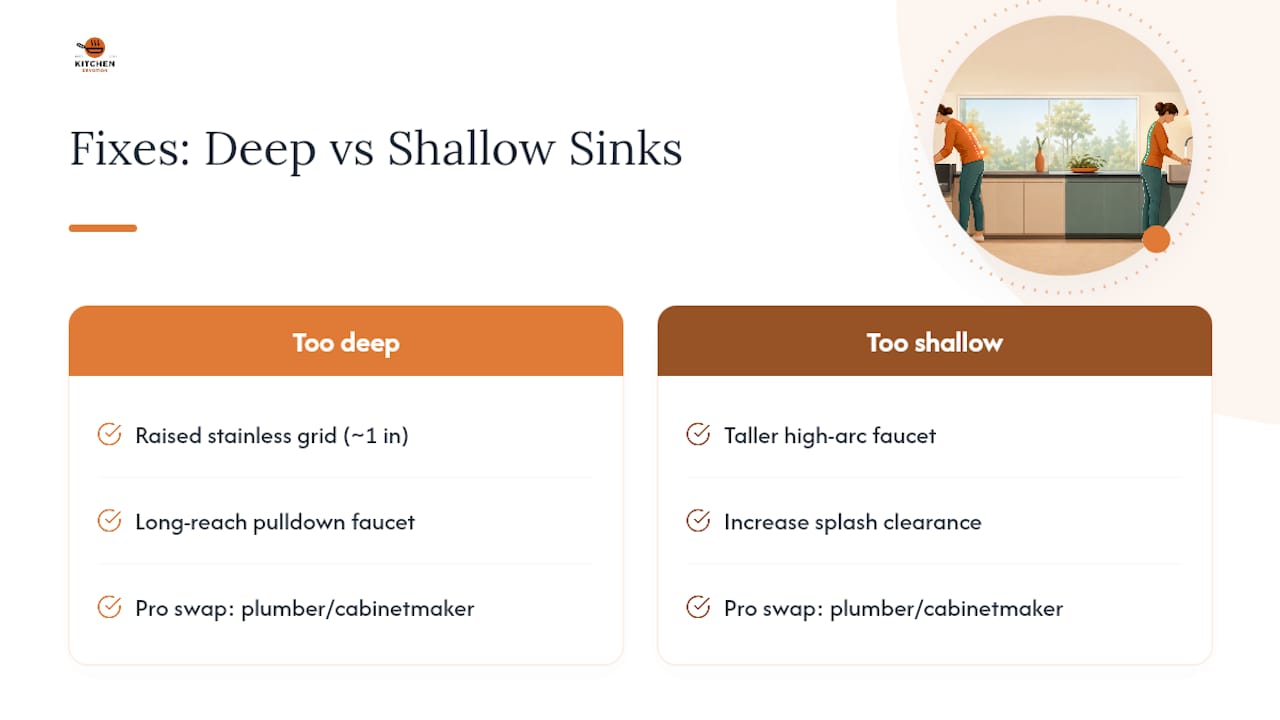
You don’t have to replace the sink to fix most of these problems. A raised stainless steel grid can lift your working surface by about an inch, which is often enough to take the edge off a basin that’s a little too deep. Faucet choice matters more than people expect too: a faucet with a longer reach and a pulldown spray head reduces the forward lean that causes most of the discomfort in the first place.
For a basin that’s too shallow, a taller faucet with a high arc creates more splash clearance without touching the sink itself. If none of these workarounds solve the problem, that’s your signal to talk to a plumber or cabinetmaker about a swap, not another patch.
Pro Tip: Try the faucet fix first. Repositioning or swapping the faucet costs a fraction of a sink replacement and solves the lean problem in most kitchens.
Why Kitchendevotion Prioritizes Measured Ergonomics Over Trends
The “deeper is always better” pitch sells sinks, but it doesn’t hold up once you’re standing at the counter for 20 minutes scrubbing a roasting pan. Sink recommendations approach the topic the way this guide does: match the basin to your height and your actual habits, not to whichever depth looks most dramatic in a product photo.
Our measuring guides and sink reviews walk through the exact reach and clearance numbers you need before ordering. Check them before you commit to a basin depth you’ll be living with for the next decade.
— K. Connors
Where to Shop for a Sink That Matches Your Measurements
You could spend a weekend cross-referencing spec sheets across a dozen manufacturer sites, or you could start with a collection already organized around the depth and mounting questions this guide just walked through. Kitchendevotion’s kitchen sinks category groups options by basin depth and mounting style, so you’re not stuck guessing whether a listed “9 inch” sink is undermount or drop-in.

If you’re still deciding between materials as well as depth, the sink material guide covers how stainless, granite composite, and fireclay each affect installation and long-term wear. And if this remodel is part of a bigger kitchen refresh, the kitchen appliance priority list for new homeowners is a solid next stop for sequencing your other purchases. Browse the sink category now and cross-reference the depth chart above before you check out.
Sources
- Ideal Kitchen Sink Depth by Height — Rachiele
- Shallow vs deep kitchen sinks — Angi
- How to choose kitchen sink — JR Stone
FAQ
What Is a Good Depth for a Kitchen Sink?
For most households, 8 to 10 inches balances capacity and comfort. Shorter users or anyone prioritizing easy reach should look toward 6 to 8 inches instead.
Is an 8-Inch Sink Deep Enough?
Yes, for most everyday tasks like hand-washing dishes and food prep. It falls short only if you regularly need to fully submerge large stockpots or sheet pans.
Is 12 Inches Too Deep for a Kitchen Sink?
Not necessarily, but 12-inch basins increase forward lean and strain for many users and can require plumbing adjustments to clear the drain and disposal properly.
What’s the Difference Between a 30-Inch and a 33-Inch Sink?
The number refers to the sink’s overall length, not its depth. A 33-inch sink offers a wider basin footprint, useful for double-bowl configurations, while depth is a separate measurement you check independently.




)
No comment