

Choose a drawer insert if you want maximum freshness and zero new footprint. Pick a pull-out organizer if a deep cabinet keeps burying jars behind pots. Go with a countertop tier or magnetic panel if you rent and can’t drill. Every option below trades reach for space, so measure your cabinet, drawer, and counter before you buy anything.
TL;DR:
- Drawer inserts are ideal for renters because they keep spices protected from heat and light, extending their potency and shelf life.
- Pull-out cabinet organizers are best suited for deep or base cabinets and can hold between 20 to 40 jars, needing proper door clearance to operate smoothly.
- Countertop tiers and carousels provide quick access to frequently used spices but require space and should be kept away from heat sources and direct sunlight.
- Magnetic panels and tins offer modular, no-drill options for small kitchens or renters, with capacity limited by available metal surface area.
- Accurate measurements of drawer height, cabinet depth, and countertop space are essential to match storage systems with actual kitchen layouts and prevent costly returns.
Table of Contents
- Spice Rack Types at a Glance
- Countertop Tiered Racks and Rotating Carousels
- In-Drawer Inserts and Spice-Drawer Systems
- Pull-Out Cabinet Organizers and Slide-Out Spice Racks
- Wall-Mounted and Cabinet-Door Racks
- Magnetic Systems, Tins, and Other No-Drill Space Savers
- How to Choose: A Measurement-First Checklist
- Measurement Rules and Organization Habits That Prevent Returns
- Choose Function Over Style: A Layout-First Take
- Helpful Resources for Measuring and Installing
- Sources
- FAQ
Spice Rack Types at a Glance
Six main formats cover almost every kitchen layout, and each one solves a different problem. Tiered countertop shelves and rotating carousels put spices in plain sight but eat into counter space. Drawer inserts hide jars in a single flat layer, which is why pairing tiered racks with drawer systems only makes sense when you’re splitting daily spices from weekly ones.
- Countertop tiers and carousels: fast one-hand access, 8–24 jars, no tools needed.
- Drawer inserts: keeps jars label-up and hidden, fits standard 18-inch drawers, needs a measuring tape.
- Pull-out cabinet organizers: best for deep or base cabinets, 20–40 jars, moderate install effort.
- Wall-mounted and door-mounted racks: frees counters, 8–20 jars, install ranges from zero-drill to screws.
- Magnetic tins and panels: renter-friendly and modular, capacity limited by metal surface area.
Renters gravitate toward drawer inserts, freestanding tiers, and magnetic panels. Homeowners with deep cabinets get more out of pull-outs and screw-mounted rails.
Countertop Tiered Racks and Rotating Carousels
Tiered shelves and lazy susans work best for cooks who reach for the same 8 to 24 spices constantly and want them visible without opening a single cabinet. A stackable rack can hold more than 20 jars on a single 12-inch cabinet shelf, and the tiered format creates two or three visible rows so nothing hides behind a taller bottle.
- Pros: instant visibility, no tools, works on a counter or inside a cabinet.
- Cons: takes up prime counter real estate and exposes jars to heat and light if placed near a stove or window.
- Placement rule: keep tiers at least a foot from a range and out of direct sunlight to protect flavor.
If your cabinet clearance runs short, look for expandable racks that adjust from about 12 to 24 inches wide instead of buying a fixed-width shelf that won’t fit.
Pro Tip: Rotating carousels shine on corner shelves other racks can’t reach. If you’ve got a lazy susan cabinet sitting half empty, that’s your carousel spot.
In-Drawer Inserts and Spice-Drawer Systems
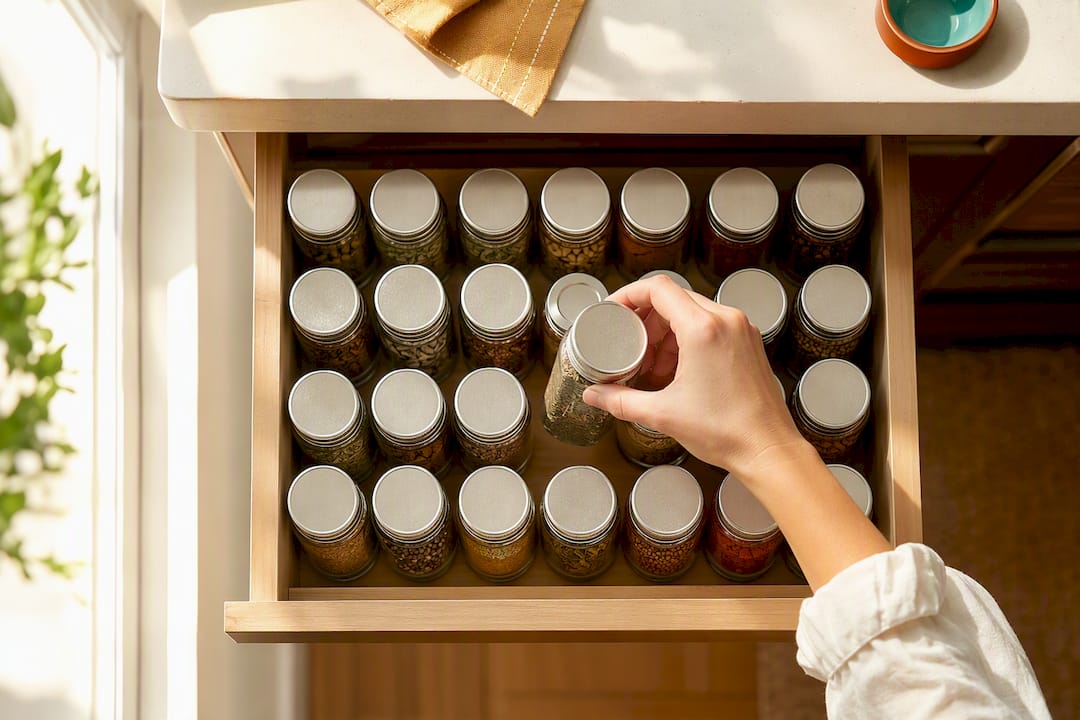
A drawer insert lays every jar flat and label-up, which helps keep spices out of heat and light better than many open shelves. That darkness matters: ground spices lose potency faster when exposed to heat, light, and humidity, so a closed drawer often outperforms a countertop tier on shelf life alone.
Before ordering, run this three-step check:
- Measure drawer clearance. You need roughly 4.5 inches of interior height for jars to sit upright without hitting the drawer above.
- Confirm width. Most inserts are built for standard 18-inch top drawers; a custom drawer needs a custom-fit or adjustable tray.
- Plan for full drawer use. An insert claims the entire drawer, so it only makes sense if that drawer isn’t already doing other work.
Typical inserts run about $20 to $35, and renter-friendly liner versions skip adhesive entirely. A spice drawer organization guide walks through the measuring step in more detail.
Pull-Out Cabinet Organizers and Slide-Out Spice Racks
Deep base cabinets are where jars go to disappear, and a pull-out organizer solves that by sliding the whole rack toward you instead of making you dig. These systems mount on metal rails, typically need 9 to 15 inches of width, and hold anywhere from 20 to 40 jars depending on how many tiers stack inside.
- Mount type matters: screw-mounted rails are sturdier for heavy daily use, while adhesive or no-drill versions suit renters willing to trade some stability for a damage-free install.
- Check door clearance before buying. A pull-out needs room to extend fully without hitting an adjacent drawer or appliance handle.
- Pull-outs beat lazy susans when your collection has outgrown a rotating tray or your cabinet corner isn’t a true corner unit.
If you’re already planning a cabinet overhaul, a home organization specialist can build pull-out spice storage directly into custom cabinetry rather than retrofitting an off-the-shelf unit.
Wall-Mounted and Cabinet-Door Racks
Small kitchens run out of counter and cabinet space fast, and wall-mounted or door-mounted racks solve that by claiming surfaces nobody else wants. Over-the-door organizers typically hold 8 to 12 jars with zero drilling, while screw-mounted rails hold 12 to 20 jars but can stress hinges if you overload a lightweight cabinet door.
- Over-the-door hangers: no tools, works in rentals, lower capacity.
- Screw-mounted wall rails: higher capacity, permanent, needs stud or anchor placement.
- Weight limit to respect: keep loaded racks under roughly 10 to 15 pounds on any single door to avoid hinge sag over time.
Renters should default to hanger-style units. Homeowners with sturdy pantry or cabinet doors get more storage from a fixed rail, and a guide to organizing small kitchen spaces covers where these racks fit best.
Magnetic Systems, Tins, and Other No-Drill Space Savers
Magnetic tins and panels are the smallest, most modular option on this list, and they’re the go-to for renters or anyone working with a truly tiny kitchen. Each tin usually holds 2 to 4 ounces, and capacity depends entirely on how much metal surface area you have on a fridge side, range hood, or magnetic strip.
- Check magnet strength before loading a tin full of denser spices like whole peppercorns.
- Keep magnetic strips away from stovetop heat, which speeds up flavor loss.
- Magnetic wins over wall-mounted racks when you have zero drillable wall space but plenty of metal appliance surface.
How to Choose: A Measurement-First Checklist
Skip the browsing-by-style trap. Take these three measurements first, then match capacity to how you actually cook.
- Drawer clearance: measure interior height with an empty jar; you need about 4.5 inches for a flat-lay insert.
- Cabinet depth: measure from the front lip to the back wall to know if a pull-out or tiered shelf will fit and extend fully.
- Counter clearance: measure the open stretch near your stove to see if a countertop tier will crowd your workspace.
Match capacity to habit: daily cooks need 8 to 12 jars in the prime reach zone, weekly cooks need 10 to 20 jars, and collectors need 30 or more spread across overflow storage.
Renters should favor no-drill products like drawer liners, freestanding tiers, and adhesive pull-outs, since permanent adhesive can weaken or leave marks over a long lease. Buy uniform jars where possible and label the lids, not just the sides, so a flat-lay drawer stays readable. Refresh ground spices within 12 to 24 months and keep them away from light, heat, and humidity no matter which system you pick.
Pro Tip: If you’re torn between two types, buy the cheaper no-drill option first. Living with it for a month tells you more about your reach habits than any measurement ever will.
Measurement Rules and Organization Habits That Prevent Returns
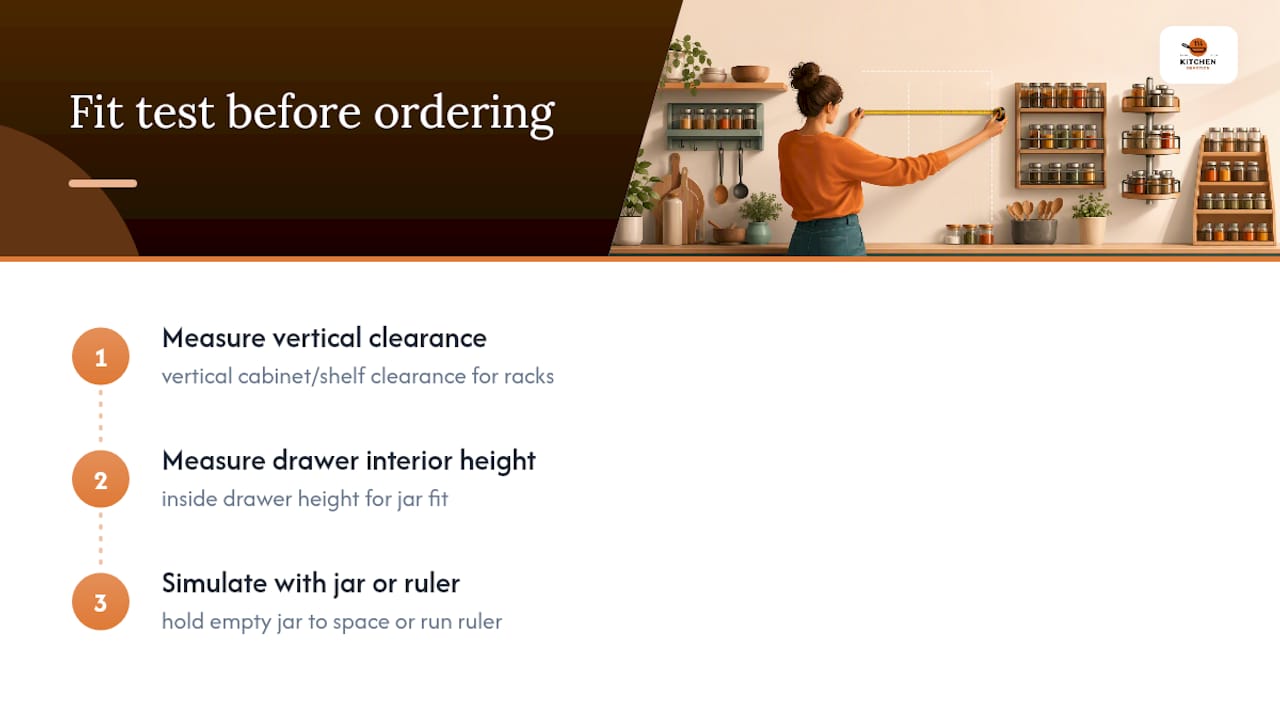
A simple two-measure test, vertical cabinet clearance and drawer interior height, prevents most of the buyer frustration that leads to returns. Simulate fit before ordering: hold an empty jar up to the shelf or drawer space, or run a ruler along the depth you measured.
Drawer and rack pairing only earns its keep when each system hosts a different tier, daily spices in the drawer, backups on a shelf. Stick to one jar size and shape where you can. A uniform lineup labeled clearly on top makes a flat-lay drawer as scannable as any tiered shelf, and it cuts the guessing game when you’re mid-recipe with wet hands.
Choose Function Over Style: A Layout-First Take
Style sells spice racks, but layout keeps them useful past the first month. The smartest move is testing a low-cost, no-drill option, an adhesive rack or a simple drawer liner, before committing to anything permanent. A rack that looks perfect on a shelf but sits two inches too deep for your reach becomes clutter within weeks, and no amount of good design fixes a measurement you skipped. Prioritize how a system fits your daily reach over how it photographs.
— K. Connors
Helpful Resources for Measuring and Installing
For deeper how-tos, see a drawer organization guide and small-kitchen storage strategies, plus the tiered vs. drawer comparison cited throughout this guide.
If your spice project is part of a bigger kitchen refresh, browse cookware sets for pieces that pair well with a newly organized cabinet, or check the tableware and dining accessories collection if you’re updating more than just storage. These categories are curated with the same measure-first, function-first thinking behind this guide.
Sources
- Spice Organization: Tiered Racks vs Drawer Systems | Declutter101
- Complete Spice Rack Guide: Keep Jars Handy in 2026
- Spice organization for tiny kitchens | CozySorted
- Best types of space-saving spice racks | EcoCraftyLiving
FAQ
What are the different types of spice racks?
The main types are countertop tiered racks, rotating carousels, in-drawer inserts, pull-out cabinet organizers, wall-mounted or door-mounted racks, and magnetic tins or panels. Each fits a different combination of cabinet depth, counter space, and rental status.
What should every spice rack have?
A good spice rack should hold jars upright and visible, keep spices away from direct heat and light, and match the clearance of the space it’s going into. It should also fit your cooking frequency, whether that’s 8 to 12 daily jars or a larger collector-sized set of 30 or more.
Which spice racks are the best?
There’s no single best type since the right pick depends on your kitchen. Drawer inserts win on freshness, pull-outs win on capacity in deep cabinets, and magnetic panels or over-the-door hangers win for renters who can’t drill.
What are the different types of vertical spice racks?
Vertical spice racks include wall-mounted screw racks, over-the-door hangers, and stacked tiered shelves inside a cabinet. Screw-mounted rails typically hold 12 to 20 jars, while over-the-door versions hold 8 to 12 jars without any tools.




No comment