Air fryers are kitchen appliances that cut cooking time by circulating hot air rapidly around food inside a compact chamber, delivering faster heat transfer than a conventional oven. The core reason why air fryers save time comes down to two factors working together: a smaller enclosure that reaches cooking temperature in minutes, and fan-driven convection that accelerates browning and moisture removal. Consumer tests by Which? found air fryers completed the same cook in 53 minutes versus 76 minutes for a conventional oven, while using significantly less energy. For anyone cooking one to two portions on a weeknight, that difference is the entire margin between a fast dinner and a long wait.
Why air fryers reduce cooking time compared to conventional ovens
The speed advantage of an air fryer is not accidental. It is the direct result of two physical properties working in combination: chamber size and forced convection.
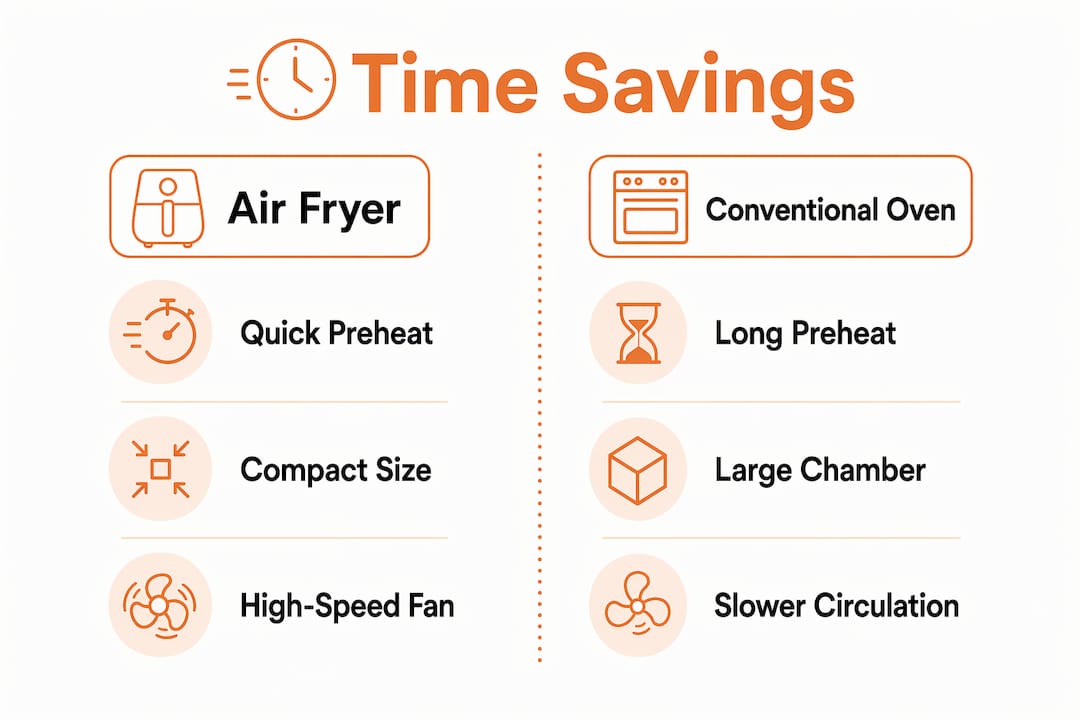
A standard built-in oven holds roughly 3 to 5 cubic feet of air. An air fryer holds a fraction of that, typically between 2 and 7 quarts. Heating a smaller volume of air to 400°F takes far less time and energy than heating a large oven cavity. This is why most air fryers reach cooking temperature in 2 to 3 minutes, while a conventional oven takes 10 to 15 minutes just to preheat. That preheat gap alone accounts for a significant share of the total time difference on any given meal.
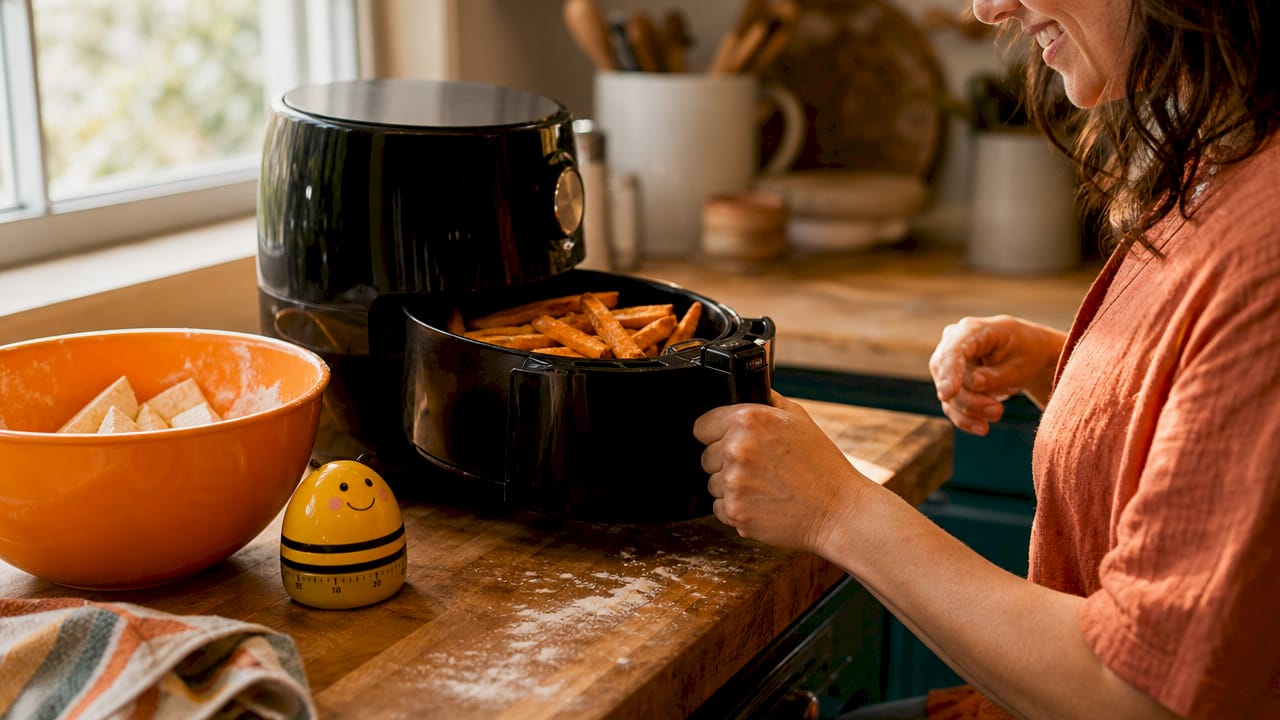
The second factor is the fan. Air fryers use a high-speed fan to push hot air directly over and around the food surface. This forced convection strips away the cool, moist boundary layer that naturally forms around food during cooking. The Maillard reaction, which is the chemical process responsible for browning and crisping, accelerates when that moisture layer is removed quickly. The result is that browning and crisping happen faster in an air fryer than in a conventional oven, shortening the total cook cycle without sacrificing texture.
Here is how the two appliances compare on the metrics that matter most for everyday cooking:
| Factor | Air fryer | Conventional oven |
|---|---|---|
| Preheat time | 2 to 3 minutes | 10 to 15 minutes |
| Energy use (small portion) | Lower (e.g., 54 kWh) | Higher (e.g., 157 kWh) |
| Cook time (small portion) | Shorter (e.g., 53 min) | Longer (e.g., 76 min) |
| Best for | 1 to 2 servings | Large meals, multiple dishes |
The energy and time savings are most pronounced for small portions. For a single chicken breast, a bag of frozen fries, or a tray of roasted vegetables, the air fryer wins on every measurable dimension.
Pro Tip: If you are cooking proteins like chicken thighs or salmon fillets, preheat the air fryer basket for 2 to 3 minutes before adding food. A hot basket creates immediate surface contact and speeds up browning from the first minute of cooking.
When air fryers do not save time: batch cooking and portion size
Air fryer cooking efficiency has a clear ceiling, and it is defined by the size of the basket. Understanding this limit prevents frustration and helps you decide when to reach for the oven instead.
The compact chamber that makes an air fryer fast for small portions becomes a constraint when you are feeding four or more people. Air fryers work best for one to two servings at a time. Once you exceed that load, you face a choice: overcrowd the basket or cook in multiple batches.
Overcrowding is the more damaging option. When food is stacked or packed tightly, the high-speed airflow cannot reach all surfaces evenly. Moisture gets trapped between pieces, and the Maillard reaction slows down. The result is food that takes longer to cook and comes out steamed rather than crispy. Basket crowding blocks airflow and traps moisture, directly increasing cooking time and reducing crispness. You end up with the worst of both worlds: a longer cook and a worse result.
Batch cooking is the more practical option, but it carries its own time cost. If a full meal requires three separate batches, each taking 12 minutes, you are looking at 36 minutes of active cooking plus the time to reload the basket between rounds. A large oven, loaded once with multiple trays, may finish the same meal faster. Cooking large batches in multiple air fryer cycles can make the oven more time-efficient overall.
The practical takeaway is straightforward:
- Air fryers win for 1 to 2 servings of a single food item
- Batch cooking for 4 or more people reduces or eliminates the time advantage
- Never stack food in the basket; a single layer is non-negotiable for speed and crispness
- For large family meals or holiday cooking, the oven remains the faster tool
Pro Tip: If you own a dual-basket model like the COSORI Dual Basket 9Qt, you can cook two different foods simultaneously at different temperatures. This largely solves the batch cooking problem for households of two to four people.
How to adapt recipes to maximize air fryer time savings
Knowing that air fryers cook faster is useful. Knowing exactly how to adjust your recipes is what actually saves you time at the stove.
The standard conversion rule is to reduce oven temperature by approximately 25°F and cut cooking time by approximately 20%. This works because the faster hot air circulation in the smaller chamber delivers more heat per minute than a conventional oven at the same setting. A recipe calling for 400°F for 25 minutes in the oven becomes roughly 375°F for 20 minutes in the air fryer. That is a reliable starting point, not a guaranteed finish line.
Follow these steps to get consistent, fast results when adapting any recipe:
- Apply the conversion formula first. Reduce temperature by 25°F and time by 20%. Write down the adjusted numbers before you start.
- Arrange food in a single layer. No overlapping, no stacking. If the basket cannot fit everything in one layer, plan for a second batch rather than crowding.
- Check doneness at the halfway mark. Because recipe conversions are starting points, variables like food thickness and frozen versus fresh will shift the actual finish time. Checking early preserves the time advantage.
- Shake or flip at the midpoint. This exposes all surfaces to direct airflow and prevents one side from overcooking while the other undercooks.
- Preheat for breaded or thick items. A preheated basket delivers more consistent and often shorter cook times for breaded chicken, fish fillets, and thick proteins. Cold starts work better for foods with longer cook times, like whole potatoes.
- Add 3 to 5 minutes for frozen foods. Frozen items require extra time to thaw before browning begins. Factor this in rather than discovering it mid-cook.
The Kitchendevotion air fryer cheat sheet covers pre-converted times and temperatures for the most common foods, which removes the guesswork entirely and keeps your cooking fast from the start.
What new air fryer technology does to cooking speed
The air fryers available in 2026 are meaningfully faster than models from five years ago. The most significant advancement is infrared heating technology, and it changes the time equation in a specific way.
Traditional air fryers still require a short preheat period before the circulating air reaches cooking temperature. Infrared models eliminate this step entirely. Infrared heating transfers heat directly to food rather than heating the surrounding air first, which means cooking starts the moment you press the button. T-fal’s infrared air fryer line is the most prominent example of this approach, combining direct infrared heat with convection airflow to deliver both speed and even cooking.
The practical benefits for daily cooking are concrete:
- No preheat wait, even for breaded or thick foods
- Consistent browning from the first minute of cooking
- Faster total meal times, particularly for quick weeknight dishes
- Less energy used per cook cycle compared to traditional air fryer models
The combination of infrared and convection is significant because infrared alone can create uneven results. Hot spots form near the heating element while outer areas cook more slowly. Adding convection airflow distributes the infrared heat evenly across the food surface, solving that problem. The result is a faster cook with the same quality output as a well-managed traditional air fryer.
For anyone serious about air fryer cooking efficiency, infrared models represent the current ceiling of what the technology can deliver. They are not universally necessary for every household, but for cooks who use their air fryer daily, the cumulative time savings across a week of meals are substantial.
Key takeaways
Air fryers save time primarily because their compact chamber heats faster and their fan-driven convection accelerates browning, cutting both preheat and cook times for small portions.
| Point | Details |
|---|---|
| Preheat time advantage | Air fryers reach cooking temperature in 2 to 3 minutes versus 10 to 15 minutes for a conventional oven. |
| Best portion size | Time savings are greatest for 1 to 2 servings; batch cooking for 4 or more people reduces the advantage. |
| Recipe conversion rule | Reduce oven temperature by 25°F and cooking time by 20% as a starting point for any recipe. |
| Basket load matters | Overcrowding blocks airflow, traps moisture, and increases cooking time. Single layers are required. |
| Infrared technology | No-preheat infrared models like T-fal’s line eliminate wait time entirely, further speeding up meals. |
What I’ve learned from cooking with an air fryer every day
I have used air fryers daily for years, and the single most common mistake I see is treating the basket like a bowl. People dump in a full bag of frozen fries, pack in four chicken thighs, and then wonder why the food took longer and came out soft. The basket is not a container. It is a cooking surface, and every piece of food needs direct exposure to moving air to cook at the speed the appliance promises.
The infrared no-preheat models genuinely changed my routine. I used to factor in a 3-minute preheat as part of my prep, which was fine but added friction on busy evenings. With an infrared model, I load the basket and press start while I am still prepping the rest of the meal. Those 3 minutes compound across 300 cooking sessions per year into something real.
My honest view on batch cooking is this: if you are regularly cooking for four or more people, a single large-basket air fryer is not the right tool for speed. A dual-basket model or a larger capacity unit solves most of that problem. But if you are cooking for one or two people, an air fryer is the fastest appliance in your kitchen for the majority of everyday meals. No other time-saving kitchen gadget delivers the same combination of speed, texture, and low cleanup. The oven has its place for large roasts and sheet pan dinners. For everything else, the air fryer wins.
— K
Find the right air fryer for your kitchen at Kitchendevotion
Kitchendevotion has done the research so you do not have to. The time-saving kitchen appliances list covers the best air fryers and other efficient tools selected specifically for home cooks who want faster meals without sacrificing quality. If you are starting out, the best budget air fryers guide covers affordable models that deliver real speed advantages for everyday cooking. Every recommendation on Kitchendevotion is chosen for performance, ease of use, and value, so you can spend less time researching and more time cooking.
FAQ
Why do air fryers cook faster than regular ovens?
Air fryers heat a much smaller chamber and use a high-speed fan to circulate hot air directly over food, cutting preheat time to 2 to 3 minutes and accelerating browning. Consumer tests show air fryers completing the same cook in 53 minutes versus 76 minutes for a conventional oven.
How much should I reduce cooking time when using an air fryer?
The standard rule is to reduce oven cooking time by approximately 20% and lower the temperature by 25°F. Treat this as a starting point and check doneness early, since food thickness and basket load affect the actual finish time.
Does overcrowding the air fryer basket slow down cooking?
Yes. Overcrowding blocks airflow and traps moisture around the food, which increases cooking time and prevents crisping. Always arrange food in a single layer for the fastest, most consistent results.
Are air fryers worth it for large families?
Air fryers are most time-efficient for one to two servings. For four or more people, multiple batches can make a conventional oven faster overall. A dual-basket model reduces this limitation significantly for mid-sized households.
What is an infrared air fryer and why is it faster?
An infrared air fryer transfers heat directly to food rather than heating the surrounding air first, which eliminates preheat time entirely. Combined with convection airflow, infrared models start cooking immediately and deliver even browning from the first minute.





No comment