

Ergonomic kitchen design is the practice of arranging your kitchen’s layout, surfaces, and storage to fit natural body movements, reduce physical strain, and boost functionality. Professionals in the field call it “human-centered kitchen planning,” and it goes far beyond picking stylish cabinets. The core goal is adapting the kitchen to you, not the other way around. When done right, it means less back pain after a long cooking session, fewer awkward reaches for heavy pots, and a workspace that genuinely supports how you cook. This guide covers the principles, the research, and the practical steps you need to get it right.
What is ergonomic kitchen design and why does it matter?
Ergonomic kitchen design means designing the kitchen’s layout, storage, and movement so tasks can be performed with natural body movement and reduced physical strain. The result is a kitchen that minimizes unnecessary movements while maximizing comfort and ease of use across cooking and cleaning workflows. Think of it as the difference between a kitchen that looks good in a catalog and one that still feels good after you have cooked three meals in a row.
The discipline draws directly from workplace ergonomics, applying the same principles used in office and factory design to the home kitchen. Key concepts include the kitchen work triangle, countertop height calibration, ergonomic zones, and clearance planning. Each of these elements addresses a specific source of physical strain that standard kitchen layouts routinely ignore.
Why does this matter for homeowners? Musculoskeletal discomfort from poor kitchen posture accumulates over years. A countertop that is two inches too high forces your shoulders up every time you chop vegetables. A cabinet placed too low means repeated bending that strains your lower back. Ergonomics is the missing link between a good-looking kitchen and one that feels comfortable during actual use.
What are the fundamental principles of ergonomic kitchen design?
The principles of ergonomic kitchen design organize around four goals: reducing unnecessary movement, fitting surfaces to the user’s body, planning clear traffic paths, and grouping tasks logically. Every design decision should serve at least one of these goals.
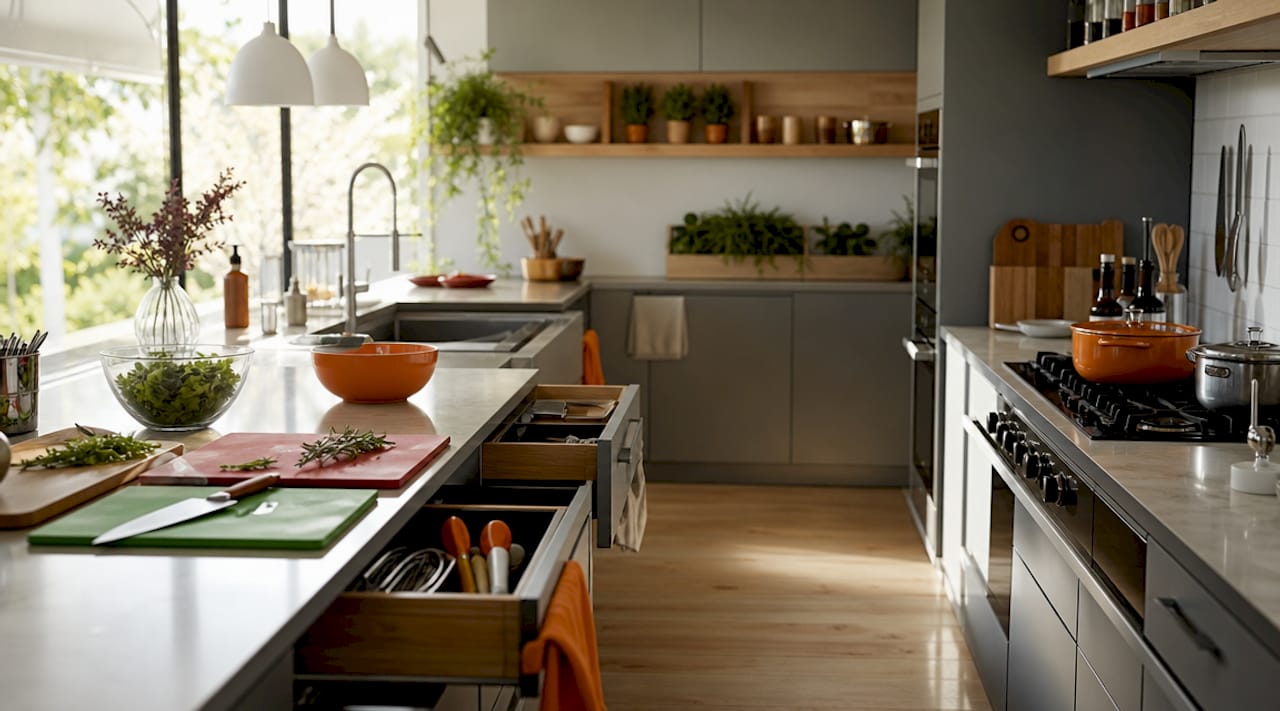
Work zone planning is the foundation. A well-designed kitchen separates tasks into distinct zones: food preparation, cooking, washing, and storage. Each zone contains the tools and surfaces needed for that specific task, so you are not walking across the kitchen to grab a cutting board or a colander. Adapting counter heights and appliance placement to fit household members’ needs is the next layer of personalization that makes zones actually work.
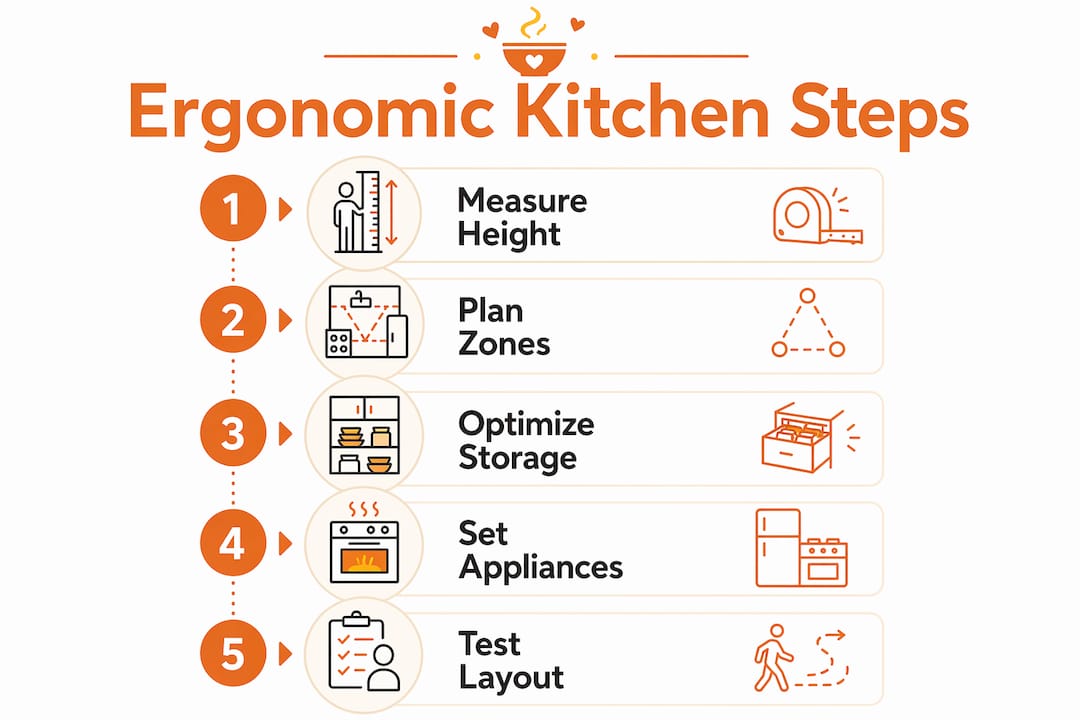
Height adjustment is the most direct ergonomic lever you have. Standard countertops in the United States sit at 36 inches, but that height suits a person roughly 5 feet 9 inches tall. Anyone shorter or taller works at a biomechanically compromised position every time they cook. Adjusting counter heights to match elbow height for each primary task reduces shoulder and neck strain significantly.
Clearance planning prevents collisions and bottlenecks. The National Kitchen and Bath Association recommends at least 42 inches of clearance in a single-cook kitchen and 48 inches for two cooks. These numbers exist because tight paths force awkward postures and increase the risk of burns and spills.
- Keep the prep zone adjacent to the sink for easy rinsing and waste disposal.
- Position the cooking zone within two steps of the prep zone to minimize carrying hot items.
- Store frequently used items between hip and shoulder height to eliminate bending and overhead reaching.
- Plan cabinet door swings so they do not block adjacent work surfaces or appliances when open.
- Allow at least 15 inches of landing space on either side of the cooktop for setting down hot pans.
Pro Tip: Measure your elbow height while standing relaxed, then subtract 2 to 4 inches. That number is your ideal prep counter height. Use it as your baseline when specifying countertops or planning a remodel.
How does the kitchen work triangle compare to modern ergonomic zone planning?
The kitchen work triangle was developed in the 1940s by researchers at the University of Illinois. It connects the three primary appliances: the refrigerator, the cooktop, and the sink. The theory holds that keeping the total distance of this triangle between 13 and 26 feet reduces unnecessary walking and improves efficiency. For decades, it was the standard framework for kitchen layout.
The triangle works well in a single-cook, closed-plan kitchen where one person moves between three fixed points. Its limitations become clear in open-plan layouts, island-heavy designs, and households where two or more people cook simultaneously. Designers adjust zones closer together when the default triangle feels too spread out, because real-world cooking involves far more than three appliances and three movements.
Zone planning replaces or supplements the triangle by organizing the kitchen around task clusters rather than appliance positions. A zone-based layout might include a dedicated baking station with a lower counter, a coffee and breakfast zone near the refrigerator, and a cleaning zone with the dishwasher and sink grouped together. Each zone is self-contained, reducing cross-traffic and the number of steps between related tasks.
| Layout approach | Best suited for | Key limitation |
|---|---|---|
| Kitchen work triangle | Single-cook, closed-plan kitchens | Ignores multi-cook and multi-task workflows |
| Zone-based planning | Open-plan, multi-cook, or specialty kitchens | Requires more upfront planning and space |
| Hybrid (triangle + zones) | Most modern kitchens | Needs careful clearance coordination |
Measuring actual user movement rather than only triangle distances reveals real ergonomic bottlenecks that standard plans miss. A designer who watches how a client actually moves through their current kitchen will catch problems that no floor plan reveals on paper.
Pro Tip: Before committing to a layout, spend one week placing sticky notes on every cabinet and drawer you open during cooking. The pattern will show you exactly where your zones should be.
Why is countertop and appliance height crucial for ergonomic kitchen design?
Counter height is the single most impactful ergonomic variable in any kitchen. A 2026 study on biomechanical strain found that standard counters exceeding elbow height by 6 to 10 cm increased discomfort during washing tasks, while multi-level counters reduced trunk flexion and shoulder elevation significantly. That is not a minor comfort issue. Repeated shoulder elevation during daily cooking accumulates into chronic strain over months and years.
Multi-level counters are the most practical solution for households with users of different heights. Multi-level countertops ranging from 75 to 90 cm suit various users and significantly reduce posture-related strain. A lower surface at 32 to 34 inches works well for baking, where you need downward pressure for kneading. A standard 36-inch surface suits most prep tasks. A raised 42-inch counter at a kitchen island is ideal for standing and eating without hunching.
A PubMed study from 2026 showed that adjustable work heights lowered neck and spine flexion and decreased workload measures during precision kitchen tasks. Adjustable-height counters, once found only in commercial or accessibility-focused kitchens, are now available for residential use through manufacturers like Häfele and Vauth-Sagel.
Task-specific height guidelines give you a practical starting point:
- Washing and rinsing: Counter at or slightly below elbow height to prevent shoulder elevation.
- Chopping and prep: 2 to 4 inches below elbow height for downward cutting force.
- Baking and kneading: 4 to 6 inches below elbow height for maximum leverage.
- Plating and finishing: At or slightly above elbow height for fine motor control.
Appliance placement follows the same logic. A wall oven installed at counter height eliminates the need to bend down to a floor-level oven, reducing lower back strain. A microwave placed above the cooktop forces overhead reaching and is one of the most common ergonomic mistakes in standard kitchen design. Position microwaves between counter height and eye level instead.
What are best practices for ergonomic storage and cabinet design?
Storage design determines how often you bend, reach, and twist during a typical cooking session. The goal is to keep the items you use most within what ergonomists call the “comfort zone,” which runs from hip height to shoulder height. Anything outside that range should hold items you use rarely.
Pull-out drawers outperform traditional cabinet doors for base storage. A deep drawer lets you see and reach everything inside without kneeling or crouching. Lazy Susans in corner cabinets solve the dead-corner problem by rotating contents to the front. Vertical dividers for baking sheets and cutting boards eliminate the need to lift and shuffle through stacked items.
- Place everyday dishes and glasses in upper cabinets no higher than 18 inches above the countertop.
- Use pull-out shelves in lower cabinets for pots, pans, and small appliances to avoid deep bending.
- Install drawer organizers at counter level for utensils and tools used during prep.
- Keep cleaning supplies in a pull-out cabinet directly under the sink for immediate access.
- Avoid placing heavy items like stand mixers in upper cabinets. Store them on the counter or in a dedicated appliance garage at counter height.
Cabinet door swings deserve specific attention. A cabinet door that opens into the path between the sink and the cooktop creates a collision hazard and forces awkward body positioning. Soft-close hinges and push-to-open mechanisms reduce the physical effort of opening and closing cabinets repeatedly during a cooking session. For corner installations, bi-fold or pocket doors eliminate the swing radius entirely.
How can ergonomic kitchen design enhance daily cooking efficiency and comfort?
The practical benefits of an ergonomic kitchen layout show up in two ways: reduced physical discomfort and faster, more fluid cooking. When your prep zone, cooking zone, and cleaning zone are logically sequenced, you move through a meal preparation in a natural arc rather than zigzagging across the kitchen. That reduction in unnecessary movement translates directly to less fatigue.
Layered lighting is one of the most underrated ergonomic features. Task lighting directly above prep surfaces eliminates shadows that cause you to lean in and squint, which strains your neck and shoulders. Under-cabinet LED strips from brands like Philips Hue or Lutron provide direct illumination without the glare of overhead fixtures.
Ergonomics is about how people actually move through the kitchen, not just fitting standard dimensions. That insight changes how you evaluate every product and design choice. An ergonomic cutting board with a non-slip base, for example, eliminates the micro-adjustments you make every time the board shifts, reducing wrist and shoulder tension during extended prep work.
- Install a touchless or single-lever faucet to reduce wrist rotation at the sink.
- Choose appliances with front-facing controls to avoid reaching over hot surfaces.
- Use anti-fatigue mats in front of the sink and cooktop to reduce leg and lower back strain during long cooking sessions.
- Select drawer pulls and cabinet handles sized for a full-hand grip rather than a pinch grip to reduce finger and wrist strain.
Pro Tip: Place your most-used kitchen appliances on the counter within arm’s reach of their primary use zone. An air fryer used daily belongs next to the cooktop, not in a cabinet across the room.
Key takeaways
Ergonomic kitchen design works when layout, height, storage, and lighting are all calibrated to the specific people who cook in that space every day.
| Point | Details |
|---|---|
| Zone planning over the triangle | Organize your kitchen by task clusters, not just appliance positions, for better multi-cook flow. |
| Counter height is critical | Match counter height to elbow height per task to reduce shoulder, neck, and back strain. |
| Multi-level counters reduce strain | Multi-height surfaces ranging from 75 to 90 cm cut trunk flexion and shoulder elevation for diverse users. |
| Storage in the comfort zone | Keep daily-use items between hip and shoulder height to eliminate unnecessary bending and reaching. |
| Appliance placement matters | Position microwaves at counter-to-eye level and wall ovens at counter height to avoid awkward postures. |
Why most ergonomic kitchen advice misses the most important step
Most ergonomic kitchen guides hand you a list of standard measurements and call it done. The 36-inch counter, the 42-inch clearance, the work triangle. Those numbers are starting points, not solutions. What I have found, working through dozens of kitchen projects, is that the real ergonomic failures happen in the gap between standard specs and the actual person cooking in that kitchen.
I worked with a household where both partners cooked daily. One was 5 feet 4 inches tall, the other 6 feet 2 inches. A single-height counter at 36 inches was a compromise that worked well for neither of them. The solution was a two-tier island with a 32-inch prep surface on one side and a 38-inch counter on the other. Neither surface was “standard.” Both were correct.
The other mistake I see constantly is treating aesthetics and ergonomics as competing priorities. They are not. A kitchen with pull-out drawers, task lighting, and multi-level surfaces can be just as beautiful as one with traditional cabinets and uniform counters. The difference is that it will still feel good to cook in after five years. Personalizing ergonomic design based on anthropometrics and task habits leads to measurably better comfort and function. That is not a design philosophy. It is what the research shows.
If you are planning a remodel or a new build, spend one session observing how you actually move through your current kitchen before you touch a floor plan. The patterns you notice will tell you more than any standard guideline.
— K
Find ergonomic appliances that work as hard as your kitchen design
A well-planned kitchen layout sets the stage, but the appliances and tools you choose determine how comfortable cooking actually feels day to day. At Kitchendevotion, you will find a curated selection of products chosen specifically for user-friendly design and real-world functionality. Whether you are looking for appliances that cut prep time or tools that reduce physical effort at the counter, the 2026 appliance guide at Kitchendevotion walks you through the best options for an ergonomic kitchen setup. Browse the full Kitchendevotion collection to find products that complement the design principles covered in this guide.
FAQ
What is the main goal of ergonomic kitchen design?
The main goal is to adapt the kitchen’s layout, surfaces, and storage to fit the natural body movements of the people who use it, reducing physical strain and improving cooking efficiency.
How high should kitchen counters be for ergonomic use?
Counter height should match your elbow height minus 2 to 4 inches for prep tasks. Research shows that counters exceeding elbow height by 6 to 10 cm increase discomfort, particularly during washing tasks.
Is the kitchen work triangle still relevant in 2026?
The kitchen work triangle is still useful as a baseline for single-cook layouts, but zone-based planning has largely replaced it in open-plan and multi-cook kitchens because it better reflects how people actually move and work.
What storage features make a kitchen more ergonomic?
Pull-out drawers, lazy Susans, and vertical dividers are the most effective storage features. They keep items visible and accessible without requiring bending, crouching, or overhead reaching.
Can ergonomic kitchen design work in a small kitchen?
Yes. Ergonomic principles apply regardless of kitchen size. In small kitchens, the priority is keeping task zones tightly grouped, using pull-out storage to maximize accessibility, and choosing compact appliances with front-facing controls to reduce awkward reaching.





No comment