
A kitchen tool set is a curated collection of food preparation implements designed to cover every core cooking task, from cutting and measuring to stirring and serving. The most effective sets include a chef’s knife, an instant-read thermometer, a kitchen scale, and a range of utensils like tongs, whisks, and spatulas. According to culinary experts, a chef’s knife handles 80 to 90% of all cutting tasks in a home kitchen, making it the single most important tool in any set. Whether you’re building your first kitchen or upgrading your gear, understanding what goes into a quality set saves you money and makes cooking measurably better.
What is a kitchen tool set and what does it include?
A kitchen tool set, also called a kitchen utensil set in retail and culinary circles, is a bundled group of implements that address the most frequent cooking tasks in one purchase. The category spans everything from basic silicone spatula collections to professional-grade sets with precision scales and thermometers. The appeal is straightforward: one purchase, coordinated tools, and no gaps in your prep workflow.

Common kitchen tool sets cover five functional categories: cutting, stirring, flipping, serving, and measuring. Each category maps to a specific source of cooking error. Cutting tools determine texture and consistency. Measuring tools determine accuracy. Temperature tools determine doneness. When a set covers all five categories, it eliminates the most common reasons home cooks produce inconsistent results.
Here are the must-have kitchen tools found in well-designed sets:
- Chef’s knife — handles the majority of slicing, dicing, and chopping tasks
- Paring knife — precision work like peeling, trimming, and detail cuts
- Microplane grater — zesting citrus, grating hard cheese, and finishing dishes
- Instant-read thermometer — confirms safe internal temperatures for meat and poultry
- Kitchen scale — measures ingredients by weight for recipe precision, especially in baking
- Whisk — emulsifies sauces, beats eggs, and incorporates air into batters
- Tongs — gripping, flipping, and plating without piercing food
- Ladle — portioning soups, stews, and sauces cleanly
- Slotted spoon — draining while serving
- Silicone spatula — folding, scraping, and working with nonstick surfaces
Pro Tip: When evaluating what tools are in a kitchen set, separate prep tools from serving tools. Prep tools like knives, scales, and thermometers directly affect cooking quality. Serving tools like ladles and slotted spoons affect presentation. Prioritize prep tools first.
The distinction between prep and serving tools matters for beginners especially. If you’re building a kitchen tools for beginners collection, start with the chef’s knife, thermometer, scale, and one good spatula. Add serving tools as your cooking expands.
How to choose the best kitchen tool set for your cooking style
Material is the single most consequential decision when selecting a kitchen tool set. The four dominant materials are silicone, wood, stainless steel, and nylon, and each has a specific role in a well-organized kitchen.
Silicone tools are dishwasher-safe, heat-resistant, and safe for nonstick cookware. They don’t scratch surfaces and don’t absorb odors. Wood tools are natural and gentle on cookware, but they are porous, which means they absorb moisture and bacteria over time if not dried properly. Nylon tools are lightweight and inexpensive, but some nylon formulations contain chemicals that can leach at high heat. Stainless steel tools are the most durable, but they will scratch nonstick coatings and are not appropriate for coated pans.
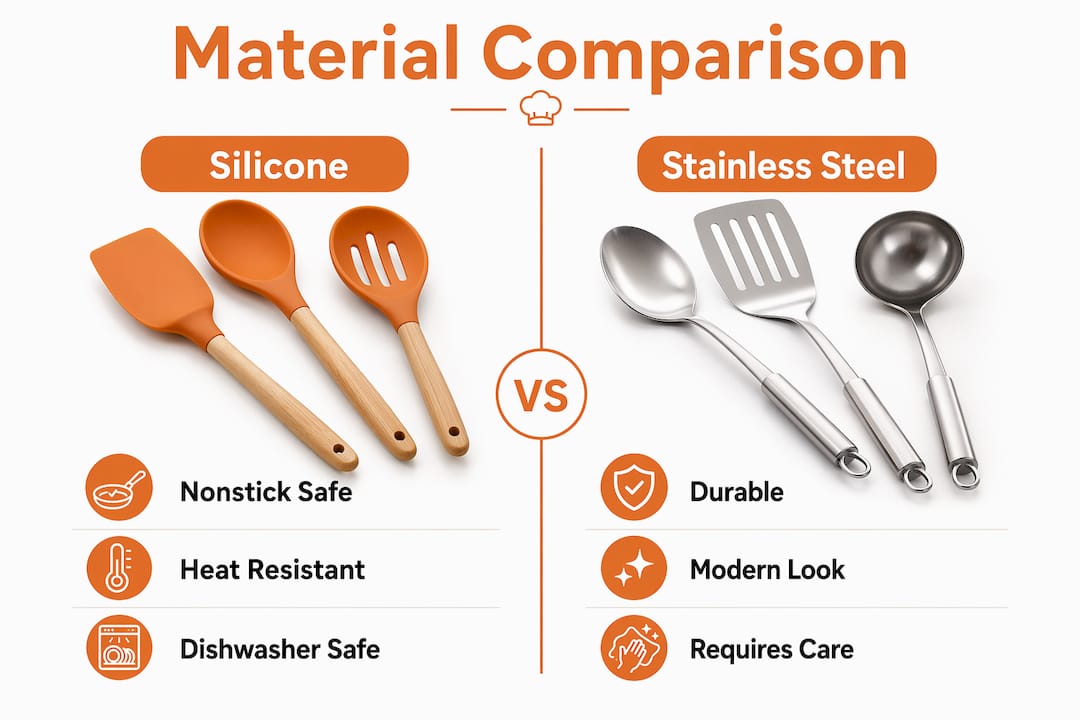
| Material | Best for | Nonstick safe | Durability | Maintenance |
|---|---|---|---|---|
| Silicone | All-purpose cooking | Yes | High | Dishwasher-safe |
| Wood | Stirring, low-heat tasks | Yes | Medium | Hand wash, dry immediately |
| Stainless steel | High-heat, uncoated pans | No | Very high | Dishwasher-safe |
| Nylon | Budget sets, light tasks | Yes | Low to medium | Dishwasher-safe |
Metal tools risk surface damage on nonstick pans, which is why silicone or wood tools are the correct choice for anyone cooking with coated cookware. This is not a minor detail. A scratched nonstick surface releases coating particles into food and degrades the pan’s performance permanently.
Quality recognition comes down to three signals: weight, finish, and joint construction. A well-made silicone spatula feels solid in the hand, not hollow. A quality whisk has tightly wound wire loops that don’t separate. A good ladle has a seamless connection between handle and bowl, not a visible seam that traps food.
Pro Tip: A sharp, well-maintained inexpensive knife outperforms a dull expensive one every time. Spend on a quality chef’s knife first, then invest in a honing steel and a whetstone. The knife you maintain is always better than the knife you neglect.
For home cooks with cookware sets that include nonstick pans, a silicone-dominant utensil set is the practical default. If you cook primarily on cast iron or stainless steel, a stainless steel tool set is the better long-term investment.
What do kitchen tool sets cost at different price points?
Kitchen tool sets range from under $100 for basic silicone collections to $225 to $362 for premium stainless steel sets. That price gap reflects real differences in material quality, tool count, and long-term durability. Understanding what each tier delivers helps you spend correctly.
| Price range | Typical material | Tools included | Best for |
|---|---|---|---|
| Under $50 | Nylon or basic silicone | 5 to 10 pieces, basic utensils | First apartment, casual cooking |
| $50 to $100 | Quality silicone | 10 to 15 pieces, includes thermometer | Home cooks, everyday meals |
| $100 to $225 | Mixed silicone and stainless | 15 to 20 pieces, full prep coverage | Serious home cooks |
| $225 to $362 | Premium stainless steel | 20 or more pieces, professional grade | Aspiring chefs, frequent cooking |
The bundled purchasing model offers two real advantages. First, sets are priced below the sum of their individual components. Second, bundled sets provide aesthetic coordination, meaning your kitchen looks organized and functions as a system rather than a collection of mismatched pieces. That coordination matters more than it sounds. A visually organized kitchen reduces cognitive friction during cooking.
The case for buying individual tools rather than a set is strongest when you have one specific gap. If you already own solid utensils but lack a precision scale or a quality thermometer, buying those individually makes more sense than purchasing a full set. The budget kitchen essentials guide at Kitchendevotion covers exactly this scenario, helping you identify which individual tools deliver the most value per dollar.
One counterintuitive finding: the most expensive sets are not always the most practical for home cooks. A $362 stainless steel set is optimized for professional-style cooking on uncoated pans. If your kitchen runs on nonstick cookware, that set is the wrong choice regardless of its quality. Match the set to your actual cooking setup, not to the highest price point you can afford.
How kitchen tool sets improve cooking efficiency and precision
The right tools don’t just make cooking easier. They eliminate specific, measurable sources of error that produce inconsistent results. Here is how a well-chosen set improves your cooking step by step:
-
Cutting accuracy with a sharp chef’s knife. Uniform cuts mean uniform cooking times. When vegetables are cut to the same size, they finish cooking at the same moment. A dull knife produces uneven cuts and increases the risk of slipping, which is the leading cause of kitchen injuries.
-
Temperature precision with an instant-read thermometer. Thermometers ensure safe doneness and prevent overcooking. A chicken breast cooked to 165°F is safe and juicy. One cooked to 185°F is dry and overcooked. The difference is a $15 thermometer used correctly.
-
Measurement accuracy with a kitchen scale. Volume measurements like cups and tablespoons introduce error because ingredient density varies. A cup of flour can weigh anywhere from 120 to 160 grams depending on how it’s packed. A kitchen scale with 1g resolution eliminates that variable entirely, which is why professional bakers measure by weight, not volume.
-
Surface protection with the right spatula. Using a silicone spatula on nonstick pans preserves the coating, which preserves the pan’s performance. A scratched nonstick surface loses its release properties and requires replacement sooner.
-
Portion control with a ladle or tongs. Consistent portioning improves presentation and helps with recipe scaling. A standard ladle holds roughly half a cup, which makes portioning soups and sauces repeatable across every serving.
Pro Tip: Clean and dry wooden tools immediately after use. Leaving them submerged in water causes warping and cracking within weeks. A quick hand wash and immediate drying extends the life of wood tools by years.
Proper tool maintenance is as important as the initial purchase. A honing steel used before each cooking session keeps a chef’s knife performing at its best between professional sharpenings. Silicone tools should be inspected periodically for tears or discoloration, which signal degradation. Proper kitchen prep tools maintained well outperform neglected premium tools every time.
The efficiency gains compound. A cook who uses a sharp knife, a calibrated thermometer, and a precision scale produces more consistent food with less effort than one relying on guesswork. Over time, that consistency builds cooking confidence, which is the real long-term benefit of investing in the right set.
Key takeaways
A kitchen tool set’s value comes from covering all five cooking task categories: cutting, stirring, flipping, serving, and measuring, with materials matched to your cookware.
| Point | Details |
|---|---|
| Definition matters | A kitchen tool set is a curated collection covering cutting, measuring, stirring, flipping, and serving tasks. |
| Material determines compatibility | Silicone and wood are safe for nonstick pans; stainless steel suits uncoated cookware only. |
| Price reflects real differences | Sets range from under $100 for basic silicone to $362 for premium stainless steel with professional-grade tools. |
| Maintenance sustains performance | A sharp, well-maintained inexpensive knife outperforms a dull expensive one at every price point. |
| Start with prep tools | Chef’s knife, thermometer, and kitchen scale deliver the highest impact on cooking accuracy for beginners. |
Why I think most people buy the wrong kitchen tool set
Most home cooks walk into a kitchen store or browse online and buy the largest set they can afford. That instinct is wrong, and I’ve seen it play out the same way every time. The set arrives, half the tools get used twice, and the rest sit in a drawer collecting dust while the cook still reaches for the same three implements they’ve always used.
The real question isn’t what’s in the set. It’s what you actually cook. If you make pasta, stir-fries, and roasted proteins three times a week, you need a chef’s knife, a silicone spatula, tongs, a thermometer, and a scale. That’s five tools. A 20-piece set adds 15 tools you won’t use and clutters your workflow.
The one investment I’d push every home cook toward is a single high-quality chef’s knife. Not a knife block. Not a set. One knife, properly maintained. Investing in one quality chef’s knife delivers outsized performance compared to acquiring a drawer full of mid-quality utensils. I’ve cooked with a $40 Victorinox Fibrox that was sharpened weekly and it outperformed a $200 German knife that hadn’t been honed in six months.
The second mistake is ignoring cookware compatibility. Buying a stainless steel utensil set when your pans are all nonstick is a fast way to ruin expensive cookware. Match your tools to your pans before you match them to your budget.
Finally, don’t underestimate the value of a well-curated knife set as the foundation of your kitchen. Everything else supports the knife. Build from there, add tools as your cooking demands them, and you’ll end up with a set that actually gets used.
— K
Build your kitchen setup with Kitchendevotion
Kitchendevotion curates kitchen tool and utensil sets specifically for home cooks and aspiring chefs who want quality without guesswork.

Every product in the Kitchendevotion collection is selected for real-kitchen performance, not just shelf appeal. Browse the full shop to find silicone utensil sets, precision thermometers, and kitchen scales matched to different cooking styles and budgets. If you’re building a complete kitchen setup, pair your tool set with one of the cookware collections to get full material compatibility from day one. Kitchendevotion also features a dedicated section for beginner prep tools if you’re starting from scratch and want a focused, practical starting point.
FAQ
What is a kitchen tool set exactly?
A kitchen tool set is a bundled collection of food preparation implements covering cutting, measuring, stirring, flipping, and serving tasks. Sets typically include a chef’s knife, spatula, tongs, whisk, ladle, and measuring tools like a scale or thermometer.
What tools are in a kitchen set for beginners?
The most important tools for beginners are a chef’s knife, a silicone spatula, tongs, an instant-read thermometer, and a kitchen scale. These five tools address the most common sources of cooking error and cover the majority of everyday recipes.
How much does a good kitchen tool set cost?
Quality kitchen tool sets range from under $100 for functional silicone sets to $225 to $362 for premium stainless steel collections. For most home cooks, a set in the $50 to $150 range provides the best balance of quality and coverage.
Are silicone or stainless steel kitchen tools better?
Silicone tools are better for nonstick cookware because they won’t scratch coated surfaces. Stainless steel tools are more durable and better suited for high-heat cooking on uncoated pans like cast iron or stainless steel cookware.
How do I maintain kitchen tools to make them last longer?
Hand wash and immediately dry wooden tools to prevent warping. Inspect silicone tools regularly for tears or discoloration. Hone your chef’s knife before each use and have it professionally sharpened once or twice a year to maintain peak cutting performance.




No comment