
Responsible sourcing in kitchenware is defined as the practice of obtaining kitchen products through ethical, sustainable supply chains that protect workers, minimize environmental harm, and deliver chemically safe tools for your home. The role of responsible sourcing in kitchenware extends well beyond eco-friendly marketing. It determines whether your cookware leaches toxins into food, whether factory workers were paid fairly, and whether the materials used will last a decade or end up in a landfill within two years. Certifications like BSCI, SA8000, LFGB, FDA, and Sedex are the primary verification tools that separate genuine ethical sourcing from greenwashing. The standard industry term for this practice is ethical procurement, and understanding it gives you real power as a consumer.
What certifications and audits verify responsible sourcing in kitchenware?
Third-party audits are the backbone of verified ethical sourcing in kitchen products. Without them, a brand’s sustainability claims are marketing copy, not evidence. The most recognized audit frameworks in kitchenware manufacturing are BSCI (Business Social Compliance Initiative), SA8000, Sedex, and SMETA (Sedex Members Ethical Trade Audit). Each one evaluates different dimensions of a factory’s operations, from worker wages and safety conditions to environmental management practices.
Here is what each audit actually covers:
- BSCI audits assess labor rights, health and safety, and management systems across the supply chain. It is widely used by European retailers sourcing from Asia.
- SA8000 is the most rigorous social accountability standard. It covers child labor, forced labor, discrimination, working hours, and compensation.
- Sedex/SMETA audits cover four pillars: labor standards, health and safety, environment, and business ethics. They are common among brands selling into UK and US markets.
- FDA certification confirms that materials used in kitchenware meet U.S. food-contact safety standards. It is non-negotiable for any product touching food.
- LFGB certification is the German equivalent and is widely regarded as stricter than FDA standards. It tests for migration of harmful substances into food under realistic cooking conditions.
Suppliers holding FDA or LFGB certifications receive 3.2x higher inquiry rates and can price 15 to 25% higher on Alibaba.com. This tells you something important: the market already recognizes that certified products are worth more, because they carry verified proof of safety.
Factory transparency is another dimension most consumers overlook. Over 70% of ethically audited cookware comes from female-owned factories undergoing BSCI, SA8000, and Sedex audits. Brands like Our Place openly disclose their factory ownership and audit results, which is the kind of transparency you should expect from any brand claiming ethical credentials.

Greenwashing is the biggest risk in this space. A brand can print “eco-friendly” on packaging without holding a single third-party audit. Supply chain traceability backed by third-party audits is the best defense against greenwashing in kitchenware sourcing. If a brand cannot show you an audit certificate or a traceability document, treat their sustainability claims with skepticism.
Pro Tip: Ask brands directly for their most recent BSCI or SMETA audit summary before purchasing. Legitimate ethical brands publish these or share them on request. If a brand deflects or offers only vague sustainability language, that is a red flag.
How do materials and manufacturing choices influence kitchenware sustainability?
The material a piece of kitchenware is made from determines its environmental footprint, its chemical safety, and how long it will serve you before needing replacement. Not all “natural” or “sustainable” materials are equal, and the differences matter more than most product descriptions let on.
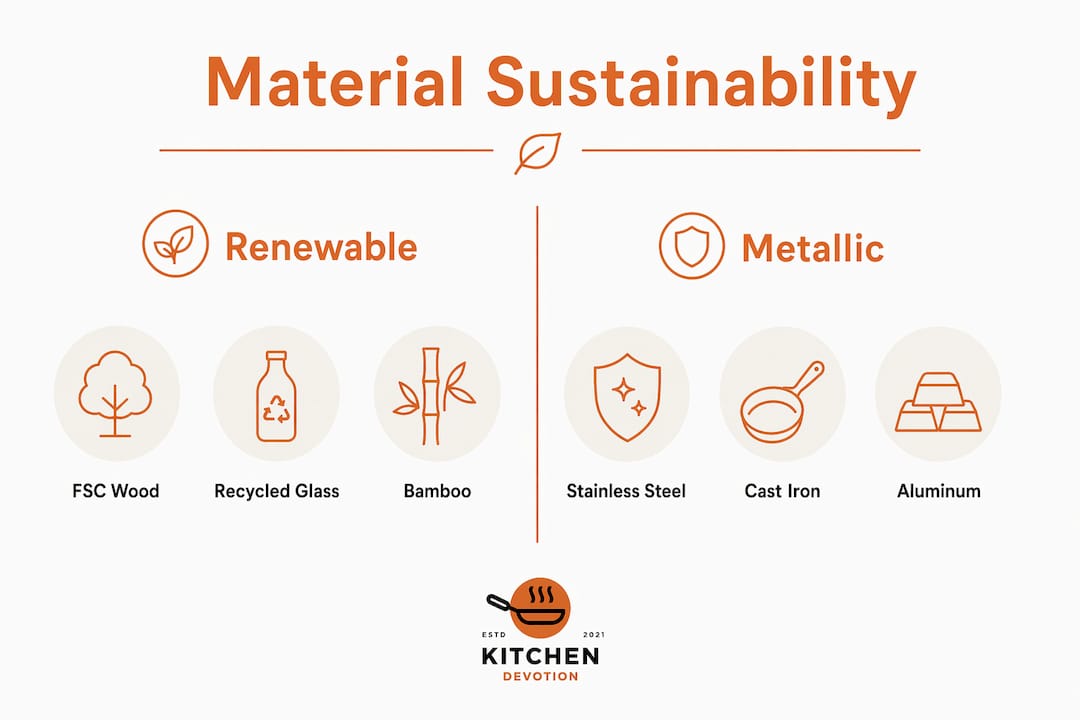
Comparing common kitchenware materials
| Material | Sustainability profile | Key certification to look for |
|---|---|---|
| FSC-certified wood | Renewable, prevents deforestation | FSC chain-of-custody certificate |
| Recycled glass | Reduces manufacturing energy by 40% | Batch traceability documentation |
| Cast iron | Extremely durable, fully recyclable | Country of origin + material grade |
| Stainless steel 304/316 | Food-safe, long lifespan, recyclable | Food-grade material certificate |
| Stainless steel 201 | Lower cost, not food-safe | Avoid for food-contact items |
| PFAS-coated nonstick | Persistent chemical risk | Avoid unless PFAS-free with batch testing |
Not all stainless steel is food-safe. Grades 304 and 316 meet rigorous food-grade standards, while grade 201 is commonly used in cheaper products and does not. This distinction rarely appears on product labels, which is why material certification documents matter.
Using FSC-certified wood and recycled glass in kitchenware reduces environmental impact significantly. Recycled glass cuts manufacturing energy costs by 40% compared to virgin glass production. That reduction translates directly into lower carbon emissions per product, which is a measurable sustainability gain, not a vague claim.
PFAS-free claims deserve particular scrutiny. PFAS-free kitchenware claims are reliable only with full batch traceability and documented testing. Without that documentation, a “PFAS-free” label is unverifiable. Brands like Xtrema and GreenPan publish their testing documentation, which is the standard you should hold all nonstick alternatives to.
Manufacturing processes also shape sustainability outcomes. High-performance induction cooktops improve energy efficiency from roughly 40% to 90%, which means induction-compatible cookware directly reduces your kitchen’s carbon footprint during everyday use. Choosing cast iron or stainless steel cookware that works on induction surfaces is a sourcing decision with long-term energy consequences.
Single-material cookware, meaning cast iron or quality stainless steel with no composite coatings, offers the strongest lifecycle sustainability. It is repairable, fully recyclable, and does not degrade into microplastics or chemical residue. Single-material, repairable cookware offers superior lifecycle sustainability compared to composite or disposable products.
Pro Tip: When evaluating a cookware purchase, ask for the material grade certificate and batch test results, not just the product description. A brand confident in its sourcing will provide both without hesitation.
What practical steps can consumers take to support responsible sourcing?
Knowing what responsible sourcing looks like is useful. Knowing how to act on that knowledge is what actually changes your kitchen’s impact. These steps are ordered by the leverage they give you as a consumer.
-
Perform a reverse inventory before buying anything new. Walk through your kitchen and catalog what you already own. Reverse inventory can reduce household food waste by up to 45%, and the same logic applies to kitchenware purchases. Buying a new “sustainable” pan you do not need is not sustainable. Extending the life of what you already own is.
-
Request compliance documentation before purchasing. Early supplier compliance documentation requests expose quality or transparency issues before you spend money. For consumers, this means emailing a brand and asking for their BSCI audit summary, LFGB test report, or material grade certificate. Brands with nothing to hide respond quickly.
-
Choose brands with transparent ethical disclosures. Look for brands that publish their factory locations, audit results, and material sourcing on their websites. Our Place, for example, discloses factory ownership and audit history. This level of transparency is achievable and should be your baseline expectation.
-
Prioritize durable, single-material, repairable kitchenware. A Lodge cast iron skillet or an All-Clad stainless steel pan will outlast ten generations of nonstick composite cookware. True sustainability balances safety, durability, and ethics. A non-toxic product made in unethical conditions fails the overall sustainability test.
-
Support companies with audited or female-owned factories. Factory ownership transparency is a reliable proxy for broader ethical standards. When a brand discloses that its manufacturing partner is a female-owned facility undergoing regular SMETA audits, that is evidence of a supply chain with accountability built in. You can verify this by checking a brand’s supplier disclosure page or asking directly.
-
Check for batch traceability on any chemical-safety claim. If a product claims to be PFAS-free, BPA-free, or lead-free, ask for the batch test report. Transitioning to PFAS-free cookware requires traceable batch testing. Credibility depends entirely on supplier transparency, not label copy.
For practical guidance on reducing waste alongside these purchasing decisions, Kitchendevotion’s guide on reducing kitchen waste pairs well with this approach.
How does responsible sourcing impact kitchen sustainability and health?
The benefits of ethical sourcing in kitchen products reach further than most consumers realize. They connect directly to your physical health, your household energy use, and the broader social systems that produce the tools you cook with every day.
On the health side, the connection is direct. Cookware made from unverified materials can leach heavy metals, PFAS compounds, or BPA into food during cooking. Verified food-safe materials, backed by FDA or LFGB certification, eliminate that risk. Understanding the difference between FDA and LFGB certifications helps consumers evaluate product safety beyond marketing claims. LFGB testing is more rigorous and tests under higher-temperature conditions that more closely replicate actual cooking.
Waste reduction is the second major benefit. Disposable kitchen items, from single-use plastic utensils to low-quality nonstick pans that degrade within a year, generate enormous waste. Choosing durable kitchenware that lasts decades removes you from that cycle entirely. Eco-conscious kitchens benefit most by extending the life of quality existing kitchenware rather than replacing it with new sustainable alternatives. The most sustainable purchase is often no purchase at all.
Energy efficiency is a third, often overlooked benefit. Induction-compatible cookware made from responsibly sourced stainless steel or cast iron allows you to use the most energy-efficient cooking method available. At 90% energy efficiency versus roughly 40% for gas, induction cooking with the right cookware cuts your kitchen’s carbon footprint significantly over time.
“The social dimension of responsible sourcing is just as important as the environmental one. Fair wages, safe working conditions, and factory transparency are not bonus features. They are the foundation of a supply chain worth supporting.”
The circular economy angle matters here too. Kitchenware made from single materials, like cast iron or stainless steel, can be fully recycled at end of life. Composite products, including most nonstick pans with polymer coatings, cannot. Choosing recyclable materials keeps your kitchen aligned with circular economy principles, where materials stay in use rather than ending up in landfill. For help organizing a kitchen that supports these habits, Kitchendevotion’s resource on kitchen waste management offers practical setup guidance.
Key takeaways
Responsible sourcing in kitchenware requires verified certifications, traceable materials, and ethical manufacturing standards working together. No single factor is sufficient on its own.
| Point | Details |
|---|---|
| Certifications are non-negotiable | BSCI, SA8000, FDA, and LFGB audits are the only reliable proof of ethical and safe sourcing. |
| Material grade determines safety | Only stainless steel grades 304 and 316 are food-safe; always request material grade documentation. |
| Batch traceability backs chemical claims | PFAS-free and BPA-free claims are only credible when supported by documented batch testing. |
| Durability is sustainability | Single-material, repairable cookware like cast iron outlasts composite alternatives and reduces long-term waste. |
| Reverse inventory first | Audit what you own before buying new items to avoid unnecessary purchases and reduce waste. |
Why I think most consumers are asking the wrong question
By K. Connors
Most people shopping for eco-friendly kitchenware ask “Is this product sustainable?” when the more useful question is “Can this brand prove it?” Those are very different questions, and the gap between them is where greenwashing lives.
I have spent years reviewing kitchenware brands, and the pattern is consistent. Brands with genuine ethical sourcing practices lead with documentation. They publish factory names, audit results, and material test reports without being asked. Brands that rely on vague sustainability language, recycled packaging, and nature-themed product names almost never back those claims with verifiable evidence.
The progress I have seen in the last few years is real but uneven. Brands like Our Place and Lodge have raised the bar on supply chain transparency. But for every brand doing it right, there are a dozen using “sustainable” as a design aesthetic rather than a sourcing standard. The certifications exist. The audit frameworks exist. The problem is that most consumers do not know to ask for them.
My practical advice: treat certification requests as a normal part of the purchase process, the same way you would check a product’s return policy. If a brand cannot produce an LFGB test report or BSCI audit summary within a reasonable timeframe, spend your money elsewhere. The brands worth supporting have already done the work. They are waiting to show you.
Affordability is a real constraint, and I will not pretend otherwise. But the most affordable sustainable choice is almost always to extend the life of what you already own. A well-seasoned cast iron pan from a decade ago beats a new “eco-friendly” nonstick pan on every sustainability metric that actually matters.
— K. Connors
Explore responsibly sourced kitchenware at Kitchendevotion
Kitchendevotion curates kitchen products with quality and conscious cooking in mind. If you are ready to put responsible sourcing principles into practice, the cookware sets collection is a strong starting point, featuring durable options built to last. For deeper guidance on selecting the right materials, the cookware materials guide walks you through food-safe grades, coating types, and what to look for in a responsibly made pan.
Kitchendevotion also covers the full kitchen picture. From tableware and dining accessories to time-saving kitchen appliances, every category is selected with both function and sustainability in mind. Browse the full Kitchendevotion shop to find products that align with your values without compromising on performance.
FAQ
What is responsible sourcing in kitchenware?
Responsible sourcing in kitchenware is the practice of procuring kitchen products through supply chains that meet verified ethical, environmental, and safety standards. It covers fair labor practices, sustainable materials, food-safe certifications, and supply chain transparency.
Which certifications should I look for when buying kitchenware?
Look for FDA or LFGB food-safety certifications and third-party social audits like BSCI, SA8000, or SMETA. FDA and LFGB certified suppliers command significantly higher buyer trust and pricing, reflecting the real value of verified safety.
How do I know if a kitchenware brand is greenwashing?
A brand is likely greenwashing if it uses sustainability language without publishing third-party audit results, material grade certificates, or batch test documentation. Legitimate ethical brands provide this documentation on request or publish it publicly.
Is PFAS-free cookware actually safe?
PFAS-free cookware is only reliably safe when the claim is backed by full batch traceability and documented third-party testing. Without that documentation, the claim is unverifiable and potentially misleading.
What is the most sustainable kitchenware choice I can make?
The most sustainable choice is to extend the life of quality kitchenware you already own. When purchasing new items, single-material options like cast iron or food-grade stainless steel 304 or 316 offer the strongest lifecycle sustainability because they are durable, repairable, and fully recyclable.





No comment