
A stylish kitchen tools checklist is a curated selection of functional, visually appealing cooking essentials designed to make your kitchen work better and look better at the same time. The best checklists cover five core categories: knives, cookware, utensils, measuring tools, and storage. A foundational kitchen setup costs approximately $345–$580 for around 30 essential items. That range covers everything from a solid chef’s knife to stackable stainless steel measuring spoons. Whether you are outfitting a first kitchen or upgrading an existing one, this guide gives you the specific tools, materials, and brands worth your money in 2026.
1. What belongs on a stylish kitchen tools checklist?
The core of any kitchen essentials list is tools that pull double duty: they perform well and look good doing it. Style in the kitchen is not about matching colors. It is about choosing materials and designs that age well, clean easily, and feel good in your hand every single day.
The ten tools that belong on every home cook’s list are:
- Chef’s knife (8-inch, high-carbon stainless steel)
- Paring knife (3–4 inch, for detail work)
- Serrated bread knife (offset handle for control)
- Cast iron or stainless steel skillet (10–12 inch)
- Saucepan with lid (3-quart, stainless or ceramic)
- Silicone spatula set (heat-resistant, BPA-free)
- Wooden spoons (acacia or beechwood, set of 3)
- Glass liquid measuring cup (2-cup, Pyrex or OXO)
- Stackable stainless steel measuring spoons (set of 6)
- Stainless steel mixing bowls (nesting set of 3)
BPA-free materials like wood, metal, and silicone are the professional standard for tools that blend style with long-term durability. Choosing these materials from the start means you replace tools far less often, which saves money and reduces clutter.
Pro Tip: Buy the best chef’s knife you can afford before anything else. A quality 8-inch knife from Wüsthof, Global, or Victorinox handles 80% of all kitchen prep tasks and outlasts a drawer full of cheap gadgets.
2. How to choose the right measuring tools for style and accuracy
Precision matters in cooking, and it matters even more in baking. A measuring tool that looks good but reads inaccurately is worse than no tool at all. The right kitchen measuring tools checklist balances aesthetics with real-world performance.
Glass vs. plastic liquid measuring cups
Glass measuring cups are favored over plastic because they are non-porous, stain-proof, microwave-safe, and maintain clear measurement markings over time. Plastic cups scratch, absorb odors, and yellow with use. Pyrex and OXO Good Grips both make glass options that look sharp on a countertop and survive decades of daily use.
| Feature | Glass (Pyrex, OXO) | Plastic |
|---|---|---|
| Stain resistance | Excellent | Poor |
| Microwave-safe | Yes | Often no |
| Marking durability | Permanent | Fades with washing |
| Visual appeal | High | Low |
| Cost | $10–$20 | $5–$10 |
Dry measuring cups and spoons
Stackable stainless steel measuring tools offer the best combination of space-saving design, durability, and accuracy while keeping a sleek look. Avoid novelty-shaped or decorative measuring sets. They look fun in the store but lack accuracy and take up unnecessary space. Brands like OXO, Cuisipro, and KitchenAid all make stainless sets that look polished in any kitchen.
One underrated move: own two sets of measuring spoons, including one rectangular set designed to fit inside spice jars. This eliminates the need to stop and wash spoons mid-recipe, which is a real time-saver when you are deep into a complex dish.
Kitchen scales: the upgrade most home cooks skip
Professional bakers use kitchen scales instead of volume cups for precise ingredient measurement, especially with flour. A cup of flour can vary by up to 20% depending on how it is scooped. A digital kitchen scale like the OXO Good Grips 11-pound scale or the Escali Primo removes that variable entirely. Modern scales are slim, often under an inch thick, and sit flat in a drawer when not in use.
Pro Tip: Store your measuring spoons on a ring rather than loose in a drawer. Keeping spoons on a ring prevents loss and keeps your set organized during busy cooking sessions.
3. Stylish cookware and knives: materials, brands, and care
Cookware is the biggest investment in any kitchen tools list, and the material you choose determines both how your kitchen looks and how long your pots and pans last. The three most popular options each have real tradeoffs.
Comparing cookware materials
Hard anodized, stainless steel, and ceramic are the dominant cookware materials, each offering different tradeoffs between durability, style, and ease of maintenance.
| Material | Style | Durability | Maintenance | Best for |
|---|---|---|---|---|
| Hard anodized | Matte, modern | Very high | Moderate | Everyday cooking |
| Stainless steel | Polished, classic | High | Low | Searing, sauces |
| Ceramic | Colorful, trendy | Moderate | Low | Low-fat cooking |
| Cast iron | Rustic, bold | Extremely high | High | High-heat, oven use |
Stainless steel from All-Clad or Cuisinart gives your kitchen a professional look that never goes out of style. Hard anodized sets from T-fal, like the T-fal Ultimate Hard Anodized 12-piece set, offer a matte finish with serious nonstick performance. Ceramic options from GreenPan or Carote bring color and a modern feel, though they require gentler care.
Essential knives for home cooks
The three knives every home cook needs are a chef’s knife, a paring knife, and a serrated bread knife. These three handle the vast majority of kitchen cutting tasks. A chef’s knife from Wüsthof Classic or Victorinox Fibrox handles chopping, slicing, and dicing. A paring knife manages peeling and detail cuts. A serrated knife saws through bread and tomatoes without crushing them.
Knife sets from brands like Henckels, Wüsthof, and Global come in matching designs that look intentional on a magnetic strip or in a wooden block. Buying a matched set costs less per knife than buying individually and keeps your countertop looking organized.
Maintenance tips that protect your investment
Proper cookware and knife care extends lifespan and maintains appearance. Hand wash cast iron and dry it immediately to prevent rust. Use a wooden or plastic cutting board under your knives to protect the blade edge. Never put high-carbon knives in the dishwasher. Store knives on a magnetic strip or in a block rather than loose in a drawer, where blades dull against other tools.
For cookware, avoid metal utensils on nonstick surfaces. Use silicone or wooden tools instead. Stack pans with felt pan protectors between them to prevent scratching.
4. How to organize your kitchen tools for lasting style
A well-organized kitchen is not just easier to cook in. It looks better and keeps your tools in better condition. The way you store your kitchen utensils list directly affects how long each piece lasts and how much you enjoy using it.
The most effective storage solutions for stylish kitchens are:
- Magnetic knife strips: Wall-mounted strips from Wüsthof or OXO keep knives visible, accessible, and safely stored without a bulky block.
- Drawer organizers: Bamboo or stainless steel organizers from OXO or Joseph Joseph keep utensils separated and easy to find.
- Pot racks: Ceiling or wall-mounted racks from IKEA or Cuisinart free up cabinet space and display cookware as a design feature.
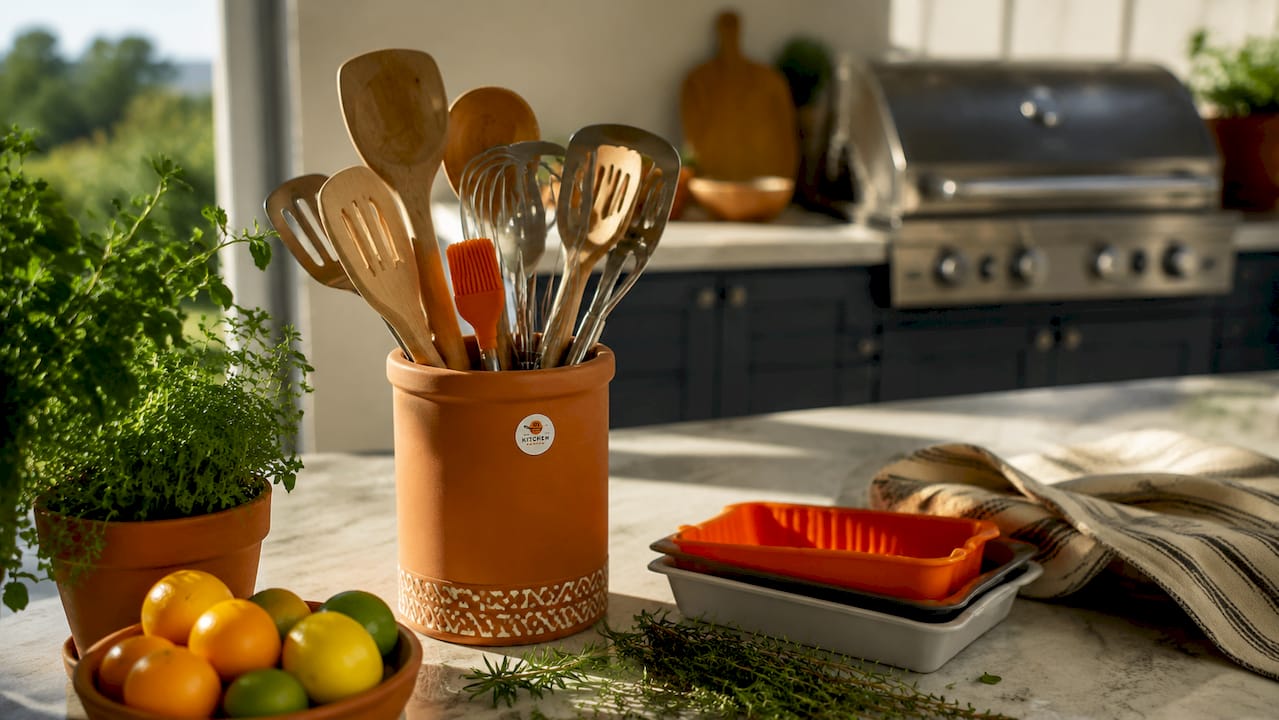
- Utensil crocks: A ceramic or stainless steel crock on the counter keeps your most-used spatulas, spoons, and tongs within reach.
- Nesting bowl sets: Stainless steel mixing bowls that nest inside each other take up one-fifth the space of non-nesting sets.
Pro Tip: Audit your kitchen tools every six months. Pull everything out, discard duplicates, and replace anything that is warped, stained, or no longer performs well. A smaller set of high-quality tools beats a crowded drawer of mediocre ones every time.
Cleaning routines by material
Different materials need different care. Silicone tools are dishwasher-safe and nearly indestructible. Wooden spoons and cutting boards need hand washing and occasional oiling with food-grade mineral oil to prevent cracking. Stainless steel tools wipe clean with a damp cloth and resist staining. Cast iron requires drying and a light coat of oil after every wash.
Ceramic cookware should be washed with soft sponges only. Abrasive pads scratch the surface and degrade the nonstick coating faster than normal cooking ever would.
Budgeting for replacements and upgrades
A complete kitchen setup runs $345–$580 when you account for all categories. That budget breaks down to roughly $100–$150 for cookware, $55–$90 for knives and cutting boards, and $30–$50 for measuring tools. Knowing these ranges helps you prioritize. Spend more on knives and core cookware. Spend less on measuring tools and utensils, where mid-range options perform just as well as premium ones.
For guidance on selecting reliable kitchen components and understanding what drives cost differences, industry resources can help you compare materials and brands before you buy.
5. Modern kitchen gadgets worth adding to your checklist
Beyond the core tools, a handful of modern kitchen gadgets genuinely improve your cooking without cluttering your counters. These are tools that earn their space.
A digital instant-read thermometer like the ThermoWorks Thermapen One reads meat temperature in under two seconds. It removes all guesswork from cooking proteins and costs less than a single restaurant meal. A mandoline slicer from OXO or Benriner produces uniform slices that a knife rarely matches, which matters for gratins, salads, and stir-fries. A silicone baking mat from Silpat replaces parchment paper entirely and lasts for years.
For small spaces, a compact air fryer from Cosori or Ninja replaces your oven for most weeknight cooking tasks. It preheats in two minutes versus 15 for a conventional oven and produces crispier results for roasted vegetables, proteins, and reheated leftovers. Kitchendevotion covers why air fryers save time in depth if you want to understand the full case before buying.
A box grater with a rubberized base from OXO handles cheese, citrus zest, and ginger without sliding. It stores flat and costs under $20. These are the gadgets that show up in professional test kitchens because they work, not because they look impressive on a shelf.
Key takeaways
A stylish kitchen tools checklist works best when every item earns its place through both function and design, starting with quality knives, accurate measuring tools, and durable cookware.
| Point | Details |
|---|---|
| Start with knives and cookware | Invest most of your budget here; quality pays off over years of daily use. |
| Choose glass and stainless for measuring | These materials stay accurate, look clean, and outlast plastic alternatives. |
| Match materials to your cooking style | Hard anodized suits everyday cooks; stainless steel suits high-heat and searing. |
| Store tools intentionally | Magnetic strips, drawer organizers, and nesting sets protect tools and reduce clutter. |
| Audit and upgrade regularly | Replace worn tools every 6–12 months to maintain both performance and kitchen aesthetics. |
Style meets function: what I have learned after years in the kitchen
I used to think stylish kitchen tools were a luxury. After years of cooking and testing products for Kitchendevotion, I think the opposite is true. Ugly, poorly designed tools make you less likely to cook. You avoid the drawer with the tangled spatulas. You reach past the dull knife. Design shapes behavior in the kitchen more than most people admit.
The tools I reach for every single day are not the most expensive ones I own. They are the ones that feel right in my hand, clean up in seconds, and look good sitting on the counter. My OXO stainless measuring cups. My Wüsthof chef’s knife on a magnetic strip. My Silpat mat folded flat in a single drawer slot. None of these are flashy. All of them are exactly right.
The most overlooked tool on most kitchen utensils lists is a good digital scale. Home cooks skip it because they think it is only for bakers. That is wrong. A scale makes every recipe more consistent, speeds up prep by eliminating multiple measuring cups, and takes up almost no space. If you own one and use it, you will wonder how you cooked without it.
My honest advice: stop buying trendy kitchen accessories that solve problems you do not have. A spiralizer sounds useful until it sits in a cabinet for two years. A quality wooden spoon, a sharp knife, and a reliable skillet will serve you better than a drawer full of gadgets you use twice. Build your checklist around what you actually cook, then add tools as real needs arise.
— K. Connors
Upgrade your kitchen with Kitchendevotion
Kitchendevotion curates cookware sets, knife collections, and time-saving appliances selected for both performance and design. Every product on the site is chosen to balance what looks good in your kitchen with what actually works when you cook.
Whether you are building your first complete kitchen or replacing tools that have seen better days, Kitchendevotion makes it easy to find exactly what you need. Browse the full range of stylish cookware sets or explore the time-saving appliances list to find tools that fit your cooking style and your kitchen’s look. If you are starting from scratch, the 2026 kitchen tool set guide walks you through every category with clear buying advice.
FAQ
What are the most important tools on a kitchen essentials list?
A chef’s knife, a 10-inch skillet, a saucepan, a glass measuring cup, and a set of stainless steel measuring spoons cover the majority of everyday cooking tasks. These five items form the foundation of any practical kitchen tools checklist.
Are glass or plastic measuring cups better for home cooks?
Glass measuring cups are the better choice. They are non-porous, stain-proof, microwave-safe, and hold their measurement markings far longer than plastic alternatives.
How much should I budget for a complete kitchen tools setup?
A foundational kitchen setup with roughly 30 essential items costs approximately $345–$580, covering cookware, knives, utensils, measuring tools, and basic appliances.
Do I need a kitchen scale if I already have measuring cups?
Yes. Professional bakers rely on kitchen scales over volume cups because scales eliminate measurement variability, especially with flour, where a scooped cup can differ by up to 20% from a weighed one.
How do I keep stylish kitchen tools looking good over time?
Hand wash wooden and cast iron tools, store knives on a magnetic strip rather than loose in a drawer, and use felt pan protectors between stacked cookware to prevent scratching.



No comment