

Kitchen counter space is the total clear, accessible surface available for food preparation, cooking staging, and cleanup tasks, and it directly determines how smoothly your kitchen functions. Most home cooks underestimate this. They blame a cramped kitchen on square footage when the real culprit is poor zoning, clutter, and fragmented surfaces. Understanding why kitchen counter space matters means recognizing it as a workflow tool, not just a design feature. The National Kitchen and Bath Association (NKBA) and ergonomic design standards give us concrete numbers to work with, and the gap between those numbers and the average home kitchen is significant.
Why kitchen counter space matters for your daily workflow
Counter space is a time-and-movement lever. According to functional zoning research, overlapping prep, cooking, and cleaning zones cause bottlenecks even when a kitchen has adequate total counter footage. That distinction matters: you can have eight linear feet of counter and still feel like you have none, because the usable, continuous surface is broken up by a stand mixer, a coffee maker, a fruit bowl, and a stack of mail.
The NKBA frames good kitchen design around continuous prep runs rather than disconnected lengths interrupted by appliances or clutter. A continuous run lets you move ingredients from cutting board to pan without picking up and relocating items. That micro-friction, the constant clearing and shifting, adds up to real time lost and real frustration gained during a weeknight dinner.

50% of renters rank sufficient counter space as the top desired kitchen feature, ranking it above storage and natural light. This tells you something important: people feel the absence of counter space more acutely than almost any other kitchen deficiency. It is the first thing you notice when you move into a new kitchen, and the last thing you think to fix when you are already living in one.
What ergonomic guidelines say about how much counter space you need
The NKBA publishes specific dimensional standards that answer the question of how much counter space you need with real numbers rather than vague advice.
| Measurement | Recommended dimension | Purpose |
|---|---|---|
| Continuous counter beside sink | At least 36 inches | Uninterrupted prep zone |
| Work aisle, single cook | 42 inches | Safe passage and appliance access |
| Work aisle, two cooks | 48 inches | Prevents collisions and bottlenecks |
| Landing zone beside appliances | 12 to 24 inches | Safe staging for hot or heavy items |
| Island-to-counter clearance | 42 to 48 inches | Traffic flow and two-cook usability |
These numbers are not arbitrary. A 36-inch continuous counter beside the sink gives you enough room to prep vegetables, hold a colander, and stage a cutting board without constantly shuffling items. Drop below that, and you are working in fragments.
Landing zones deserve special attention. The recommended 12 to 24 inches beside your refrigerator, stove, and sink are not decorative gaps. They are safety buffers and staging areas. A hot pan needs somewhere to go immediately. Groceries need a surface the moment the refrigerator door opens. Without these zones, you are improvising every time, and improvising in a kitchen leads to accidents.
The kitchen work triangle connects the sink, stove, and refrigerator in a layout that minimizes unnecessary movement. Counter placement relative to these three points determines how useful your surfaces actually are. A beautiful stretch of counter on the wrong wall, far from your main work triangle, contributes almost nothing to your daily cooking efficiency.
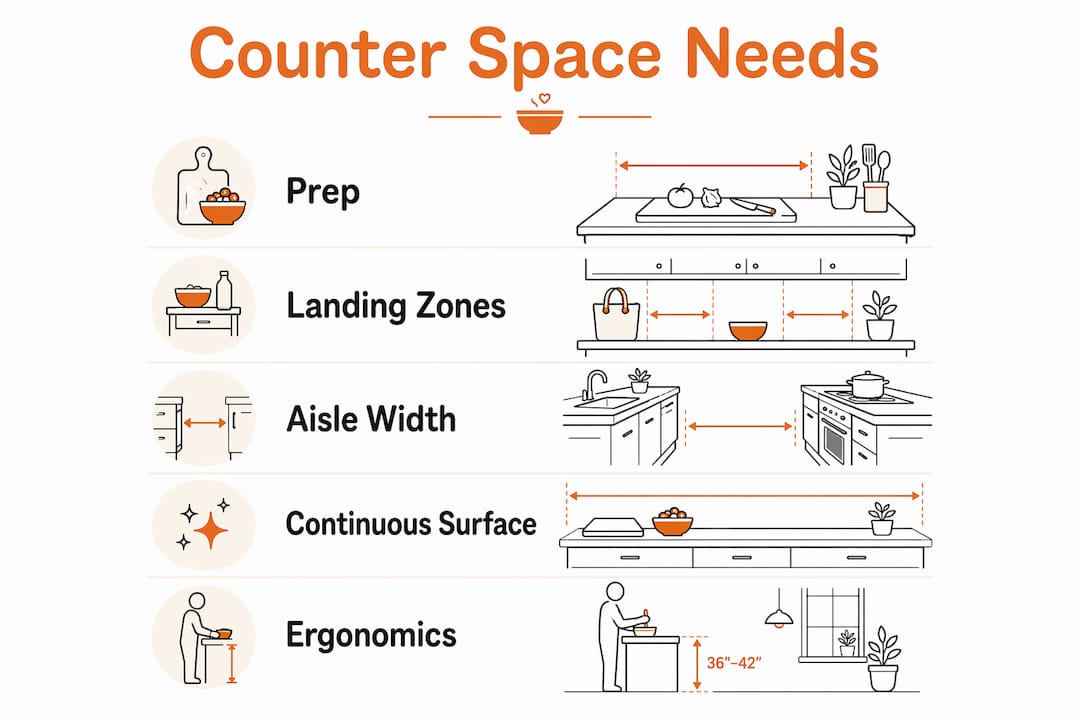
For households with two cooks, kitchen layout and counter space planning becomes even more critical. The 48-inch aisle standard exists specifically so two people can work simultaneously without blocking each other’s access to appliances or prep zones.
How adequate counter space reduces kitchen bottlenecks
The benefits of countertop space go beyond comfort. They affect safety, speed, and the quality of what you cook.
Consider a common scenario: you are making a stir-fry. You need a prep zone for vegetables, a staging area beside the stove for prepped ingredients, and a landing spot for the finished dish. If those three zones overlap or compete with a toaster, a knife block, and yesterday’s mail, you are not cooking efficiently. You are managing chaos.
Here is what adequate, well-zoned counter space actually delivers:
- Parallel tasking. You can chop vegetables while a sauce reduces, because your prep zone and staging zone are separate and clear.
- Safer cooking. Hot pans, sharp knives, and raw proteins each need dedicated space. Crowded counters force dangerous proximity between these items.
- Faster cleanup. A clear counter beside the sink means dishes move directly from the table to the wash zone without a detour through the prep area.
- Reduced decision fatigue. When every surface has a purpose, you stop wasting mental energy figuring out where to put things.
For households that host guests or cook with family members, the importance of kitchen counter space multiplies. Two people working in a kitchen with fragmented surfaces will constantly interrupt each other. Two people working in a kitchen with defined, continuous zones can operate almost independently.
Pro Tip: Assign every appliance a permanent home in a cabinet or drawer, and only bring it to the counter when you are actively using it. This single habit can reclaim 18 to 24 inches of prep space in most kitchens.
What practical steps can home cooks take to maximize counter space
Maximizing usable counter space does not require a renovation. It requires a clear-eyed look at what is actually sitting on your counters and why.
-
Apply the containment zone rule. Designate one 24 to 36-inch section of counter as your only permitted “always-on” zone for items like a coffee maker or a knife block. Everything else gets stored. This approach can expand your ready-to-use prep surface from roughly 30% of your counter to 90%.
-
Audit your countertop appliances. Pull everything off your counters and ask one question: do you use this item daily? A stand mixer used twice a month does not earn counter real estate. Store it and reclaim that space for active prep.
-
Organize drawers and cabinets for fast return. Items drift onto prep zones when drawers and cabinets are not organized for quick, intuitive access. If putting something away takes more than five seconds, it will end up on the counter. Cutlery trays, drawer dividers, and cabinet organizers solve this directly by making storage faster than counter-dropping.
-
Add a mobile cart or narrow island. If your kitchen layout allows it, a rolling cart adds 10 to 15 square feet of prep surface that you can position where you need it and store when you do not. This is especially effective in galley kitchens where permanent counter additions are not possible.
-
Use vertical storage aggressively. Wall-mounted magnetic knife strips, pegboards for utensils, and under-cabinet hooks all move items off horizontal surfaces without removing them from the kitchen. The goal is to keep your counters reserved for active work, not passive storage.
Pro Tip: Before you buy any organizer or storage product, spend one week noting exactly which items end up on your counter every day. Buy solutions for those specific items rather than generic organizers that solve problems you do not have.
How to balance counter space with storage needs
The tension between counter space and storage is real, especially in smaller kitchens. More upper cabinets mean less natural light and a more closed-in feel. More lower cabinets can crowd the floor plan. The goal is not to maximize one at the expense of the other. It is to make both work harder.
| Approach | Counter space impact | Storage impact |
|---|---|---|
| Upper cabinet removal | Gains open counter feel, adds light | Loses overhead storage |
| Deep drawer installation | Neutral | Replaces hard-to-reach cabinet interiors |
| Under-counter pull-outs | Neutral | Maximizes lower cabinet usability |
| Mobile cart addition | Adds prep surface | Adds flexible storage |
| Drawer organizers | Frees counter from clutter | Improves existing storage efficiency |
The most practical approach for most home cooks is to improve the usability of existing storage before adding new surfaces. When drawers and cabinets are organized so that every item has a clear, accessible home, the counter stops acting as overflow storage. That shift alone can double your effective prep area without touching a single cabinet door.
Vertical storage is the most underused option in residential kitchens. A pegboard above a prep zone, a magnetic strip beside the stove, or a wall-mounted spice rack each removes items from horizontal surfaces without requiring additional floor space or cabinetry.
Key takeaways
Effective kitchen counter space is defined not by total surface area but by continuous, well-zoned, clutter-free prep runs that align with NKBA ergonomic standards and your personal cooking workflow.
| Point | Details |
|---|---|
| Continuous surface beats total footage | A 36-inch uninterrupted counter outperforms six fragmented feet of cluttered surface. |
| NKBA standards set the baseline | Aim for 36 inches beside the sink, 42 to 48-inch aisles, and 12 to 24-inch landing zones. |
| Clutter is the primary usability thief | Limiting counters to daily-use items can expand active prep space from 30% to 90%. |
| Storage organization prevents counter creep | Organized drawers and cabinets remove the incentive to drop items on prep surfaces. |
| Two-cook kitchens need wider clearances | A 48-inch aisle and defined zones allow two people to work without constant interference. |
Counter space is the kitchen’s most underrated design decision
I have looked at a lot of kitchens, and the pattern is consistent. Homeowners spend thousands on appliances and finishes, then lose half their prep surface to a toaster they use twice a week and a pile of cookbooks they never open. The counter is treated as a display surface rather than a work surface, and the kitchen suffers for it.
The insight most people miss is that total counter length is almost irrelevant. What matters is how much of that length is continuously usable at any given moment. I have cooked in small galley kitchens that felt spacious because every inch was intentional, and I have cooked in large open-plan kitchens that felt cramped because the counters were buried under clutter and misplaced appliances.
The NKBA guidelines are not just for architects and designers. They are a practical checklist for any home cook who wants to understand why their kitchen feels frustrating. If your work aisle is under 42 inches, or your sink has less than 36 inches of clear counter beside it, you are working against the space rather than with it. Those are fixable problems, and most of them do not require a renovation.
What I find most interesting is that the fix is almost always behavioral before it is structural. Clear the counters, organize the storage, assign zones, and most kitchens become significantly more functional without a single dollar spent on remodeling.
— K
How Kitchendevotion helps you get more from your kitchen
Kitchendevotion is built for home cooks who want their kitchen to work as well as it looks. Whether you are rethinking your counter layout, searching for appliances that earn their counter space, or looking for tools that make prep faster and cleanup easier, Kitchendevotion curates products that justify every inch they occupy.
From premium cookware to space-conscious air fryers and eco-friendly utensils, every product on Kitchendevotion is selected with functional counter use in mind. The site also features buying guides and kitchen organization advice designed specifically for home cooks who want practical results, not just aesthetics. If you are ready to treat your counter space as the high-value work zone it actually is, Kitchendevotion is a strong place to start.
FAQ
Why does kitchen counter space matter so much?
Counter space directly controls how efficiently you can prep, cook, and clean. Fragmented or cluttered surfaces create bottlenecks that slow down every meal, regardless of how large your kitchen is.
How much counter space do I need beside the sink?
The NKBA recommends at least 36 inches of continuous counter beside the sink. This provides enough uninterrupted surface for active food preparation without constant rearranging.
What is the fastest way to increase usable counter space?
Remove any appliance you do not use daily and assign it a cabinet home. Organizing drawers so items return quickly stops counter creep and can reclaim significant prep surface within a single afternoon.
How wide should the aisle between my counter and island be?
For a single cook, 42 inches is the recommended minimum. For two cooks working simultaneously, 48 inches prevents collisions and keeps both prep zones accessible at the same time.
Does counter space affect kitchen resale value?
Yes. Research shows that 50% of renters rank sufficient counter space as their top desired kitchen feature, above storage and natural light. Buyers and renters consistently prioritize functional prep surfaces when evaluating a kitchen.




No comment